

Start with a defensible, simple model that matches your sales cycle. Position-based or linear works for most mid-complexity teams, last-touch only makes sense for short cycles or tactical bid decisions, and data-driven attribution is worth the setup once you have volume and clean CRM data behind it. Data quality beats model sophistication every time, so run two models in parallel before you trust either one.
TL;DR:
- Position-based and W-shaped attribution models are best suited for B2B sales cycles over 90 days, with multiple stakeholder interactions.
- Data-driven attribution requires at least 300 to 400 conversions per month to produce stable, reliable results.
- High-quality, clean CRM data and consistent UTM tagging are critical for accurate attribution, especially for call tracking in home services.
- Running two models in parallel helps validate channel rankings and identify data gaps before shifting budgets based on attribution.
- Call tracking and account-level data are essential for home services where revenue typically closes over the phone, influencing the choice of attribution model.
Table of Contents
- What Are the Main Types of Revenue Attribution Models?
- How Do Different Attribution Models Change Channel Rankings?
- How Do You Choose the Right Attribution Model?
- What Data and CRM Setup Does Attribution Actually Require?
- How Do You Validate That an Attribution Model Is Actually Right?
- When Should You Move to Data-Driven Attribution?
- How Does Attribution Setup Differ by Business Type?
- How Leapify Media Applies Attribution for Home Service Operators
- Sources
What Are the Main Types of Revenue Attribution Models?
Revenue attribution models fall into three families: single-touch, multi-touch, and data-driven. Each answers a different question, and confusing them is the fastest way to misallocate a marketing budget.
Single-touch models give 100% of the credit to one interaction in the buyer's journey. They're fast to set up and easy to explain to a CFO, but they systematically miss most of the path a buyer actually takes, especially once a deal touches more than two or three channels.
- First-touch attribution credits the very first interaction, whatever brought a stranger into your world. It's the right lens for measuring brand awareness and top-of-funnel channel performance, but it will happily tell you that a random blog visit from 14 months ago "caused" a $40,000 deal.
- Last-touch attribution credits whatever happened right before the conversion, often a demo request or a "request a quote" form. It's defensible for short sales cycles and for tactical decisions like which ad to pause this week, but it undervalues everything that built the pipeline in the first place.
Multi-touch models split credit across several touchpoints instead of handing it all to one. This is where most mid-market teams should actually live.
- Linear attribution splits credit evenly across every touchpoint in the path. It's the simplest multi-touch option and a good sanity check against your single-touch numbers, though it treats a random newsletter click the same as a sales call.
- Time-decay attribution weights recent touches more heavily than early ones, usually on an exponential curve. It fits sales-driven motions where the last few weeks before close matter more than the first.
- U-shaped (position-based) attribution puts heavy weight on the first touch and the lead-creation touch, splitting the middle thin. A common rule of thumb assigns roughly 40% to first touch, 40% to lead creation, and 20% to everything in between.
- W-shaped attribution adds a third milestone, usually opportunity creation, and spreads credit across three anchor points instead of two, often close to a 30/30/30/10 split with the remainder spread across minor touches.
- Full-path attribution extends that logic across the entire customer lifecycle, including post-sale touches like renewal or expansion, which matters if your revenue includes upsell and retention.
Data-driven attribution (DDA) is a different animal entirely. Instead of applying a fixed rule, it uses machine learning to analyze your historical conversion paths and assign fractional credit based on what actually correlated with conversions in your own data. It's the most accurate option in theory, and the least forgiving in practice: it needs real volume to work, and it still can't see what happens on a phone call, in a text thread, or across a dark-social share it never tagged.
How Do Different Attribution Models Change Channel Rankings?
The model you pick doesn't just change a report. It changes which channel gets next quarter's budget. Here's a concrete way to see it.
- Say a buyer's path looks like this: organic search (day 1), paid social ad (day 12), branded search (day 40, the day they book a demo). Under first-touch attribution, organic search gets 100% of the credit and paid social looks worthless. Under last-touch, branded search gets 100% and organic search vanishes from the report entirely, even though it started the whole relationship.
- Linear attribution splits that same deal three ways, giving each touch roughly a third of the credit. That flattens the extremes, but it also implies the branded search click, which only happened because the buyer already knew your name, deserves equal weight to the cold organic visit that found you. It usually doesn't.
- Position-based attribution handles this path more realistically. Organic search (the discovery moment) and the demo-request touch (the conversion moment) each get the heavy weight, while paid social gets a smaller, honest slice for keeping the deal warm in the middle. This is closer to how a sales team actually experiences the deal.
- W-shaped attribution adds a fourth data point by crediting opportunity creation separately from lead creation. If that same buyer had a sales call two weeks after the demo request, W-shaped would isolate the touch that triggered that call, which is often a nurture email or a case study download that linear and position-based both bury in the middle.
- Time-decay attribution would favor branded search and paid social over organic, since both happened closer to the close date. That's genuinely useful if your sales cycle is short and volatile, but it will chronically undervalue every top-of-funnel channel, which makes it a bad primary model if brand awareness spend is a meaningful line item.
The pattern to notice: single-touch models are quick but incomplete, and every multi-touch model is really just a different bet about which moments in the buyer's journey deserve more weight. Position-based and W-shaped tend to win in B2B settings specifically because most B2B deals have a recognizable shape: a discovery moment, a lead-creation moment, and (for W-shaped) an opportunity-creation moment that sales can actually verify against CRM stage changes. That verifiability is the real advantage. Linear and time-decay are excellent baselines to run alongside your primary model precisely because they make no assumptions about which touch matters most, so any big gap between their numbers and your primary model's numbers is worth investigating before you shift budget.
How Do You Choose the Right Attribution Model?
Three variables decide this, in order of importance: sales cycle length, monthly conversion volume, and how many channels a typical buyer touches before converting.
Sales cycle length sets your floor.
- Under 30 days: last-touch or time-decay both work reasonably well, since there's little journey to obscure. Ecommerce impulse purchases and simple lead-gen forms often live here.
- 30 to 90 days: this is where position-based or linear earns its keep. There's enough of a journey that single-touch models start lying to you, but not so much complexity that you need a third or fourth milestone.
- Over 90 days: W-shaped or full-path attribution, tied to account-level CRM stages rather than individual contact touches, becomes the more honest option. Aligning model choice with your GTM motion and cycle length matters more here than in any other segment, since a 6-month enterprise sale genuinely involves multiple stakeholders touching different content at different times.
Conversion volume decides whether data-driven attribution is even usable.
- Fewer than 100 conversions a month: stick with a rules-based model. DDA has nothing meaningful to learn from and will produce unstable, flickering credit assignments.
- 100 to 300 conversions a month: you're in a gray zone. Some platforms will offer DDA here, but treat the output as directional, not authoritative.
- 300 or more conversions a month: DDA becomes genuinely reliable, since platforms generally need substantial monthly conversion volume before data-driven models stabilize.
Channel count is the tiebreaker. Two or three channels, keep it simple with linear or position-based. Five or more channels, including paid, organic, email, referral, and direct, and you need either W-shaped or DDA to avoid collapsing real complexity into a model that can't hold it.
Pro Tip: Before you commit budget to whatever your primary model says, run a second model in parallel for one full reporting cycle. If linear and position-based agree on your top three channels, you can act with confidence. If they disagree wildly, that gap is telling you something about your data, not about your channels.
What Data and CRM Setup Does Attribution Actually Require?
Attribution is only as good as the data feeding it, and most teams underinvest here relative to how much time they spend arguing about which model to use.
- Clean up CRM hygiene first. Duplicate contact records, missing lead-source fields, and deals with no attached campaign data will corrupt every model equally, no matter how sophisticated it is. Fixing CRM completeness and consistent tagging usually delivers a bigger accuracy gain than switching models.
- Decide between account-level and contact-level tracking early. B2B teams with buying committees should attribute at the account level, rolling up every contact's touches into one journey. Ecommerce and simpler B2C funnels can stay at the contact or session level without losing much accuracy.
- Standardize UTM parameters across every campaign before you launch, not after you notice the reporting is a mess. One inconsistent naming convention ("fb-ads" versus "facebook_ads" versus "FB_Ads") can silently split one channel's credit into three phantom channels.
- Set up server-side tracking where cookie loss or ad blockers are cutting into your data, and document your data processing agreements if you're handling EU visitor data, since cross-domain and server-side setups often touch compliance requirements that a marketing team alone won't catch.
- Add call tracking with dynamic number insertion (DNI) if phone conversions matter to your business. A dedicated call tracking setup lets you map an inbound call back to the exact campaign, keyword, and even ad creative that drove it, which is the single biggest attribution gap for any business that closes deals over the phone.
- Map every call and form fill to a closed job or closed deal in your CRM, not just to a lead status. A properly automated CRM that ties revenue back to the original touchpoint is what makes any downstream attribution model trustworthy instead of theoretical.
- Fix your lookback windows and keep channel definitions consistent across platforms. GA4, your ad platforms, and your CRM will each default to different lookback windows unless you force them to match, and a 30-day window in one tool compared against a 90-day window in another will make your numbers disagree for reasons that have nothing to do with marketing performance.
- Keep a tie-out log that records what each platform reported for a given month, so you can audit drift later instead of re-litigating it from memory.
Expect at least one full sales cycle of clean data before any of this feels trustworthy. For a 90-day cycle, that means roughly four to six months before your numbers become directionally reliable, not the first full month you turn tracking on.
How Do You Validate That an Attribution Model Is Actually Right?
No model gets this perfectly right on its own, which is why the strongest teams treat attribution as a triangulation exercise rather than a single source of truth.
- Run two models side by side for a full reporting cycle and document where they disagree. Agreement on your top three channels is a good sign; a wide gap means your data, not your model choice, needs attention.
- Use geo holdouts for any channel that eats more than 15% of your budget. Turn a channel off in a subset of markets, keep it running everywhere else, and compare revenue. This is the closest thing to a true causal test most marketing teams can run without a data science team.
- Bring in marketing mix modeling (MMM) alongside multi-touch attribution when you have offline or brand spend that MTA can't see. MMM answers a different question than attribution does. It tells you what a channel is worth in aggregate, even when individual touchpoints were never tracked, while MTA tells you which specific touches correlated with specific conversions.
- Watch for the same pitfalls every time: missing leads that never made it into the CRM, inconsistent UTM naming that fractures one channel into several phantom ones, and lookback window mismatches between ad platforms and your CRM that make two reports disagree for no real reason.
Only about 18% of marketers report high confidence in their attribution data, which is the real reason parallel models and incrementality testing matter more than picking the "correct" model on the first try. Confidence comes from cross-checking, not from choosing well once.
When Should You Move to Data-Driven Attribution?
Data-driven attribution is worth adopting once your data can actually support it, and it changes more than your reports.
- Volume threshold: most platforms need roughly 300 to 400 conversions in a rolling 30-day window before DDA produces stable results. Below that, expect the model to fall back to a simpler rule-based method automatically, or to produce credit assignments that swing wildly month to month.
- Bidding impact: switching to DDA changes the signal your bidding algorithm optimizes against. Last-click bidding chases whatever closes the deal at the final moment; DDA lets Smart Bidding weight the earlier touches that actually built the path to conversion, which often means shifting budget toward channels that last-click was systematically undervaluing.
- Cross-report confusion: GA4 and your ad platforms don't always agree, and that's often by design. GA4 exposes different attribution scopes, event, session, and first-user, that report channel credit differently even within the same tool, so a channel showing strong numbers in Google Ads and weak numbers in GA4 isn't necessarily a data error.
- Where DDA still falls short: it can't attribute a phone call it never tracked, a word-of-mouth referral, or a dark-social share in a private group chat. If those channels matter to your business, pair DDA with call tracking and, ideally, an incrementality test rather than trusting the model's blind spots away.
How Does Attribution Setup Differ by Business Type?
The framework stays the same. The starting point and timeline don't.
- B2B with a buying committee: start with account-level tracking rolled up across every contact, and move toward W-shaped or full-path attribution once opportunity creation is reliably logged in your CRM. Expect four to twelve months of data maturity before multi-touch splits are trustworthy for a committee-driven sale.
- Ecommerce: last-click bidding is a reasonable starting point below the DDA volume threshold, but run a quick A/B or geo test on your top paid channel as soon as you have the traffic to support one. Stores that accept online payments should also connect order-level revenue data directly to ad platform reporting so conversion value, not just conversion count, feeds the model.
- Home services (HVAC, plumbing, roofing, restoration): most revenue closes over the phone, not on a landing page, so call tracking with DNI has to come before any attribution model matters. Map every tracked call through to a booked and completed job in the CRM, then start with a simple position-based model that credits the ad or search click that generated the call and the call itself as the conversion event. Local Service Ads add another wrinkle worth tracking separately, since they often convert on the call itself rather than a web form.
How Leapify Media Applies Attribution for Home Service Operators
Home service companies almost always close revenue on a phone call, which means any attribution setup that ignores calls is measuring the wrong thing from the start. Leapify Media builds attribution instrumentation around that reality: dynamic number insertion tied to specific campaigns and keywords, CRM mapping that follows a lead from first click through booked job through completed invoice, and, where a client's data sensitivity calls for it, on-premise processing instead of routing call and customer data through third-party AI infrastructure.
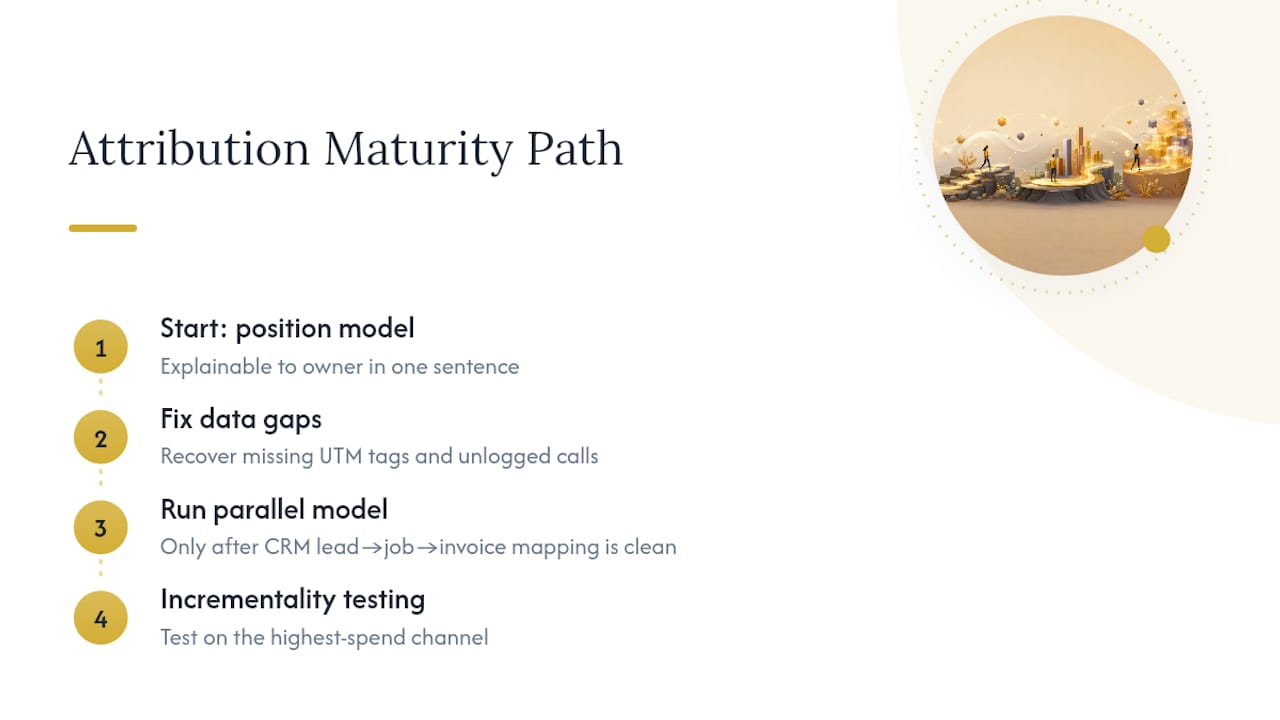
The model maturity path looks the same across most home service clients. Start with a simple position-based model that most owners can explain to their own team in one sentence. Fix the data gaps that show up in the first month, usually missing UTM tags or calls that never got logged back to a job. Run a second model in parallel once the CRM is clean. Only then introduce incrementality testing on the highest-spend channel. Clients who've followed that sequence with Leapify Media's marketing infrastructure have seen return on ad spend improve dramatically once budget stopped chasing whatever channel happened to get last-click credit.
Sources
- Attribution Models Compared: Which One to Use 2026 | Prooflytics
- Revenue Attribution Models: Which One Fits Your GTM (And Why Most Teams Pick Wrong) | Landbase
- Marketing Attribution Models Explained | ConversionStudio