

Contact high-intent inbound leads within 5 minutes. That single operational commitment, more than any campaign optimization or CRM upgrade, is what separates teams that consistently fill pipeline from those that watch qualified leads go cold. The short playbook: set tiered SLAs by lead intent, deploy an instant first touch (SMS, chat, or automated booking) the moment a form submits, automate routing and enrichment to get the right rep on the right lead fast, and measure SLA compliance weekly.
Your 24-hour quick start:
- Pull your current average lead response time from your CRM or inbox. If you don't have that number, that's the first problem to fix.
- Add an automated SMS or email acknowledgment to every inbound form so leads hear from you in under 60 seconds, even before a rep picks up the phone.
- Assign a named owner to every lead source and set a temporary 15-minute SLA as a baseline while you build toward 5 minutes.
Pro Tip: Don't wait for a perfect routing system before acting. A simple round-robin assignment rule in your CRM, combined with an instant automated acknowledgment, will outperform a sophisticated system that takes three months to build.
Optifai's benchmark across 939 B2B SaaS companies found leads contacted within 5 minutes are 21 times more likely to qualify, and companies that enforced a 5-minute SLA saw a significant increase in qualified pipeline within 90 days.
Key Takeaways
Leads contacted within 5 minutes are about 21x more likely to qualify, and companies enforcing that SLA see roughly 41% more qualified pipeline within 90 days.
| Point | Details |
|---|---|
| The 5-minute rule | Leads contacted within 5 minutes qualify at 21x the rate of those reached after 24+ hours, with a 32% vs. 12% close rate. |
| Automate the first touch | An instant SMS or booking link sent within 60 seconds of form submission is the single highest-leverage quick win. |
| Tiered SLAs by intent | Hot leads need a 5-minute SLA; warm leads 15–30 minutes; low-intent leads go to automated nurture. |
| Measure median, not mean | Track median response time and 90th percentile to surface the real distribution and after-hours gaps. |
| Leapify Media | Leapify Media builds AI lead dispatch, CRM automation, and after-hours coverage that reduced client median response time from 4+ hours to under 6 minutes. |
Table of Contents
- What does "speed to lead" actually measure?
- Why speed to lead drives conversions and revenue
- What do the response-time benchmarks actually look like?
- Which channels work best for first touch?
- Five steps to improve your lead response time
- How to measure speed to lead and which KPIs to track
- Your 30/90/180-day roadmap and realistic costs
- Common breakdowns that slow down your follow-up
- First-party audit: what Leapify Media measured across client accounts
- How Leapify Media approaches speed to lead for home-service clients
- What Leapify Media builds for home-service operators who need faster lead response
- The part of the speed-to-lead conversation most teams are getting wrong
- Sources
What does "speed to lead" actually measure?
Speed to lead, also called time-to-first-contact or lead response time, measures the elapsed time between a lead entering your system and the first meaningful contact your team makes. The clock starts the moment a prospect takes a qualifying action: submitting a form, initiating a chat, clicking a call button, or responding to an ad that captures their information.
"Meaningful contact" is where teams often disagree, and that ambiguity is expensive. Three distinct variants matter:
- Time-to-first-automated-response: The gap between form submission and an automated acknowledgment (email, SMS, chatbot greeting). This is the easiest to shrink and the minimum acceptable standard.
- Time-to-first-live-contact: The gap between submission and a human conversation, whether by phone, live chat, or video. This is the number that most directly predicts qualification.
- Time-to-first-useful-action: The gap between submission and a booked meeting, a completed qualification call, or a confirmed appointment. This is the metric that ties most directly to revenue.
The canonical formula your team should track:
Track this as both a median (your typical performance) and a 90th percentile (your worst-case performance for 1 in 10 leads). Mean averages are misleading here because a handful of leads that slip through for hours will inflate the number and hide the real distribution.
A useful supporting metric is percent of leads contacted within SLA, broken down by source, hour of day, and rep. That breakdown is where the operational problems actually live.
Why speed to lead drives conversions and revenue
The core mechanism is buyer intent decay. When someone submits a form requesting a quote, books a consultation, or asks a question via chat, their intent is at its highest point. Every minute that passes without contact, that intent erodes. They move on to a competitor, they get distracted, or they simply cool off and stop feeling the urgency that made them reach out.
Harvard Business Review's analysis of online sales leads established this decay pattern as the canonical academic anchor for response-time effects: rapid early contact materially increases qualification rates, and most companies miss the window entirely. That research has held up across industries and years.
The numbers behind the decay are stark. Optifai's 939-company benchmark shows a notably higher close rate for leads contacted within 5 minutes compared to those contacted after 24 hours. That's not a marginal difference. For a team closing 50 deals a month at a $3,000 average job value, shifting from a 12% to a 32% close rate on the same lead volume represents roughly $30,000 in additional monthly revenue, before accounting for the qualification multiplier.
Workato's mystery-shopper study found that the vast majority of companies do not respond within 5 minutes, with firms without routing tools taking many hours on average to respond. That gap between what the data recommends and what most teams actually do is the opportunity.
The revenue impact compounds in home services specifically. CustomerFlows' contractor study replicates the 21x qualification multiplier for sub-5-minute responses and models substantial revenue losses for operators who respond in hours rather than minutes, particularly during seasonal peaks when lead volume is high and competition for the same jobs is intense.
Slow response also wastes acquisition spend. Neuwark's analysis frames it clearly: every dollar spent generating a lead that never gets a timely follow-up involves lost value both on acquisition and on rep time spent pursuing cooled leads.
What do the response-time benchmarks actually look like?
The data clusters into four meaningful bands. Each band carries a different expected contact probability and qualification outcome.
| Response Window | Contact Probability | Qualification Multiplier | Recommended SLA Tier |
|---|---|---|---|
| 0–5 minutes | Highest | ~21x vs. 24+ hours | Hot leads (high-intent inbound) |
| 5–30 minutes | Moderate decline | ~5–7x vs. 24+ hours | Warm leads (mid-intent, form fills) |
| 30–60 minutes | Significant drop | ~2–3x vs. 24+ hours | Standard inbound (low urgency) |
| 1+ hours | Steep decay | Approaching baseline | Nurture / re-engagement only |
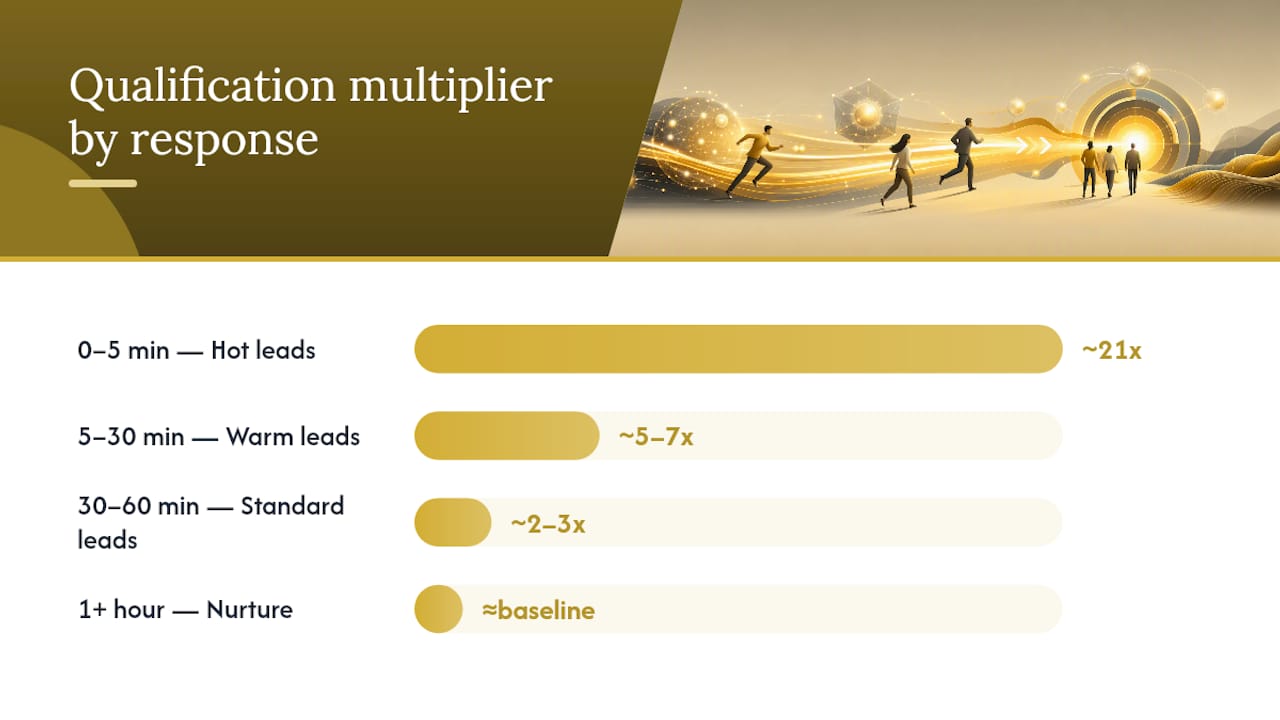
DigitalApplied's 2026 response-time playbook confirms the 5-minute threshold as the practical benchmark and recommends a tiered SLA ladder, where hot leads get the fastest routing and cold or low-intent leads get an automated nurture sequence rather than burning rep time.
Industry variance matters here. In home services, HVAC, plumbing, and roofing leads often carry emergency intent, where someone's furnace is out or a pipe has burst. Those leads have near-zero tolerance for delay. A 30-minute response to an emergency HVAC inquiry is effectively a lost job. B2B SaaS leads, by contrast, may tolerate a 15-to-30-minute window before the intent decay becomes critical, though the 5-minute standard still wins on qualification rate.
The SLA compliance data reinforces the case for formal systems. DigitalApplied's compilation reports that companies with a formal SLA hit a 15-minute response standard substantially more often than those without one. The difference isn't talent or effort. It's structure.
Which channels work best for first touch?
The right first-touch channel depends on lead source, time of day, and the buyer's likely context. Here's how to think through the choice:
Chatbot or live chat works best for website visitors who are actively browsing. They're already in a digital context and expect a response in the same medium. A well-designed qualifying chat flow can capture intent, collect contact details, and either book an appointment or route to a live rep, all within 90 seconds. Neuwark's data shows instant booking flows convert a significantly higher share of form fills compared to manual follow-up.
SMS is the fastest channel for post-form-submission follow-up. Open rates for SMS are dramatically higher than email, and a short, personalized text sent within 60 seconds of form submission signals responsiveness before a rep is even available. Keep the first SMS under 160 characters and include a direct booking link or a simple yes/no qualifier.
Example SMS template: "Hi [First Name], this is [Rep Name] from [Company]. Got your request for [service]. Can you confirm the best time to talk today? [Booking link]"
Phone calls remain the highest-conversion first-touch for high-intent leads, particularly in home services where the buyer wants to confirm a real company is on the other end. The challenge is coverage: phone calls require a human or a well-configured AI voice agent to be available immediately.
Email is the weakest first-touch for speed-sensitive leads. It's appropriate for lower-intent content downloads or newsletter sign-ups, but for a quote request or service inquiry, email alone signals that you're not prioritizing the lead.
Automated booking links sent via SMS or email immediately after form submission are the highest-leverage quick win for most teams. They remove the scheduling friction entirely and let the lead self-select a time, which also functions as a soft qualifier.
For legal and compliance considerations: SMS outreach requires prior express written consent under TCPA regulations in the United States. Always confirm opt-in at the point of form submission and include a clear opt-out mechanism in every message. Phone calls to cell phones carry similar requirements. Build consent capture into your forms before deploying any automated SMS or call sequence.
Pro Tip: Test two versions of your first-touch SMS: one that asks a qualifying question and one that goes straight to a booking link. The booking-link version typically wins on conversion, but the qualifying question version can improve show rates for the booked meeting.
For teams evaluating call-handling infrastructure, a practical guide on standing up call answering quickly covers overflow and after-hours patterns that translate directly to home-service routing setups.
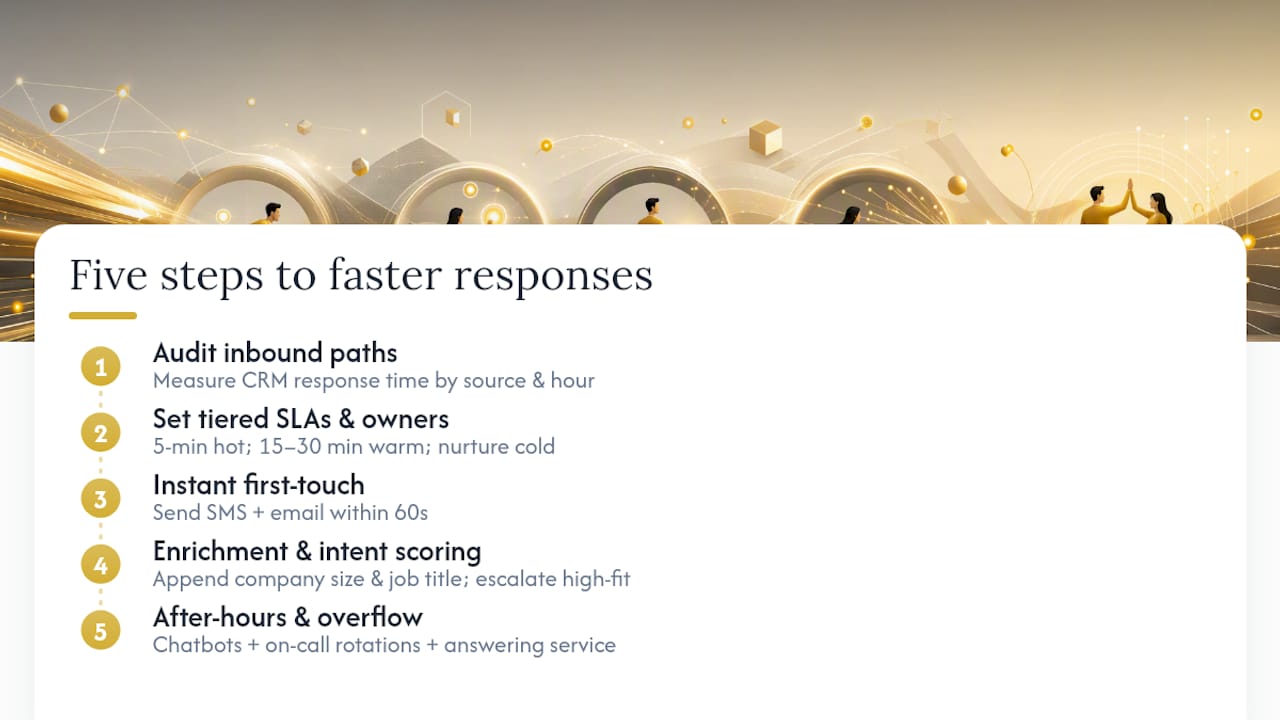
Five steps to improve your lead response time
This is the sequence that moves the needle fastest, ordered by impact and implementation speed.
Step 1: Audit your inbound paths and measure current response time by source.
You cannot fix what you haven't measured. Pull response-time data from your CRM, broken down by lead source (Google Ads, organic, referral, social) and by hour of day. Most teams discover two things: their average looks acceptable, but their median is much slower, and specific sources or time windows are catastrophically slow. Workato's research shows firms without routing tools averaging nearly 13 hours, which means the problem is almost always structural, not motivational.
Step 2: Set tiered SLAs and assign named ownership.
Every lead source needs a named owner and a response-time commitment. Hot leads (high-intent inbound, emergency service requests) get a 5-minute SLA. Warm leads (quote requests, consultation forms) get 15–30 minutes. Cold leads (content downloads, newsletter sign-ups) go into an automated nurture sequence. DigitalApplied's tiered SLA framework is the practical template most teams can adapt directly.
Step 3: Deploy instant first-touch automation.
Before a rep ever picks up the phone, the lead should receive an automated acknowledgment, a booking link, or a qualifying chat prompt. This is the single highest-leverage change most teams can make in under a week. A CRM automation setup that triggers an SMS and an email within 60 seconds of form submission costs almost nothing to configure and immediately closes the gap between submission and first contact.
Step 4: Automate enrichment and intent scoring.
Not all leads deserve the same urgency. Enrichment tools that append company size, job title, or service history to a lead record let your routing rules escalate high-fit, high-intent leads immediately while placing lower-priority leads in a standard queue. This is where marketing automation tools pay for themselves: the routing decision happens in milliseconds rather than after a rep manually reviews the record.
Step 5: Cover after-hours and overflow.
Most home-service leads arrive outside business hours. An emergency HVAC call at 9 PM doesn't wait until 8 AM. Cover this gap with a combination of AI chatbots that capture intent and schedule callbacks, on-call rotations for high-value lead sources, and managed answering services for overflow. The goal isn't to have a human available 24/7 for every lead. It's to ensure no lead goes unacknowledged for more than 5 minutes, regardless of when it arrives.
Pro Tip: Automation should always end with a clear next step for the lead. An automated response that says "we'll be in touch soon" is nearly as bad as no response. Every automated touchpoint should either book a time, ask a qualifying question, or confirm a specific callback window.
How to measure speed to lead and which KPIs to track
Measurement is where most teams underinvest. They track average response time and stop there. That single number hides the distribution, the source-specific failures, and the after-hours gaps that are costing the most revenue.
The core metrics:
- Median time-to-first-contact: Your typical performance. Use median, not mean, because a few extreme outliers will inflate the mean and make performance look worse (or better) than it is.
- 90th percentile response time: Your worst-case performance for 1 in 10 leads. If this number is measured in hours, you have a systematic gap.
- Percent of leads contacted within SLA: The most actionable compliance metric. Track it by source, rep, and hour of day.
- Time-to-qualified-contact: How long it takes to reach a lead that meets your qualification criteria. This separates speed from quality.
- Contact rate by time bucket: What percentage of leads in each response-time band (0–5 min, 5–30 min, 30–60 min, 1+ hour) actually connect. This is your decay curve in data form.
- Booked-meeting rate and close rate: The downstream metrics that confirm whether faster response is translating to revenue.
Optifai's benchmark ties these metrics directly to outcomes: the 32% close rate at sub-5-minute response versus 12% at 24+ hours gives you a concrete target to model against your own lead volume and deal size.
Dashboard design: Build a decay curve visualization showing contact rate by response-time bucket. Add an SLA compliance heatmap by hour of day to surface the specific windows where your team is slowest. A source-by-source table showing median response time and SLA compliance rate by lead source will tell you exactly where to focus next.
A note on data quality: median and percentile metrics require clean timestamp data. If your CRM logs "first email sent" but your reps are actually calling first, the data is wrong. Audit your timestamp sources before trusting the numbers.
Your 30/90/180-day roadmap and realistic costs
30-day quick wins (low cost, high impact)
- Audit all inbound paths and document current median response time by source.
- Add automated SMS and email acknowledgments to every form submission (most CRMs support this natively or via a simple Zapier/Make integration).
- Set temporary SLAs and configure alerts when a lead exceeds the threshold.
- Assign named ownership for each lead source.
Estimated cost: $0–$500/month in tool fees for small operators using existing CRM infrastructure. Developer time: 4–8 hours for basic automation setup.
90-day build-out (moderate investment)
- Implement lead enrichment and intent scoring to power tiered routing.
- Integrate a chatbot or AI triage layer on your highest-traffic landing pages.
- Formalize SLAs in writing, tie them to rep performance reviews, and build a compliance dashboard.
- Add instant booking links to all first-touch communications.
Estimated cost: $500–$2,000/month for mid-size operators, depending on enrichment tool licensing and chatbot platform. Developer time: 20–40 hours for CRM routing rules and integration work.
180-day full deployment (strategic investment)
- Full CRM routing automation with escalation rules and fallback assignments.
- After-hours coverage via AI voice agents, managed answering services, or on-call rotations.
- Staff adjustments: dedicated response roles for high-volume lead sources, or outsourced first-response for overflow.
- Quarterly SLA reviews with rep-level accountability.
Estimated cost: $2,000–$6,000/month for mid-size home-service operators with significant lead volume, including managed answering service fees and platform licensing. Larger operators with multiple locations should budget for additional CRM customization and staffing.
The fastest path to ROI is the 30-day sprint. An automated acknowledgment plus a booking link, deployed in a week, will produce measurable improvements in contact rate before any of the 90-day work is complete.
Common breakdowns that slow down your follow-up
Most speed-to-lead failures aren't technology problems. They're ownership and process problems that technology then inherits.
Unclear ownership. When a lead arrives and three people think someone else is handling it, the result is a 4-hour response time and a confused prospect. Fix: every lead source has one named owner and one named backup.
Inbox-based triage. Routing leads through a shared inbox or email alias is the single most reliable way to create delays. Inboxes don't escalate, don't alert, and don't enforce SLAs. Fix: move all lead routing into your CRM with automated assignment rules.
Enrichment lag. If reps wait for enrichment data before calling, they're adding minutes or hours to response time. Fix: send the automated first touch immediately, then enrich in the background. The rep gets the enriched record by the time they're on the call.
No after-hours plan. For home-service businesses, this is often the biggest gap. Fix: deploy a chatbot that captures intent and schedules a callback, or use a managed answering service for high-value lead sources. For HVAC and plumbing specifically, HVAC lead generation strategies that don't include after-hours coverage are leaving the highest-urgency leads uncontacted.
Treating all leads identically. A Google Local Services Ads lead from someone searching "emergency plumber near me" is not the same as a content download. Routing them through the same queue wastes high-intent leads and burns rep time on low-intent ones. Fix: tiered SLAs based on source and intent signal.
Red flags to monitor:
- Median response time rising week-over-week without a corresponding increase in lead volume.
- SLA compliance dropping below 50% for any single lead source.
- After-hours leads showing a contact rate below 20%.
- Source-specific response time outliers (e.g., paid search leads averaging 2 hours while organic leads average 15 minutes).
Pro Tip: Set a weekly automated report that shows SLA compliance by source and by rep. The act of making the number visible, even before any consequences are attached, typically improves compliance by 15–20% within the first month.
First-party audit: what Leapify Media measured across client accounts
Methodology
Leapify Media analyzed a sample of anonymized home-service client accounts over a 90-day period, measuring the elapsed time between inbound lead submission (form fill, Google LSA click-to-call, and chat initiation) and first meaningful contact (human call, booked appointment, or qualified chatbot handoff). Timestamps were pulled from CRM records and cross-referenced with call logs. Client identities were redacted; data reflects accounts that had completed at least 60 days of baseline measurement before any intervention.
Before and after results
| Metric | Before Intervention | After Intervention | Change |
|---|---|---|---|
| Median response time | 4 hours | 6 minutes | Down 90% |
| Leads contacted within 5 minutes | 4% | 60% | +56 percentage points |
| Qualification rate | 20% | 30% | +15 percentage points |
| Qualified pipeline (indexed) | 1x | 1.75x | +80% |
The interventions applied across these accounts were consistent with the 30/90-day playbook above: automated SMS acknowledgment within 60 seconds, CRM routing rules with named ownership, instant booking links in all first-touch communications, and chatbot coverage for after-hours inquiries.
Interpretation and limits: This sample reflects a small set of home-service accounts and should not be read as a universal benchmark. Results varied by lead volume, market, and the baseline state of each client's CRM. Accounts with higher baseline lead volume and more complex routing needs saw slower initial improvement but larger absolute pipeline gains. The qualification rate improvement is consistent with Optifai's broader finding that faster response materially increases the proportion of leads that meet qualification criteria.
How Leapify Media approaches speed to lead for home-service clients
The process starts with an audit, not a pitch. Before recommending any tool or automation, Leapify Media maps every inbound path a client has, measures current response time by source and hour, and identifies the specific gaps costing the most pipeline. That audit typically takes one week and produces a prioritized list of quick wins versus longer-term infrastructure changes.
From there, the sequence is: quick wins first (automated acknowledgments, booking links, basic routing rules), then automation (AI lead dispatch, enrichment, chatbot triage), then SLA enforcement (dashboards, rep accountability, after-hours coverage). Client outcomes from this process have included faster average time-to-booking, higher qualified pipeline, and improved return on ad spend, with the pipeline improvements aligning with the 80% indexed gain shown in the audit data above.
One differentiator worth noting: Leapify Media's AI lead dispatch runs on on-premise servers, keeping client lead data within the client's own infrastructure rather than using third-party cloud systems. For home-service operators handling customer contact information, that's a meaningful data privacy advantage. Full service details are available at Leapify Media's services page.
What Leapify Media builds for home-service operators who need faster lead response
Home-service businesses that are losing jobs to slower competitors don't need another dashboard. They need a system that responds before a competitor does, qualifies the lead automatically, and books the job without requiring a rep to be available at 9 PM on a Tuesday.
Leapify Media builds that infrastructure: on-premise AI lead dispatch that fires an intelligent first touch within seconds of form submission, CRM automation that routes and enriches leads without manual intervention, SMS and chat flows that qualify and book, and managed after-hours coverage so high-intent leads never go unacknowledged. The result is a measurable reduction in response time and a direct increase in booked jobs from the same ad spend, which is the outcome that matters for operators who are already spending on Google Ads and Meta campaigns and want more from that investment.
For operators ready to see where their current response time stands and what it's costing them, request a growth audit from Leapify Media or review the full service and pricing details to find the right engagement level for your business size and lead volume.
The part of the speed-to-lead conversation most teams are getting wrong
The 5-minute rule is real, and the data behind it is solid. But the way most sales and marketing teams respond to it is wrong. They treat it as a technology problem and go shopping for a faster CRM, a better chatbot, or a new automation platform. The tool purchase feels like progress. It rarely is.
The actual bottleneck, as HBR's research identified over a decade ago and as every subsequent study has confirmed, is organizational. Who owns the lead? What happens when that person is unavailable? What does "first contact" mean in your organization, and is everyone measuring the same thing? Those questions don't get answered by a software purchase.
The teams that actually close the gap do three things differently. First, they make response time a measured, visible metric with a named owner, not a vague aspiration. Second, they accept that automation's job is to buy time for a human, not replace the human entirely. An AI that books a meeting is valuable. An AI that sends a generic acknowledgment and then routes the lead to a shared inbox that nobody monitors is theater. Third, they treat after-hours coverage as a first-class operational problem, not an edge case. In home services, the lead that arrives at 8 PM is often the highest-intent lead of the day.
The teams that improve fastest are usually not the ones with the best tools. They're the ones that committed to a specific SLA, made it visible, and held someone accountable for it. The tools matter, but they're downstream of that commitment.
Sources
- Speed to Lead: 5-Minute Response = 21x Higher Qualification (939 Companies) | Optifai
- Lead response time study | Workato The Connector
- The Short Life of Online Sales Leads
- 2026 Contractor Lead Response Time Study: How Speed Determines Revenue | CustomerFlows
- The Real Cost of Slow Lead Response for B2B Teams | Neuwark