
The fastest path to more roof repair leads right now is a three-channel stack: Google Local Service Ads (LSAs), selective exclusive or live-transfer pay-per-lead, and targeted PPC on high-intent queries like "emergency roof leak repair" and "hail damage repair near me." Run those in parallel while you build the owned channels — Google Business Profile, reviews, and local SEO — that lower your cost per lead over the next 12 months. The single biggest operational lever across every channel is speed-to-lead. Contacting a new lead as quickly as possible can significantly increase your close rate compared to calling much later.
Start this week:
- Activate or audit your LSA account and verify your Google Guaranteed status
- Set up an AI text-back or auto-response so every inbound lead gets a reply in under 60 seconds
- Pick one exclusive or live-transfer pay-per-lead source and run a capped 30-day test
This month:
- Claim and fully optimize your Google Business Profile (GBP)
- Launch a same-day review request via text after every completed job
- Set a strict monthly cap on rented lead spend — route a portion of that budget into GBP and SEO
Over 6–12 months:
- Publish several city service pages targeting "roof repair in [City]" and storm-damage keywords
- Build a structured referral program with automated 30-day follow-up
- Start a YouTube cadence (drone inspections, damage walkthroughs) to compound organic reach
Typical CPL benchmarks: Shared leads run within a range, exclusive and live-transfer leads cost more, and LSAs have their own cost range. Inbound organic leads, once your GBP and SEO mature, can become significantly less expensive.
Pro Tip: Treat every dollar spent on bought leads as rent. It keeps the lights on, but it builds nothing. Redirect a fixed slice of that spend each month into review collection and GBP optimization — those assets compound and lower your blended cost per lead over time. Leapify Media's AI dispatch and CRM automation are built specifically to make that transition faster.
Table of Contents
- Where to get roof repair leads fast: the best paid channels
- How to build owned channels that lower your cost per lead
- How to budget for roofing lead generation and measure real ROI
- How to convert roofing leads into booked inspections and signed contracts
- How to vet lead vendors before you sign anything
- A practical channel mix by revenue stage
- How Leapify Media builds roofing lead systems that actually close
- Key Takeaways
- Why paid leads are rent and owned channels are equity
- Leapify Media builds the infrastructure that turns leads into booked jobs
- Useful sources and further reading
Where to get roof repair leads fast: the best paid channels
The three channels that fill a roofing pipeline fastest are LSAs, pay-per-lead marketplaces, and direct Google Ads. Each has a different cost structure, exclusivity level, and close-rate profile.
Google Local Service Ads sit above the regular search results and the map pack. You pay per lead, not per click, and the Google Guaranteed badge does real conversion work. LSA cost-per-lead typically runs within a moderate range, with close rates that can be considered moderately strong. The catch: you need background checks cleared, a solid review count, and patience during the verification window. Once live, LSA leads are exclusively yours and carry high intent.
Pay-per-lead marketplaces split into three tiers. Shared leads are sold to multiple contractors simultaneously, making the competition for the lead more intense. Exclusive leads are assigned only to you and tend to have better close rates. Live-transfer leads connect you directly to a homeowner with very high intent.
Direct Google Ads on queries like "emergency roof repair," "roof leak fix," and "hail damage contractor" generate leads that are exclusively yours. Call-only campaigns work especially well for repair and emergency jobs where the homeowner wants to talk, not fill out a form.
Storm response is its own category. Search volume for damage-related terms significantly spikes within the first couple of days after a storm event, and the first few days capture the bulk of insurance restoration leads. Pre-build your storm campaigns before the season, have canvassing teams ready to deploy within 24 hours, and use county permit data and EagleView claim signals to target direct mail at the highest-probability addresses.
| Channel | Typical CPL | Exclusivity | Lead intent | Verification | Recommended start budget |
|---|---|---|---|---|---|
| Google LSA | $75–$250 | Exclusive | High (retail + emergency) | Google Guaranteed | $500/mo |
| Shared pay-per-lead | $40–$120 | Shared (3–5 roofers) | Mixed | Varies by vendor | $1,000/mo (test cap) |
| Exclusive pay-per-lead | $150–$400 | Exclusive | High (retail + insurance) | OTP/TrustedForm-style | $1,000/mo |
| Live-transfer leads | $200–$600 | Exclusive | Highest (emergency/insurance) | Call-recorded, real-time | $1,500/mo |
| Google Ads (PPC) | $150–$300+ | Exclusive | High (repair + emergency) | First-party | $1,500/mo |
Pro Tip: Cap your monthly rented-lead spend before you start, not after. Set the number, stick to it, and route at least 15% of that budget into review collection and GBP optimization. The roofer who never sets a cap ends up 100% dependent on paid channels with nothing to show for it after 12 months.
How to build owned channels that lower your cost per lead
Owned channels take longer, but they produce the highest close rates and the lowest long-term CPL. Inbound leads from SEO and GBP typically close at 25–50% and can drop to $20–$120 per lead once your presence matures. The patience tax is real: expect 6–12 months before organic volume becomes meaningful.
Google Business Profile is the highest-leverage starting point. A fully optimized GBP with 50+ reviews, consistent NAP data, weekly posts, and photo uploads can land you in the local map pack for "roof repair near me" searches. That placement costs you nothing per click. Claim it, complete every field, and implement a same-day review request via text after every job. Structured review and referral systems produce multiple review-generating events per completed project over time, which compounds your GBP authority over time.
Local SEO and city pages are the next layer. Publish 4–6 dedicated pages targeting queries like "hail damage repair in [City]," "emergency roof leak repair near me," and "roof replacement [Neighborhood]." These pages rank in 60–120 days and pull in leads with no ongoing media spend.
Timeline:
- Days 1–30: Claim/optimize GBP, launch review request automation, publish two core service pages
- Days 30–90: Add 4–6 city pages, start a referral follow-up sequence, produce first YouTube inspection video
- Months 3–6: GBP begins ranking in map pack, city pages start pulling organic traffic, referral leads appear
- Months 6–12: Organic CPL drops, blended cost per lead falls, reduce rented-lead share accordingly
YouTube and video content compounds slower but builds trust faster than text. Drone inspection videos, storm damage walkthroughs, and "what to do after hail" content attract homeowners at the research stage and convert them when they are ready to call.
Pro Tip: Turn every completed job into a referral engine. Send a two-step automated sequence: a review request text the day of completion, then a referral ask 30 days later with a small incentive. Most contractors skip the 30-day follow-up and leave referral leads on the table.

How to budget for roofing lead generation and measure real ROI
The number that matters is not cost per lead. It is cost per closed job, which means you have to segment your math by job type.
Benchmark CPL ranges: Typical CPL ranges vary by lead type, with shared leads at a lower cost, exclusive and live-transfer leads higher, and inbound organic leads as the most cost-efficient once mature.
| Job type | Typical AOV | Benchmark close rate | Cost per closed job (at $150 CPL exclusive) |
|---|---|---|---|
| Insurance restoration | $8,000 | 50% | $300 |
| Retail replacement | $14,000 | 20% | $430 |
| Repair | $2,500 | 60–80% | $250 |
Insurance restoration often closes at a relatively high rate, retail replacement at a moderate rate, and repair leads tend to close at a higher rate in many markets. That spread means a $400 exclusive lead for an insurance restoration job can be a better investment than a $40 shared lead for a retail replacement.
The calculation:
- Take your CPL for the channel ($150 exclusive lead)
- Divide by your close rate for that job type (25% for retail replacement)
- Result: $600 cost per closed job
- Compare to your gross margin on that job type ($2,800 on a $14,000 replacement at 20% margin)
- If the math works, scale; if not, shift budget to a higher-close-rate job type or channel
Budgeting rules of thumb:
- Reinvest 8–12% of gross revenue into lead generation during growth phases
- Set a hard monthly cap on rented leads to control spending
- Run a 60-day vendor test: track close rate by lead ID, cost per closed job, and revenue per closed job
- At day 60, cut any channel where cost per closed job exceeds 15% of AOV
Moving from a tracked to an attributed reporting system — where you know exactly which source produced each closed job — can improve marketing ROI by 30–50% in 90 days. Most contractors track cost per lead and ignore close rate by source, which means they routinely cut the channels that actually pay and keep the ones that look cheap on paper.
How to convert roofing leads into booked inspections and signed contracts
Most contractors treat lead generation as a volume problem. It is actually a response-time problem. The operational changes below raise close rates on every channel you run.
Operational must-haves:
- 24/7 lead capture: AI receptionist or auto-text that fires within 60 seconds of a new lead
- Call routing: leads go to the right rep or crew type (insurance vs retail vs repair) immediately
- CRM with source attribution: every lead tagged by channel, job type, and lead ID from day one
- Booking workflow: inspection slots available within 24–48 hours, confirmed by text
- Inspector sales training: documentation collection, scope presentation, and close process
Qualifying fast: Ask three questions on first contact. Is this an insurance claim or out-of-pocket? How old is the roof? When did the damage occur? The answers route the lead to the right rep and set the right expectations before the inspection.
Sample first-contact text (within 60 seconds of lead submission): "Hi [Name], this is [Your Company]. We just got your request for a roof inspection. We have openings tomorrow and Thursday — which works better? Reply here or call us at [number] and we'll get you scheduled right now."
CRM setup priorities: Tag every lead with source, job type, and lead ID. Set SLA rules: any lead older than 5 minutes without a contact attempt triggers an alert. Track close rate per source and per job type weekly. Lead conversion software that integrates source attribution with your booking calendar makes this automatic rather than manual.
Pro Tip: Use instant text-back plus a two-minute call SLA on all pay-per-lead channels. That combination alone can double close rates on shared leads, where you are competing against other contractors who are slower to respond.
How to vet lead vendors before you sign anything
Most bad lead experiences come from skipping due diligence before the first check clears. Here is the process that protects your budget.
Questions to ask every vendor before signing:
- Where do your leads come from? (Paid search, social, organic, or recycled lists?)
- Are leads exclusive to me, or sold to other contractors?
- What is your refund or replacement policy, and what is the window?
- Can I see sample lead data before I commit?
- Do you use OTP verification, TrustedForm-style timestamped form captures, or call recording?
- What is your duplicate detection process?
- Will you provide a trial period with a capped spend?
Red flags that should stop the conversation:
- No verification stack (no OTP, no TrustedForm, no call recording)
- Vague lead delivery SLAs ("leads arrive within a few days")
- Refusing to share sample lead data or a trial period
- No clear refund window or replacement guarantee
- Inflated close-rate claims with no data to back them
Contract clauses to negotiate:
- Exclusivity clause: confirm in writing the lead goes only to you
- Replacement guarantee: get a defined window (typically 24–72 hours) for bad or duplicate leads
- Refund timeframe: know exactly how long disputes take to resolve
- Data ownership: your lead data stays yours, not the vendor's
- TCPA indemnity: vendor confirms leads opted in and indemnifies you for TCPA violations
- Lead resale disclosure: written confirmation leads will not be resold after delivery
On TCPA compliance: the Telephone Consumer Protection Act requires that any lead you call or text has given prior express written consent. Buying leads from a vendor who cannot document that consent puts you at legal risk. Always confirm the consent chain in writing before purchasing.
30–60 day vendor onboarding checklist:
- Cap spend at $1,000–$2,000 for the test period
- Tag every lead with the vendor ID in your CRM
- Track contact rate, booking rate, and close rate by lead ID
- At day 30, review: if close rate is below 10% on exclusive leads, escalate or exit
- At day 60, decide: scale, renegotiate, or replace
Pro Tip: Ask for TrustedForm certificates or equivalent timestamped proof on every lead. If a vendor cannot provide it, you have no way to verify consent or dispute a bad lead. That is not a vendor you want handling your TCPA exposure.
A practical channel mix by revenue stage
The right channel mix depends on where your business is today, not where you want to be.
| Channel | Under $1M (startup) | $1M–$3M (growth) | $3M+ (scale) |
|---|---|---|---|
| LSA | 30% | 25% | 15% |
| Google Ads / PPC | 20% | 20% | 20% |
| Pay-per-lead (exclusive) | 25–50% | 20% | 10% |
| GBP / local SEO | 10% | 20% | 25% |
| Referral system | 5% | 10% | 15% |
| Storm readiness / direct mail | 0% | 5% | 15% |
Phase 1 (months 0–3): Cash flow first. Run LSA and exclusive pay-per-lead to fill the schedule. Claim and optimize GBP. Start review collection. Do not wait for organic to kick in before you have crews working.
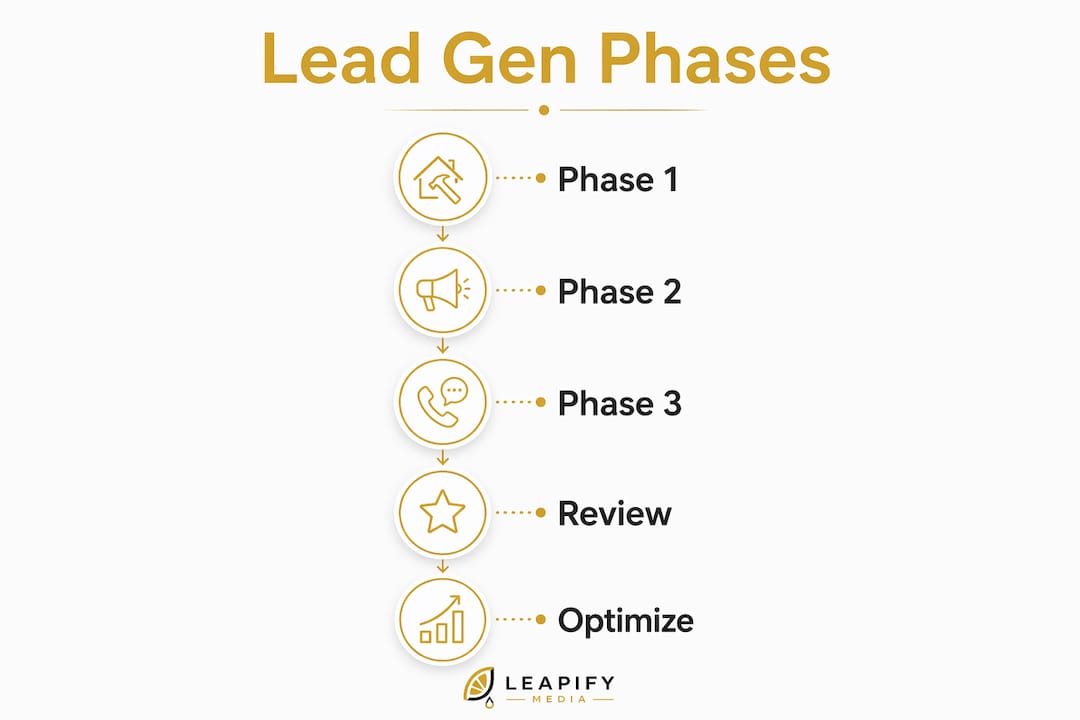
Phase 2 (months 3–9): Build the owned layer. Publish city pages and storm landing pages. Automate review requests and referral follow-ups. A diversified stack for growth-stage roofers typically includes GBP plus 4–6 city pages, LSA, selective pay-per-lead, and a referral system running in parallel.
Phase 3 (months 9–18): Reduce rented share. As organic leads grow, shift budget from pay-per-lead toward content, YouTube, and referral incentives. Your blended CPL should be falling by month 12.
Capacity planning: Match your channel mix to your crew capacity. Buying 40 leads a month when you can only run 15 inspections wastes budget and trains your team to ignore leads. Scale lead volume with crew utilization, not ahead of it.
- Set a monthly inspection capacity ceiling before buying leads
- During storm surges, activate pre-built campaigns and add temporary canvassing capacity
- Never pause owned-channel investments to fund a storm surge — keep a 10–15% budget margin specifically for surge buying
Pro Tip: Pre-build your storm campaigns in the off-season. A contractor who activates a pre-built campaign in hour one of a storm captures leads that the competitor who is building from scratch in hour 24 will never see. Storm-event readiness is the single biggest revenue differentiator in hail-prone markets.
How Leapify Media builds roofing lead systems that actually close
A mid-sized roofing contractor in the Midwest came to Leapify Media spending heavily on shared pay-per-lead with a close rate below 12% and no visibility into which sources were producing closed jobs. The challenge was not lead volume. It was response time, attribution, and a CRM that tracked nothing useful.
The Leapify Media approach:
- Audit: Map every active lead source, tag historical jobs by source and job type, identify the CPL and close rate per channel
- Test cap: Set a hard monthly spend cap on rented leads, activate LSA, and implement AI-powered text-back within 60 seconds of every new lead
- Automation and speed-to-lead: Deploy on-premise AI dispatch to route leads by job type (insurance vs repair vs retail) and trigger the first contact sequence automatically
- Scale and migrate: As GBP rankings and city pages began producing organic leads at months 4–6, shift budget from shared pay-per-lead toward owned channels
The result: close rate improved from below 12% to above 25% on the same lead sources, driven entirely by faster response and better qualification routing. The client reported a 20x return on ad spend across the full engagement.
Leapify Media's on-premise AI infrastructure means client lead data stays on private servers, not shared third-party platforms. That matters when you are handling homeowner contact data and insurance claim information.
Pro Tip: Before you change your lead sources, fix your intake. A contractor with a 5-minute response SLA and a working CRM will outperform a contractor with better leads and a broken follow-up process every time.
Key Takeaways
The fastest way to lower your blended cost per roof repair lead is to run paid channels for immediate cash flow while building GBP, reviews, and local SEO as owned assets that compound over several months.
| Point | Details |
|---|---|
| Speed-to-lead is the top lever | Calling within 5 minutes can double your close rate versus waiting an hour — fix intake before buying more leads. |
| Segment ROI by job type | Insurance restoration closes at 50%; retail replacement at 20% — your CPL threshold should reflect the job type, not a flat number. |
| Vet vendors before you spend | Require exclusivity, TrustedForm-style verification, TCPA indemnity, and a written replacement guarantee before committing budget. |
| Build owned channels in parallel | GBP, city pages, and review automation lower blended CPL over 6–12 months — start week one, not after paid is "working." |
| Leapify Media | Leapify Media's AI dispatch, GBP optimization, and CRM automation are built to close more leads from the same spend — audit your current system first. |
Why paid leads are rent and owned channels are equity
The contractors who struggle with lead generation are almost never the ones who picked the wrong channel. They are the ones who picked only one kind of channel and never built the other.
Paid leads, whether LSA, PPC, or pay-per-lead, are rent. The moment you stop paying, the leads stop. There is no asset, no compounding, no memory. That is not a flaw; it is the design. Rented leads are the right tool for filling a schedule this month. The mistake is treating them as a long-term strategy.
Owned channels work the opposite way. The city page you publish in month two is still ranking in month fourteen. The 80 reviews you collected last year are still converting browsers into callers today. The referral system you automated six months ago is still generating leads without media spend. That is equity. It compounds, and it does not stop when you pause a campaign.
The contractors who win pair both deliberately. They run paid to fund operations while owned channels build underneath. By month 12, their blended CPL is falling because organic is picking up a growing share of volume. By month 18, they have real leverage: they can throttle paid down during slow months and let organic carry the baseline.
The behavioral mistake I see most often is contractors who cut owned-channel investment the moment paid leads slow down, then restart from zero when they want to grow again. Reviews do not rebuild overnight. GBP authority does not recover in a week. The roofer who stays consistent with owned-channel investment through slow periods is the one who has a real business when storm season hits.
Leapify Media builds the infrastructure that turns leads into booked jobs
Most roofing contractors have a lead problem that is actually a conversion problem. The leads exist. The response system, the CRM, and the attribution are broken. Leapify Media's home service growth infrastructure is built specifically for contractors who want to stop renting every lead and start building owned demand.
The service stack covers the full system: AI-powered lead dispatch that responds in under 60 seconds, GBP and LSA optimization that builds map-pack presence, on-premise intent scoring that routes leads by job type before a human touches them, CRM automation with source attribution, and content production for city pages and storm landing pages. Unlike agencies that rely on third-party AI platforms, Leapify Media runs on-premise servers, so your homeowner data and lead intelligence stay private.
The starting point is a system audit: where your leads are coming from, what your close rate is by source and job type, and where response time is bleeding revenue. From there, the build is phased — paid channels stabilized first, owned channels built underneath, rented-lead share reduced as organic matures. Contractors who have gone through this process report close rates more than doubling on the same lead sources, with a reported 20x return on ad spend across full engagements.
Book a discovery call to see what the audit covers and what a realistic 90-day build looks like for your market.
Useful sources and further reading
The figures, CPL ranges, and close-rate benchmarks in this article come from the following sources. Each is worth reading in full if you want to pressure-test the numbers against your own market.
- Pay-Per-Lead vs Inbound Roofing Leads (2026) — Stensland Consulting: The most detailed breakdown of shared vs exclusive vs inbound CPL ranges and close-rate data available publicly. The speed-to-lead data (5-minute vs 1-hour contact) comes from this source.
- Roofing Lead Generation: 7 Channels That Work — Kihan Marketing: Covers LSA setup requirements, review thresholds, and the diversified channel stack recommended for $1M–$3M contractors.
- Lead Generation for Roofers 2026: Build a Real System — Skill Mammoth: The source for close-rate segmentation by job type (insurance restoration, retail replacement, repair) and the 30–50% ROI improvement from moving to attributed reporting.
- Advanced Roofing Lead Generation Strategies for the USA in 2026 — LeadsuiteNow: Storm-event data (300–800% search spike), the 72-hour window, and county permit / EagleView targeting tactics.
- Roofing Paid Leads vs Organic — Sprout Sage Solutions: Honest practitioner breakdown of the paid vs organic trade-off, with the "blended CPL falls over time" framing that runs through this article.
- How to Get Roofing Leads in 2026 — Elevarus: Detailed explanation of the verification stack (OTP, bot filtering, duplicate detection) and why sticker CPL is the wrong metric.
- Leapify Media Services: Full breakdown of the AI dispatch, CRM automation, GBP optimization, and content production services referenced in the case study section.
- Lead Conversion Software Agencies — Leapify Media Blog: Guidance on CRM selection and conversion tools for contractors setting up source attribution and booking workflows.
- Marketing Automation Tools — Leapify Media Blog: Covers AI dispatch and review workflow automation relevant to the speed-to-lead and review collection tactics in this article.