
Send a service-first SMS within 60 seconds of every missed inbound call. That one rule recovers more leads than any follow-up sequence you'll build later. The automated missed call text back is the industry term for this; some platforms call it "missed call auto-reply" or "call deflection SMS," but the mechanic is identical: your phone system detects a no-answer event and fires a text before the caller opens Google to find your competitor.
Every message needs three things: your business name, an acknowledgment of the missed call, and a single reply-friendly question. Add "Reply STOP to opt out" and you're legally covered for the initial transactional reply.
Do these right now (takes 5–15 minutes):
- Place a test call to your business line and let it ring to voicemail
- Confirm a text arrives within 60 seconds
- Reply STOP and verify the opt-out is logged and honored
- Check that the reply lands in a monitored inbox, not a dead-end number
Table of Contents
- What do you need before setting up missed call text back?
- How do you configure a missed call text back step by step?
- What should your missed call response text actually say?
- U.S. compliance: TCPA, 10DLC, and carrier rules you need to know
- DIY, SaaS platform, or agency: which path is right for you?
- How do you measure whether your missed call text back is working?
- Implementation checklist for home-service businesses
- Key Takeaways
- The part most guides skip: speed without a system is still a leak
- Leapify Media builds this infrastructure for home-service operators
- Useful sources and further reading
What do you need before setting up missed call text back?
Get these prerequisites confirmed before you touch any platform settings. Skipping this step is why most setups stall on day one.
Phone number and carrier requirements
| Requirement | What to confirm |
|---|---|
| Number type | Local 10-digit (10DLC) for most small businesses; toll-free for high-volume or national brands |
| SMS capability | Your number must be SMS-enabled — many VoIP lines are not by default |
| 10DLC registration | Required for local numbers sending business SMS; register through The Campaign Registry |
| Missed-call event | Your phone system must expose a webhook or call-status event (no-answer, missed) |
| Reply inbox | Replies must route to a monitored inbox or CRM — not a send-only number |
For a side-by-side look at how different phone systems expose missed-call webhooks, the RingCentral vs Nextiva comparison covers the specific webhook support differences that matter here.
Legal and consent checklist
An inbound missed call gives you a service-message basis for one transactional reply. That basis is narrower than it sounds. You cannot use it to send promotional content or to start a drip sequence without separate opt-in. Every message must include a clear opt-out instruction ("Reply STOP to unsubscribe"), and that opt-out must be honored within 10 business days under the FCC's rules at 47 CFR 64.1200. Keep a log of every opt-out with a timestamp.
Pro Tip: Before launch, send a test STOP reply and confirm the system suppresses that number from all future automated texts. A broken opt-out is the fastest path to a carrier complaint.
How do you configure a missed call text back step by step?
This procedure works whether you're using a platform with a built-in feature or assembling it from parts. Platforms like GoHighLevel have a dedicated Missed Call Text Back configuration screen; others require a webhook-to-SMS workflow you build manually.
- Build the automation flow. The 5-step loop is: detect missed call → send immediate service SMS → capture reply → qualify the lead → route to CRM or dispatch. Set the send delay to 0 seconds (immediate) for business-hours calls.
Integration validation table
| Integration point | What to verify |
|---|---|
| Webhook fires on no-answer | Test with a real call; confirm event payload arrives |
| SMS sends within 60 seconds | Measure time-to-text on three test calls |
| Reply routes to monitored inbox | Reply from a personal phone; confirm it appears in CRM |
| STOP opt-out suppresses future texts | Send STOP; attempt a second text; confirm suppression |
| CRM record created on reply | Check that contact and conversation log appear automatically |
CallRail's automated response documentation covers the reply-routing and CRM integration steps in detail if you're using that platform.
What should your missed call response text actually say?
Short wins. The goal of the first message is a reply, not a sale. A single focused question consistently outperforms multi-question or open-ended openers — keep it transactional and reply-friendly.
Three copy-and-paste templates
Template 1 — Business hours (immediate service reply)
Hi, this is [Business Name]. We just missed your call. What service can we help you with today? Reply STOP to opt out.
Template 2 — After-hours acknowledgment
Hi, this is [Business Name]. We missed your call and our office is closed, but we'll reach out first thing tomorrow morning. What's the best way to help you? Reply STOP to opt out.
Template 3 — Emergency routing trigger (keyword-based)
Hi, this is [Business Name]. We missed your call. If this is an emergency (burst pipe, no heat, power issue), reply EMERGENCY and we'll connect you with our on-call tech now. Otherwise, we'll call you back shortly. Reply STOP to opt out.
Messaging rules that move the needle
- One question only — "What service can we help you with?" beats "What service do you need, what's your address, and when are you available?" every time.
- After-hours answering is high-value. Callers who get an acknowledgment at 9 PM are far less likely to book with the next company they find. The after-hours flow retains callers who would otherwise be gone by morning.
U.S. compliance: TCPA, 10DLC, and carrier rules you need to know
The legal framework here is specific, and the consequences of getting it wrong range from carrier blocking to TCPA litigation.
Key compliance requirements
| Rule | What it means for your missed-call text |
|---|---|
| TCPA / 47 CFR 64.1200 | Inbound call creates a service-message basis for one transactional reply; promotional content requires separate written consent |
| 10DLC registration | Local 10-digit numbers sending business SMS must be registered through The Campaign Registry before carriers will deliver them reliably |
| Opt-out handling | Every message must include a STOP instruction; opt-outs must be honored within 10 business days |
| Recordkeeping | Log the inbound call timestamp, the outbound text timestamp, message content, and any opt-out events |
| FCC blocking procedures | Carriers can block numbers generating high complaint rates; the FCC's Illegal Texts process gives providers authority to act on complaints |
10DLC registration through The Campaign Registry is not optional for local numbers. Carriers enforce this at the network level: unregistered campaigns face filtering, throttling, or outright blocking. Registration typically takes 1–5 business days and requires your business EIN, use-case description, and sample message content.
Operational compliance checklist:
- Message content contains no promotional offers or upsells
- STOP opt-out language appears in every automated text
- Opt-outs are logged with timestamps and suppressed immediately
- 10DLC brand and campaign registration is active before first send
- Inbound call logs are retained for at least 4 years (TCPA statute of limitations)
- DNC (Do Not Call) registry interactions are reviewed with your legal counsel if you plan to expand beyond transactional replies
This is general information, not legal advice. Confirm your specific setup with a qualified attorney familiar with TCPA and FCC regulations.
DIY, SaaS platform, or agency: which path is right for you?
The fastest implementation wins the most leads. But "fastest" depends on your team's technical capacity and how much ongoing maintenance you can absorb.
Implementation path comparison
| Dimension | DIY (Zapier/Make + Twilio) | SaaS platform (built-in feature) | Managed agency |
|---|---|---|---|
| Setup time | 1–3 days (technical skill required) | 2–4 hours | 3–5 days (agency onboarding) |
| Monthly cost | — | — | Varies by retainer |
| Compliance help | None — you own it | Partial (templates, opt-out handling) | Full (agency manages it) |
| CRM integration | Manual mapping required | Often native | Fully configured |
| Maintenance | You fix it when it breaks | Platform updates automatically | Agency monitors and updates |
| Best for | Tech-savvy solo operators | Small teams wanting speed | Multi-location or high-volume operators |
For a broader look at marketing automation tools that support missed-call workflows, the platform options vary significantly in how much they expose missed-call triggers versus requiring custom webhook work.
Decision matrix by business profile
Solo owner / single truck: Use a SaaS platform with a built-in missed-call text-back feature. The setup is fast, the compliance templates are pre-built, and you don't need a developer. Expect to be live in an afternoon.
Small team (2–10 employees): SaaS platform with CRM integration. The priority is getting replies into a shared inbox so any team member can respond. CRM automation that routes missed-call replies to the right person cuts response time dramatically.
Multi-location operator: Managed implementation. The complexity of routing calls from multiple numbers, managing 10DLC registration per location, and maintaining compliance documentation across locations is too high for a part-time admin to handle reliably.
How do you measure whether your missed call text back is working?
Launch is not the finish line. The metrics below tell you whether the automation is recovering leads or just sending texts into the void.
Primary KPIs
| Metric | How to measure | Target range (home services) |
|---|---|---|
| Time-to-text | Timestamp of missed call vs. timestamp of SMS send | Under 60 seconds |
| Reply rate | Replies received ÷ texts sent | 35% for sub-60-second sends; 10–15% for sends after 5 minutes |
| Qualified-lead rate | Leads that provide service type and address ÷ total replies | — |
| Booked-job rate | Jobs booked from missed-call flow ÷ qualified leads | — |
| Opt-out rate | STOP replies ÷ texts sent | Under 2% (above this, review message content) |
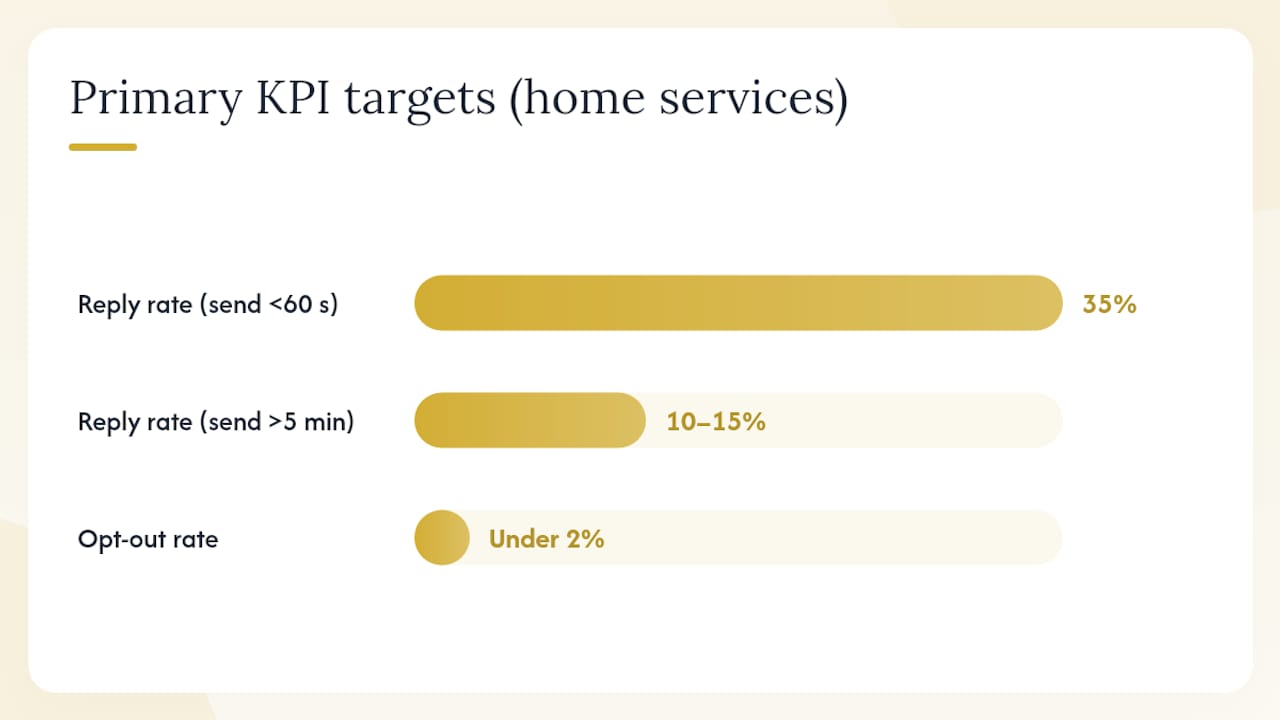
Home-service operators consistently see higher conversion from missed-call reply flows than from cold outbound SMS, because the caller initiated contact. That intent signal is what makes the reply rate benchmarks above achievable.
A/B test plan
- Test the single question — Try "What service can we help you with?" against a trade-specific version ("Plumbing issue or drain problem?"). Measure qualified-lead rate, not just reply rate.
Pair missed-call data with your broader lead sources. Google LSA leads, for example, often come in via phone call, making the missed-call flow a direct extension of your paid lead strategy.
Implementation checklist for home-service businesses
Getting from "I want this" to "it's live" takes less time than most operators expect. The common reasons trades miss calls on job sites are well-documented: active work, loud environments, single-person operations. The automation covers those gaps automatically once it's running.
Priority actions (do these first):
- Confirm your business number is SMS-enabled and 10DLC-registered
- Choose your platform or integration path (SaaS vs. DIY vs. managed)
- Write your initial templates using the three examples above
- Configure the missed-call trigger with a 0-second send delay
- Run three end-to-end test calls and measure time-to-text
- Verify STOP opt-out suppression works before going live
Routing and escalation rules:
- Business hours: immediate service SMS, reply routes to shared team inbox
- After hours: acknowledgment SMS with morning callback promise, flag for first-call-of-day queue
- Emergency keyword detected: route to on-call technician via SMS or call forwarding
- No reply within 2 hours: trigger a manual callback task in your CRM
Timeline:
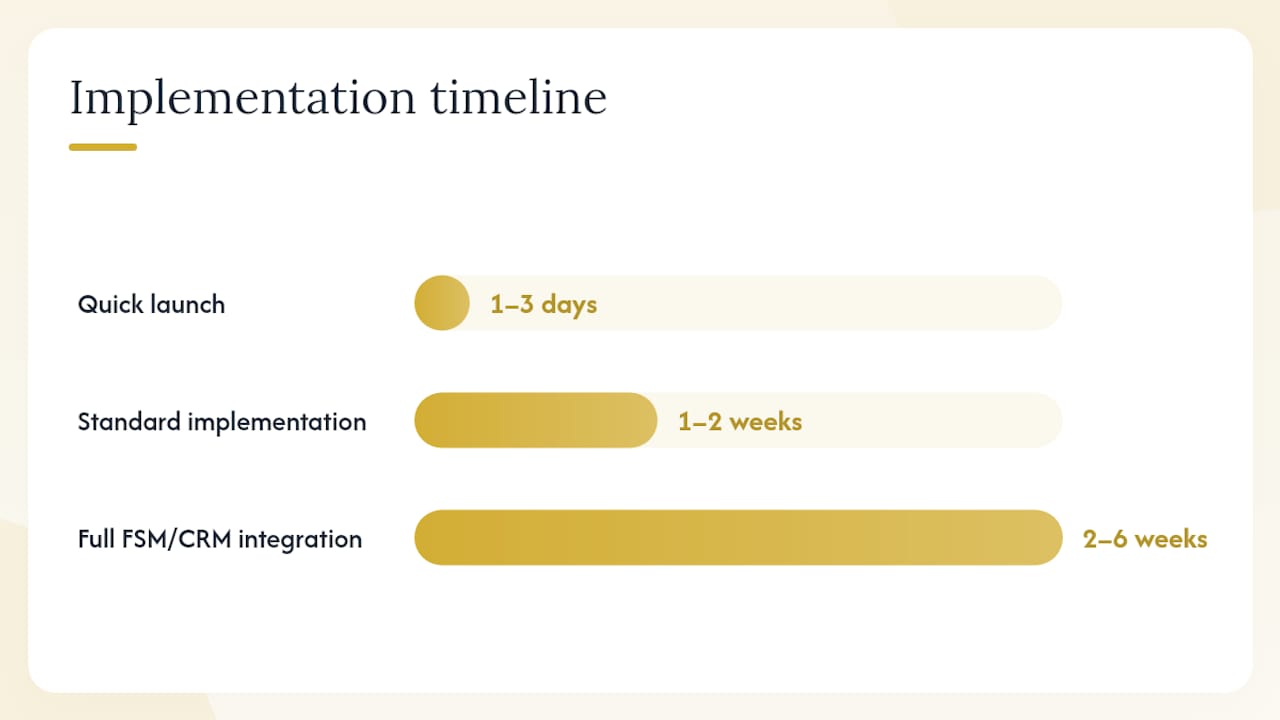
- Quick launch (1–3 days): SaaS platform with built-in feature, single location, pre-written templates
- Standard implementation (1–2 weeks): Custom webhook integration, CRM field mapping, team inbox setup, compliance review
- Full FSM/CRM integration (2–6 weeks): Multi-location routing, field service management connection, 10DLC registration per location, A/B test framework
Key Takeaways
Automated missed call text back works when speed, compliance, and a single-question message structure are all in place from day one.
| Point | Details |
|---|---|
| Speed is the primary variable | Texts sent within 60 seconds produce higher reply rates; waiting several minutes reduces those rates significantly. |
| One question per message | A single, reply-friendly question consistently outperforms multi-question or open-ended first messages. |
| 10DLC registration is required | Local numbers sending business SMS must be registered through The Campaign Registry before carriers will deliver reliably. |
| Measure booked-job rate, not just reply rate | The goal is recovered jobs; track qualified leads and bookings from the missed-call flow, not just text replies. |
| Leapify Media manages the full stack | For home-service operators who want AI dispatch, CRM automation, and compliance built in, Leapify Media handles setup and ongoing management. |
The part most guides skip: speed without a system is still a leak
Most articles about missed call text back stop at "set it up and watch the leads roll in." That framing misses the harder problem: the text fires, the lead replies, and then nothing happens because no one is watching the inbox.
Speed to text matters, but speed to human matters just as much. A reply that sits unanswered for four hours is only marginally better than no reply at all. The businesses that actually recover jobs from these flows have one thing in common: the reply routes somewhere a real person sees it within minutes, whether that's a dispatcher, a CRM task, or an on-call tech's phone.
The compliance piece also gets underweighted. Operators hear "transactional reply, you're fine" and assume that covers everything. It covers the first message. The moment you add a coupon, a review request, or a "while we have you" upsell to that initial text, you've crossed into marketing territory and the transactional basis evaporates. Keep the first message surgical: name, acknowledgment, one question, opt-out. Everything else comes after the lead has replied and opted into a conversation.
The after-hours flow is where the real money is. Most competitors aren't running one. A caller who gets a text at 9:47 PM saying "we saw your call and we'll reach out first thing tomorrow" is almost certainly still available in the morning. A caller who gets silence books whoever answers next.
Leapify Media builds this infrastructure for home-service operators
Home-service businesses that want missed-call automation without the setup headache have a direct path: Leapify Media builds the full lead-recovery stack, including AI-powered dispatch, CRM automation, and on-premise data control, so your missed calls convert to booked jobs without a developer on your payroll.
The difference between a DIY setup and what Leapify Media deploys is the layer underneath: on-premise AI that classifies incoming replies (emergency vs. routine), routes urgent leads to the right technician in real time, and logs every interaction in a CRM your team actually uses. Compliance templates, 10DLC registration, and opt-out handling are built into the setup, not bolted on afterward. Clients report a 20x return on ad spend across their full marketing infrastructure, with missed-call automation as one of the core recovery mechanisms.
If you're running Google Ads or Meta Ads and losing leads to unanswered calls, that's a fixable revenue leak. Request a free audit from Leapify Media and get a clear picture of how many leads your current setup is dropping, and what a managed implementation would recover.
Useful sources and further reading
For anyone who wants to go deeper on the legal, technical, or implementation side:
- Text Message Compliance (10DLC) regulations and guidelines — CallRail Help Center
- Automated responses for missed calls — CallRail Support
- Missed Call Text-Back for Home Services: How HVAC, Plumbing, and Roofing Companies Capture After-Hours Leads
- Automate Missed-Call Follow-Up: 5 Steps [Guide]
- How Home Service Businesses Can Automate Missed-Call Text Backs (and Recover Lost Jobs)
- AI Missed-Call Automation for Home Services: How to Recover Jobs Before Competitors Answer | ProTradeHQ