

How AI benefits small and medium businesses right now
The U.S. Small Business Administration puts it plainly: AI helps you do more with less. For small and medium businesses in 2026, that translates into real, measurable gains across operations, marketing, and customer service.
Here is what artificial intelligence for business actually delivers:
- Efficiency gains. Automate repetitive tasks like email sorting, meeting summaries, and inventory restocking so your team focuses on higher-value work.
- Cost reduction. AI tools can cut labor hours on routine processes, helping offset inflation and rising overhead.
- Competitive edge. Businesses using AI can respond to customers faster, personalize outreach, and spot market trends before competitors do.
- Labor shortage mitigation. The SBA notes AI can compensate for skilled labor gaps by handling tasks that would otherwise require additional hires.
- Better decisions. AI analyzes your own client data to surface patterns and gaps you would likely miss manually.
- Stronger security. Security software with AI can process threat data faster and apply patches before damage spreads.
The U.S. Chamber of Commerce data reinforces this picture: nearly 96% of SMB owners plan to adopt emerging technologies including AI, signaling that the question is no longer whether to adopt, but how fast.
Common AI terms every small business owner should know
Understanding the vocabulary prevents you from buying the wrong tool or getting sold something you do not need.
1. Automation
Automation takes a rule-based, repetitive task and handles it without human intervention. Think: routing customer support tickets, sending follow-up emails after a meeting, or generating weekly sales reports from your CRM. This is the most accessible entry point for most small businesses.
2. AI agents
Agents go further. They handle multi-step workflows, adapt to context, and make decisions along the way. An AI sales agent might qualify a lead, draft a proposal, and schedule a follow-up call without a human touching it. AI for business divides into these three practical levels: automation, agents, and analytics.

3. Analytics and predictive AI
Analytics AI finds patterns in your data and surfaces insights you would otherwise miss. Demand forecasting, customer churn prediction, and pricing analysis all fall here. This category requires the most data maturity to use well.
4. Generative AI
Generative AI creates new content from prompts: text, images, code, summaries, product descriptions. Tools in this category power content creation, market research, and customer communication at scale.
5. NotebookLM
Google's NotebookLM is a research and thinking tool that grounds AI responses in documents you upload. Feed it your SOPs, client notes, or financial reports and ask questions directly. It does not hallucinate answers from the web; it works from your material.
6. Microsoft 365 Copilot
Microsoft 365 Copilot is built directly into Word, Excel, PowerPoint, Outlook, and Teams. It summarizes email threads, drafts responses, generates reports from spreadsheet data, and recaps meetings. If your team already uses Microsoft 365, this is the lowest-friction AI upgrade available.

7. Google AI Professional Certificate
The Google AI Professional Certificate is a free training program for US small businesses with 500 or fewer employees and a valid EIN. Seven courses and 20+ interactive activities cover practical AI skills. Eligible businesses also receive three months of Google Workspace Business Standard at no cost, valued at $42 per employee.
8. Google Workspace Business Standard
Google Workspace Business Standard includes Gemini AI built into Gmail, Docs, Sheets, and Slides, plus 2 TB of storage per user, custom business email, and enterprise-grade security. The free three-month access through the Google AI Certificate offer makes it a practical starting point for teams not yet using a paid productivity suite.
Risks and challenges you need to plan for
AI adoption carries real risks. The SBA is direct about this: using AI means assuming a certain amount of risk, and human oversight is not optional.
- Intellectual property. AI pulls content from the web. Anything you publish could inadvertently infringe on a patent, copyright, or trademark. Review all AI-generated output before it goes public.
- Security vulnerabilities. Avoid feeding sensitive or proprietary data into free AI tools. That data can enter the model's training pool and surface elsewhere.
- Customer trust. AI-detection tools may flag your outreach as spam or inauthentic. A human should review every customer-facing message AI generates.
- Ethical concerns. No federal law currently requires businesses to disclose AI use, but the SBA recommends drafting a public statement explaining how your business uses it.
- Financial output accuracy. The SBA cautions that human oversight is needed to verify financial outputs. Never rely on AI-generated numbers in contracts or filings without independent review.
- Data quality. IBM notes that poor-quality or siloed data leads to inaccurate AI recommendations. Your AI is only as good as the data you feed it.
AI training and tools available to US small businesses
The best place to start is usually the software you already pay for.
- Microsoft 365 Copilot is available as an add-on to existing Microsoft 365 Business plans. If your team lives in Outlook and Teams, this is the fastest path to AI-assisted productivity.
- Google AI Professional Certificate is free for qualifying US SMBs through Coursera. No prior AI experience required. Completing it unlocks three months of Google Workspace Business Standard.
- NotebookLM is free and works immediately. Upload any business document and start asking questions. It is particularly useful for client research, competitive briefings, and onboarding materials.
- Google Workspace Business Standard includes Gemini in your existing Google apps. For teams already using Gmail and Docs, the upgrade is minimal.
The SBA recommends starting with low-effort, high-impact tasks like automating email management, meeting summarization, and marketing content creation. Both NotebookLM and Microsoft 365 Copilot are specifically highlighted for grounding AI responses in your internal data rather than generic web content.
Shopify entrepreneurs add a useful nuance: AI content generation works best when you feed the tool strong example material rather than generic prompts. Existing high-performing content as seed material improves output quality and keeps your brand voice intact.
Pro Tip: Before buying any new AI tool, check whether the software you already use has AI features built in. Microsoft 365 Copilot, Google Workspace's Gemini, and CRM platforms like HubSpot all include AI capabilities that most teams never activate.
How widely are US small businesses actually using AI?
The adoption curve has moved sharply upward. 58% of U.S. small businesses use generative AI as of 2026, nearly doubling the rate since 2023. That figure was 40% in 2024.
58% of U.S. small businesses now use generative AI, up from 40% in 2024 and nearly doubling since 2023.
The industries seeing the most impact are marketing, customer service, and operations, where AI handles content creation, ticket routing, and data analysis at a scale small teams could not manage manually. Stanford's 2026 Artificial Intelligence Index Report documents productivity gains of 14%–15% in customer support and up to 26% in software development.
The gap between businesses using AI and those still evaluating it is widening. Waiting is no longer a neutral position.
Best practices for successful AI adoption in your business
The most common reason AI projects fail is starting with the technology instead of the problem. Identify the pain first.
Start with a 10-minute operational audit. List your team's five most time-consuming weekly tasks. Score each on three criteria: frequency, predictability, and pain (1–5 each). Multiply the scores. The highest number is your first AI opportunity.
Once you have identified the process, match it to the right AI category:
- Automation for repetitive, rule-based tasks (email routing, report generation)
- Agents for multi-step workflows requiring decisions (lead qualification, customer support)
- Analytics for pattern recognition in your business data (churn prediction, demand forecasting)
IBM's guidance is clear: successful AI integration requires a data foundation, a governance model, and a plan for employee skills development. Transitioning from isolated chatbots to an integrated AI operating model is what generates lasting business value.
Run a 30-day pilot before committing. Process real transactions through the AI solution alongside your existing process, compare accuracy and speed, and measure the outcome before scaling. Most businesses see measurable results within 30 days when they focus on a single, well-scoped process.
A step-by-step guide to implementing AI in your business
Week 1: Run the operational audit. Document the highest-scoring process in detail: inputs, steps, outputs, and exceptions. Estimate its current cost in hours and dollars.
Week 2: Determine which AI category fits. Research two or three tools that address your specific process. Request demos focused on your exact use case, not generic presentations. Get pricing and timelines in writing.
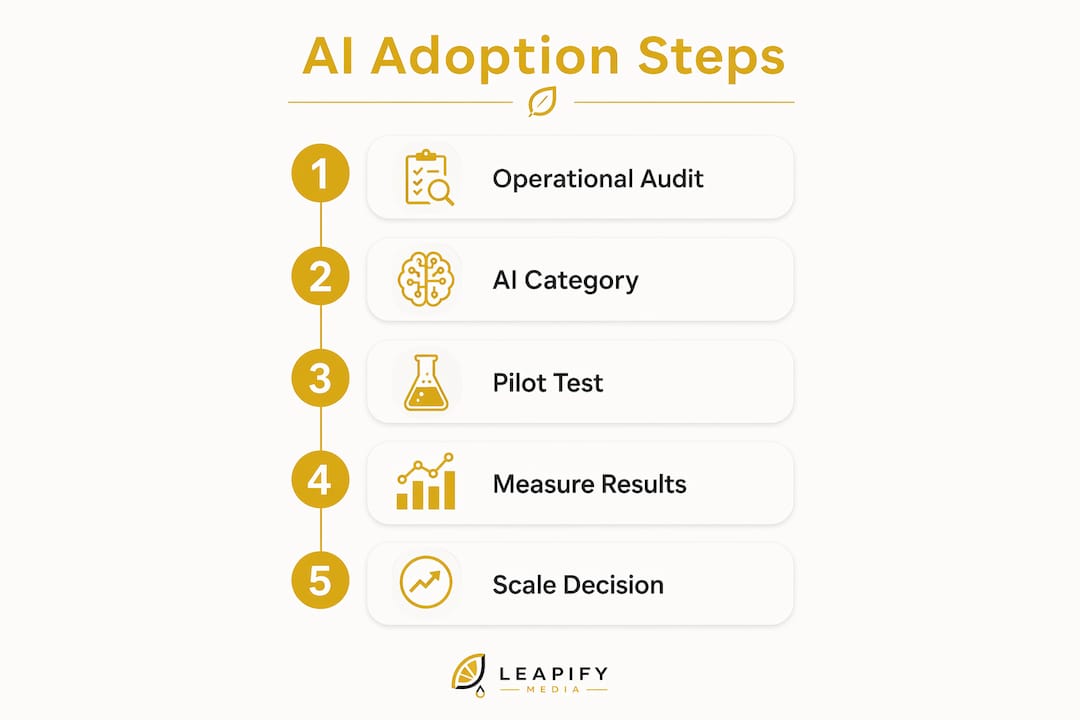
Week 3: Run a pilot alongside your existing process. Process 20–50 real transactions through both systems. Note where the AI handles exceptions poorly.
Week 4: Measure results. Compare time saved, error rate, and output quality against your baseline. Decide whether to scale, adjust, or try a different tool.
The biggest mistake first-time adopters make is evaluating AI tools before identifying a specific process to improve. "We need AI" is not a business case. "We spend 15 hours a week on manual invoice processing" is.
AI in action: real applications across SMB industries
- Retail and e-commerce. AI generates product descriptions, schedules social posts, and analyzes which inventory items are trending before stockouts happen.
- Home services. AI dispatch tools score inbound leads by intent and route them to the right technician automatically. Leapify Media builds on-premise AI infrastructure for home service companies, with clients reporting up to 20x return on ad spend by converting ad spend directly into booked jobs.
- Professional services. NotebookLM lets consultants upload client documents and generate briefings in minutes rather than hours.
- Restaurants and hospitality. AI handles reservation confirmations, review responses, and demand forecasting for staffing.
- Healthcare and wellness. AI chatbots answer appointment and insurance questions around the clock, reducing front-desk call volume.
For multi-location businesses, AI supports workflow coordination across sites by centralizing scheduling, reporting, and customer communication in one system.
What does AI actually cost for a small business?
The range is wide. Free tools like Google's Gemini and NotebookLM cover basic productivity tasks at no cost. Microsoft 365 Copilot and similar embedded AI tools run as add-ons to existing subscriptions. Specialized SaaS AI tools typically run in the range of a few hundred dollars per month. Custom-built AI systems for complex workflows can reach five figures or more for initial setup.
The right investment depends on the value of the problem you are solving. A process that costs your business $4,000 a month in manual labor justifies a meaningful monthly tool spend. Start with embedded AI in software you already use before adding new line items to your budget.
Legal and ethical considerations for US businesses using AI
No federal law currently mandates AI disclosure for businesses, but the legal environment is shifting. The SBA recommends consulting an attorney to confirm your AI use aligns with local laws and best practices.
Key areas to address:
- Intellectual property. Verify that AI-generated content does not infringe on existing copyrights or trademarks before publishing.
- Data privacy. Avoid inputting personally identifiable information or proprietary business data into public AI tools. Review the data handling policies of any tool you use.
- Consumer protection. The Federal Trade Commission has issued guidance on AI-generated endorsements and deceptive practices. Disclose AI use in advertising and customer communications where it could mislead.
- Governance. IBM recommends building governance from the beginning, including security, legal, and compliance stakeholders before scaling AI use.
Drafting an internal AI use policy now, even a short one, protects you as regulations tighten.
How to measure ROI from AI in your business
Measurement starts before you deploy. Establish a baseline: how long does the process take today, what does it cost, and what is the error rate? After 30 days with AI, compare the same metrics.
Track four categories:
- Time saved per task or per week
- Cost reduction in labor or vendor spend
- Quality improvement in error rate, customer satisfaction, or output consistency
- Revenue impact in leads generated, conversion rate, or average order value
Training and upskilling employees on AI tools maximizes ROI and reduces resistance to change. A team that understands how to use a tool correctly gets more from it than one handed a login and left to figure it out.
Key Takeaways
AI adoption delivers the strongest results for US small businesses when it starts with a specific operational problem, not a tool.
| Point | Details |
|---|---|
| Start with the problem | Identify your most time-consuming, predictable process before evaluating any AI tool. |
| Match AI type to task | Use automation for repetitive tasks, agents for multi-step workflows, and analytics for data patterns. |
| Use embedded AI first | Microsoft 365 Copilot, NotebookLM, and Google Workspace include AI features most teams never activate. |
| Adoption is accelerating | 58% of U.S. small businesses use generative AI in 2026, nearly double the 2023 rate. |
| Measure before and after | Establish a baseline cost and time metric before deploying AI, then compare at 30 days. |
Ready to put AI to work in your business?
Leapify Media builds AI-powered marketing and operational infrastructure specifically for home service businesses. From on-premise AI lead dispatch to Google Ads management and CRM automation, every system is engineered in-house so your client data stays private and your ad spend converts into booked jobs. If you want to see what a purpose-built AI system looks like in practice, visit Leapify Media to learn how home service companies are achieving up to 20x return on ad spend.