

For most U.S. home-service owners who need AI-driven lead-to-job automation, neither RingCentral nor Nextiva alone closes the gap between a ringing phone and a booked field job. Both are capable VoIP platforms, but converting inbound calls into dispatched jobs requires automation and CRM depth that neither ships out of the box.
- AI automation readiness: RingCentral includes most AI features in its base Core plan ($20/user/month billed annually), while Nextiva gates real-time transcription, call summaries, and emotion scoring behind its $75/user/month Power Suite CX tier.
- Integration tax: Analysts report that mandatory add-ons and regulatory fees push real total cost of ownership 20–25% above headline pricing for both platforms.
If you run a voice-first contact center or simply need a reliable phone system with no dispatch automation, either platform works well. But if your goal is turning marketing spend into booked jobs, read on.
Table of Contents
- How RingCentral, Nextiva, and Leapify Media compare for home services
- The real trade-offs: AI, dispatch, cost, and what breaks at scale
- How these options were evaluated
- Leapify Media removes the integration tax entirely
- Key Takeaways
How RingCentral, Nextiva, and Leapify Media compare for home services
| Leapify Media | RingCentral | Nextiva | |
|---|---|---|---|
| Best for | Home-service owners who want end-to-end lead→job conversion without assembling vendors | Tool-heavy teams or larger operations needing broad API access and 400+ integrations | Small to mid-size teams wanting simpler onboarding and bundled digital engagement |
| Core telephony | Managed VoIP within full infrastructure stack | Unlimited domestic calling, multi-level IVR, call queues, call recording | Unlimited calling, auto-attendant, call queues, voicemail-to-text |
| AI & automation | On-premise AI intent scoring, lead dispatch, CRM automation | AI transcription, summaries, sentiment tracking in base plan; AI receptionist available | AI receptionist (XBert), transcription, emotion scoring — gated behind $75 tier |
| CRM / dispatch integration | Native CRM setup + dispatch automation managed for client; no middleware required | 400+ integrations; CRM connectors from Advanced plan; HubSpot rated 2.5/5 by users | roughly nine native integrations; CRM access gated behind higher tiers |
| Pricing model | Monthly retainer; one-time AI dispatch setup fee; no per-user AI add-on surprises | From $20/user/month; AI and advanced integrations push costs higher at scale | —; AI features require $75 Power Suite CX plan |
| Admin complexity | Fully managed; no internal IT required | Powerful but reviewers consistently flag the backend as overwhelming | Cleaner admin panel; personalized onboarding reduces setup time for small teams |
| Scalability | Scales with business growth; infrastructure managed by Leapify | Open/integration-first architecture; highly extensible | Unified platform; less flexible for custom workflows |
| Support & SLA | Dedicated account management | —; Trustpilot score driven by billing complaints | —; G2 4.5/5 |
| Security & data | On-premise AI servers; client data stays proprietary | Enterprise-grade cloud security | Enterprise-grade encryption; SOC 2 compliant |
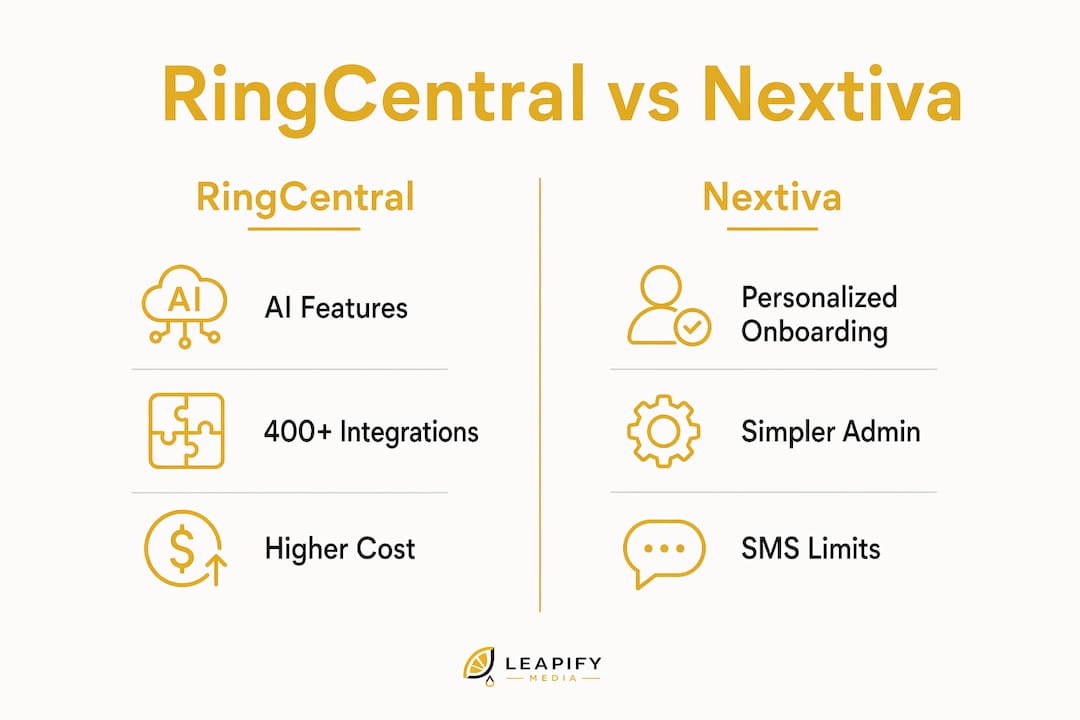
Pricing reality check: Both vendors advertise entry prices that look manageable. The problem is what comes next. AI features like sentiment analysis and real-time transcription often add $40–$80 or more per user per month on top of the base plan costs. For a 10-person field team, that's $400–$800 or more monthly in AI add-ons alone, before factoring in CRM connectors, toll-free minutes, or regulatory fees.
The real trade-offs: AI, dispatch, cost, and what breaks at scale
AI features: who gets what at which price
RingCentral includes AI transcription, call summaries, and its AVA assistant in the base Core plan. That's a genuine advantage over Nextiva, which locks real-time transcription and emotion scoring behind the $75 Power Suite CX tier. For a home-service operator who wants AI call notes without a major upgrade, RingCentral wins this round.

The catch: implementing AI features effectively requires testing transcription accuracy on field-noisy calls and validating that automated routing preserves SLA windows for urgent dispatches. A plumber's truck cab is not a quiet office. Neither platform ships pre-tuned for that environment.
CRM and dispatch: where both platforms fall short
Basic IVR and routing alone are insufficient for high-pressure job booking. A call that comes in while your crew is on-site needs to trigger technician assignment, ETA confirmation, and job logging, not just ring a phone. Neither RingCentral nor Nextiva handles that natively.
RingCentral offers 400+ pre-built integrations, including ServiceTitan and Jobber connectors, but the quality varies. Its HubSpot integration is rated 2.5/5 by users. Nextiva offers roughly nine native integrations, with CRM access gated behind higher tiers. Either way, you're building middleware or paying someone to build it for you.
The integration tax in practice
Here's how headline pricing actually grows for a 10-person HVAC team on RingCentral Advanced ($35/user/month):
- Base plan: $350/month
- AI add-ons (RingSense analytics): additional per-user cost
- CRM connector (Salesforce or ServiceTitan): additional per-user cost
- Toll-free minute overages: variable
- Regulatory fees: variable
The 20–25% TCO premium analysts cite is conservative for teams that actually use the AI and integration features they bought the platform for.
Admin complexity and time-to-value
Nextiva's personalized onboarding model shortens setup time for teams without dedicated IT. Its admin panel scores higher on ease of use (G2: 4.5/5 vs. RingCentral's 4.2/5). RingCentral is more powerful but reviewers repeatedly describe the backend as overwhelming, with nine separate mentions of complex admin setup in one major review analysis.
Migration risks and vendor questions to ask
Before signing with either platform, get clear answers on:
- What are the SMS caps per user per month, and what do overages cost?
- How long does number porting take, and what's the SLA?
- Which AI features are included in the plan you're quoting, and which require add-ons?
- What's the E911 compliance process for multi-location operations?
- What is the data residency policy, and where are call recordings stored?
- What does the cancellation process look like? (RingCentral's has generated significant complaints.)
SMS caps and number-porting friction are among the most common sources of surprise costs and delayed migrations. Get those numbers in writing before you commit.
Pro Tip: Connect your call tracking software to your VoIP platform before going live. Without attribution data flowing from the first call, you cannot measure which ad campaigns are actually booking jobs, and you lose the feedback loop that makes AI intent scoring useful.
How these options were evaluated
The comparison above draws on published platform documentation, third-party review aggregators (G2, Trustpilot), and hands-on integration scenario analysis conducted by Leapify Media's team. Integration scenarios were assessed by mapping a standard home-service inbound call flow: marketing channel triggers call, call routes to available technician or dispatcher, job details captured in CRM, technician assigned and confirmed, follow-up automated. Each platform was evaluated against that flow to identify where native features end and middleware or manual steps begin. Pricing was verified against current published plan pages and cross-referenced with analyst cost-modeling that accounts for AI add-ons, CRM connectors, and regulatory fees.
Leapify Media removes the integration tax entirely
If you've read this far, you've seen the pattern: both RingCentral and Nextiva are solid phone systems that require significant additional work and cost to function as a lead-to-job engine for a home-service business.
Leapify Media is built specifically to solve that problem. The AI dispatch and CRM automation infrastructure Leapify Media builds for home-service operators handles the full flow from inbound marketing call to booked field job, with on-premise AI servers that keep your data proprietary and no per-user AI add-on surprises.
- Fewer missed calls turned into missed jobs: on-premise intent scoring and automated dispatch routing mean urgent calls reach the right technician, not a voicemail.
- Faster time-to-value: no middleware assembly, no IT team required; Leapify manages integrations with your existing CRM and scheduling tools.
- Predictable total cost of ownership: monthly retainer model with one-time AI dispatch setup, not a base price that doubles once you add the features you actually need.
Home-service operators working with Leapify Media have reported up to 20x return on ad spend. To see what that infrastructure looks like for your business, explore Leapify Media's services or visit leapifymedia.com to start a conversation.
Key Takeaways
For home-service businesses, the RingCentral vs Nextiva decision is secondary to the larger question of whether either platform can actually convert marketing calls into booked jobs without significant added cost and integration work.
| Point | Details |
|---|---|
| Neither platform closes the full loop | Both RingCentral and Nextiva require external automation to convert inbound calls into dispatched field jobs. |
| AI costs more than advertised | AI add-ons can significantly increase the monthly cost on top of base plan pricing for either platform. |
| RingCentral wins on AI access | RingCentral includes most AI features in its base plan; Nextiva gates them behind the $75 Power Suite CX tier. |
| Nextiva wins on ease of use | Nextiva's cleaner admin and personalized onboarding suit small teams without dedicated IT resources. |
| Leapify Media removes the integration tax | Leapify Media's managed AI dispatch and CRM infrastructure handles the full lead→job flow with predictable pricing and no middleware assembly. |