

Federal law lets you record a phone call you're part of without telling anyone, but several states override that and demand everyone on the line agree first. The safest rule for anyone recording calls that might cross state lines: if a single participant sits in an all-party state, get consent from every person before you hit record. Skip that step and you risk criminal charges, civil damages, or a recording that gets thrown out of evidence entirely.
TL;DR:
- Recording calls across state lines should always include consent from all parties if any participant is in an all-party consent state, or risk criminal and civil penalties.
- Stricter state laws, like California and Pennsylvania, can override federal one-party rules when a participant from those states is involved, especially if the call is physically or legally linked to that state.
- Verbal, recorded notices at the start of inbound or outbound calls provide the strongest proof of valid consent, with log details essential for legal defense.
- Penalties for illegal recording include statutory damages, criminal charges, and exclusion of recordings as evidence, which can severely impact legal or business recoveries.
- Implementing automatic disclosures via IVR, training agents, logging metadata, and storing recordings securely forms a practical and effective compliance strategy.
Table of Contents
- Call Recording Laws in the US: The Federal Baseline
- State Call Recording Rules: One-Party vs. All-Party States
- Interstate Calls: Which State's Call Recording Law Applies?
- What Counts as Valid Consent to Record a Call
- Penalties for Illegal Call Recording and What You Risk
- Business & Employer Compliance Checklist for Call Recording
- How to Get Consent to Record a Call: Scripts and Documentation
- Why Compliant Call Capture Protects More Than You Think
- Call Recording Laws and Privacy Rights: The Bigger Picture
- Recording Calls With Government Officials or Law Enforcement
- International Calls and Call Recording Law Beyond US Borders
- The Real Compliance Gap Isn't the Law, It's the Follow-Through
- Building Compliant Call Capture Into Your Phone System
- Where to Verify Call Recording Laws by State
- Sources
- FAQ
Call Recording Laws in the US: The Federal Baseline
The federal floor for call recording laws in the US comes from the Wiretap Act, 18 U.S.C. § 2511. Under section 2511(2)(d), a person who is a party to a wire, oral, or electronic communication can record it without telling the other side, as long as the recording isn't made to commit a crime or a tort. That's the one-party consent standard, and it applies nationwide as a legal floor. States can require more; none can require less.
"Wire, oral, or electronic communication" covers ordinary phone calls, VoIP calls, and most digital voice traffic. It does not cover a silent video feed of someone typing, which is why people sometimes assume a screen recording or webcam capture falls under wiretap law when it doesn't. The statute is about intercepting communications, not just observing behavior.
Federal protection has real limits. It disappears the moment the recording serves a criminal or tortious purpose, such as blackmail, harassment, or extortion. It also doesn't help you if a third party who isn't part of the call taps in and records without any participant's knowledge. That's a classic wiretap violation, distinct from a participant simply recording their own conversation.
Common misreadings of the federal baseline:
- Assuming federal law overrides state law when a state sets a stricter standard. It doesn't.
- Believing "wire communication" means only landlines. It covers cellular and VoIP traffic too.
- Thinking silence from the FCC means recording is unregulated. The FCC explicitly says it doesn't police private call recording and defers to state attorneys general and state commissions for enforcement.
- Believing consent from one party always protects you, regardless of intent behind the recording.
That last point matters more than people think. Consent doesn't launder a recording made to commit a crime.
State Call Recording Rules: One-Party vs. All-Party States
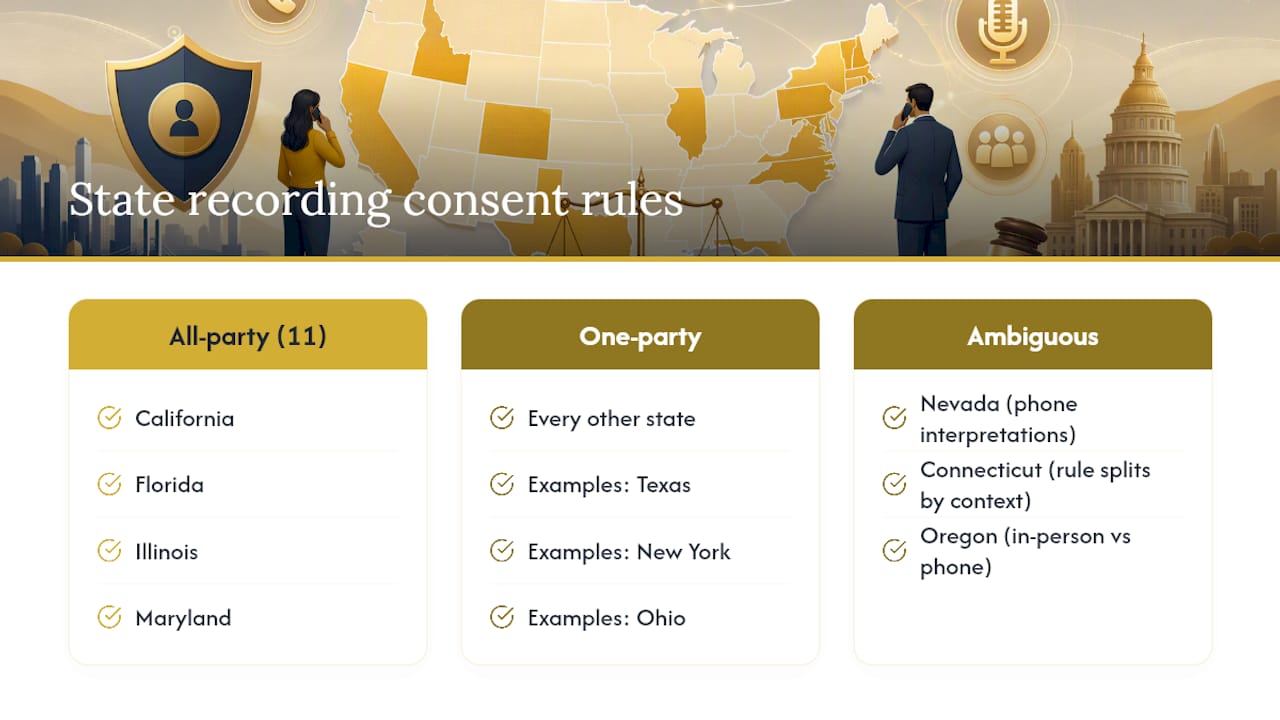
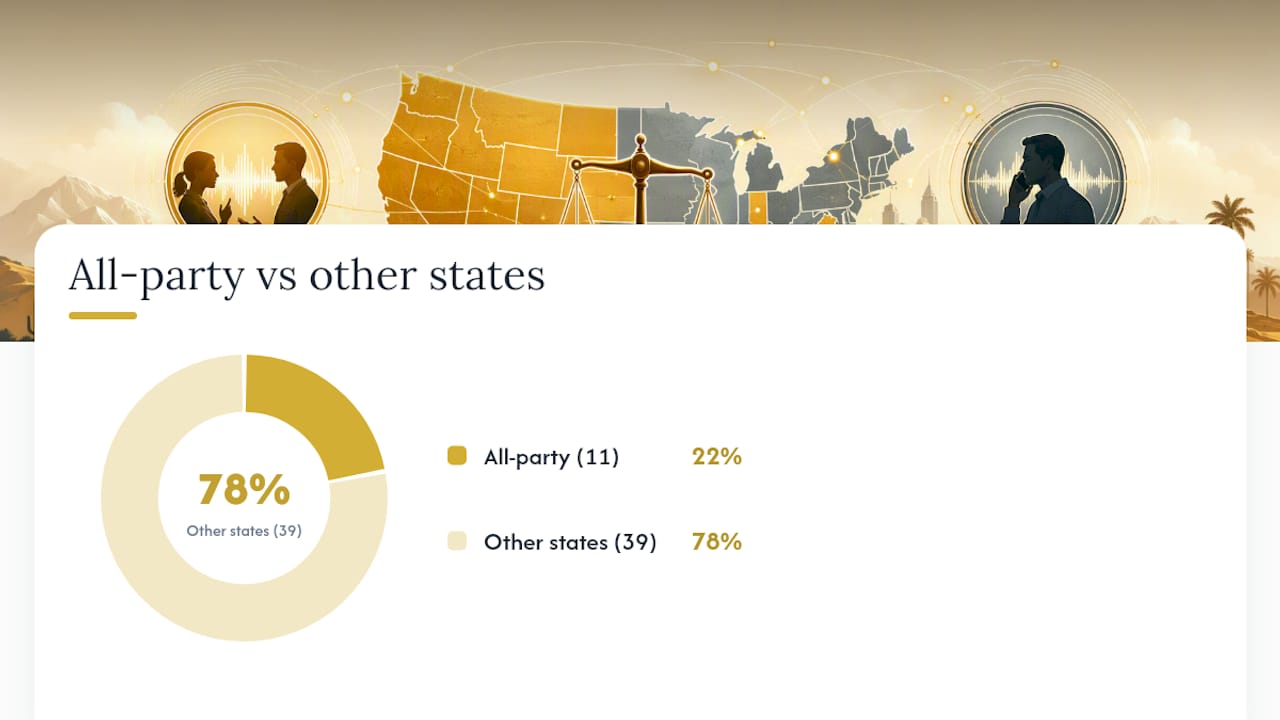
Most states mirror the federal one-party standard: if you're on the call, you can record it. A smaller group of states requires all-party consent, meaning every person on the line has to agree before recording starts. A 50-state survey from Justia lists eleven strict all-party consent states.
The commonly cited all-party consent states include California, Florida, Illinois, Maryland, Massachusetts, Michigan, Montana, Nevada, New Hampshire, Pennsylvania, and Washington.
Every other state, including large ones like Texas, New York, and Ohio, follows the one-party rule. That means the recorder just needs their own consent, not the other party's.
A few states don't fit neatly into either bucket. Nevada's statute has produced conflicting court interpretations: some rulings have treated telephone conversations as requiring all-party consent while treating in-person conversations differently, which has left attorneys advising clients to treat Nevada as an all-party state for phone calls specifically. Connecticut splits its rule by context, applying a stricter standard to certain call types while allowing more latitude elsewhere. Oregon's statute historically distinguished between in-person and telephone conversations too, with in-person recording rules looser than what applies to phone calls.
This patchwork is exactly why "check your state" isn't a throwaway line. A business operating a call center in Texas might feel confident under a one-party rule, right up until a Pennsylvania customer calls in and the state calling in, not the state answering, ends up controlling the analysis.
Pro Tip: Don't rely on a summary article, including this one, as your final word on a specific state's statute. Pull the actual code section using Justia's 50-state survey or RecordingLaw's statute breakdowns, and confirm the citation before you build a policy around it.
If your business takes calls from customers in multiple states, and most do, the state list above is really a risk map. The states you should worry about aren't just where you're headquartered. They're every state your callers might be sitting in when the phone rings.
Interstate Calls: Which State's Call Recording Law Applies?
When a call crosses state lines, courts don't agree on a single formula for which state's law controls, and that uncertainty is precisely why the safe operational rule is to assume the stricter law applies.
The case every compliance team eventually runs into is Kearney v. Salomon Smith Barney, decided by the California Supreme Court in 2006. A brokerage firm based in California, a one-party consent state, recorded calls with its Georgia clients without disclosure. Georgia law would have allowed that recording outright. California's all-party consent law would not. The California Supreme Court sided with California, ruling that the state's interest in protecting its residents' privacy justified applying California's stricter law to a call where one participant was physically in Georgia and the recording device sat there too.
That outcome tells you something uncomfortable if you run a call center: recording where you sit doesn't protect you if the person on the other end sits somewhere stricter.
Courts use a few different anchors when sorting out these conflicts:
- Where the recording device or server physically sits
- Where each party is physically located during the call
- Which state has the stronger public policy interest in the outcome (the approach Kearney took)
- The forum where the lawsuit is actually filed, which can apply its own state's choice-of-law rules
Because these approaches point in different directions depending on the facts, RecordingLaw's guidance treats the strictest-state rule as a practical engineering control rather than a legal guess. If any party is in an all-party state, get consent from everyone, full stop, regardless of where your equipment or headquarters happen to be.
Statistic Callout: All-party consent states make up about a fifth of the country, but if callers originate from those states, a meaningful share of your call volume carries legal risk you can eliminate with a two-second disclosure. The math favors defaulting to disclosure every time.
What Counts as Valid Consent to Record a Call
Not every notice you slap on a call qualifies as legal consent, and this is where a lot of businesses get sloppy.
- Verbal, on-the-record announcement plus an audible response. Saying "this call may be recorded for quality purposes" and having the other person continue the conversation, or better, say "okay" or "understood," is the strongest form of proof you can generate. It's captured in the recording itself, timestamped, and unambiguous.
- IVR pre-recorded announcements for inbound calls. A recorded message played before the call connects to an agent, informing the caller that the line is recorded, satisfies notice requirements in most jurisdictions for inbound traffic. Outbound calls are different: an IVR message played only after you've already dialed out doesn't help if the agent starts talking before the notice runs. Outbound calls need the agent to deliver a spoken notice at the start of the conversation.
- Written consent captured in advance. A signed service agreement, a checked box in an app, or a documented account-opening disclosure that states calls may be recorded can serve as consent for future calls, especially in business-to-consumer relationships where the customer has already agreed to terms.
- Passive signals are the weak link. A banner on a video conferencing screen, a bot with "recording" in its display name, or a list of call attendees emailed after the fact generally does not meet consent standards in strict states. Courts have been skeptical of the idea that someone "should have noticed" a UI element buried in a browser tab.
Washington is the interesting exception here. State statute treats an announcement recorded on the call itself as sufficient consent, according to FCC guidance referencing state-specific language. That's a narrower bar than what courts in states like Pennsylvania have applied, where continued participation after a notice has sometimes needed something closer to an audible acknowledgment to hold up.
Documentation is what separates a defensible policy from a hopeful one. At minimum, log the timestamp of the notice, the specific audio file or script version played, the caller's number, and whether the call was inbound or outbound. If you ever need to prove consent existed, "we usually play a notice" isn't going to cut it. "Here's the exact file, played at this exact second, on this exact call" will.
Penalties for Illegal Call Recording and What You Risk
Getting call recording consent wrong isn't a paperwork problem. It's a criminal and civil exposure problem, and the numbers in strict states are designed to sting.
Several all-party states attach statutory damages to illegal recording, meaning a plaintiff doesn't have to prove actual financial harm to collect. Illinois, for example, has historically classified certain wiretapping violations as felony offenses, not misdemeanors, a rarity among states and a signal of how seriously the legislature treats the issue. Pennsylvania and California both allow civil suits with damages that can run well beyond the cost of any harm actually suffered, precisely because the statutes are built to deter, not just compensate.
Key exposure points to understand:
- Criminal liability. Several all-party states treat willful violations as criminal offenses, with penalties ranging from fines to jail time depending on the state and whether the violation is charged as a misdemeanor or felony.
- Civil liability. Under the federal Wiretap Act, a violation can trigger civil suits with statutory damages, punitive damages, and attorney's fees, quite apart from any state-level claim running in parallel.
- Evidentiary exclusion. A recording obtained in violation of state consent law can be ruled inadmissible in court, which matters enormously if that recording was your evidence in a dispute, a harassment claim, or a contract disagreement.
- Lost protection for criminal purpose. Federal law strips away one-party consent protection the moment a recording is made to further a crime or a tort, regardless of what state you're in.
Statistic Callout: A business operating call centers across even five or six states doesn't need a lawyer's memo to see the exposure. If it's taking thousands of calls a month and even a fraction originate from all-party states, a single class action alleging systematic non-disclosure can turn a policy gap into a seven-figure liability fast, since statutory damages in some states apply per violation, not per lawsuit.
Business & Employer Compliance Checklist for Call Recording
A workable compliance program doesn't require a legal department. It requires a short list of habits applied consistently, every call, every time.
- Default to all-party disclosure for any interstate call. Don't try to guess where each caller is standing. Play the notice regardless.
- Program your IVR to play the recording notice before the call connects to a live agent. This covers inbound traffic automatically and removes human error from the equation.
- Train agents on outbound scripts that open with a spoken disclosure. The script should include a brief pause for the other party's response, and the agent should note or log any objection.
- Log metadata for every recorded call. Capture the timestamp, the specific notice file or script version played, the caller's number, and confirmation that the notice played in full.
- Restrict access to stored recordings and encrypt them at rest. Recordings often contain payment details, health information, or other sensitive data, which raises the stakes if storage is breached.
- Set a retention schedule and stick to it. Keep recordings only as long as business or legal need requires, then delete them on schedule rather than letting archives grow indefinitely.
- Involve counsel before expanding into new call types or new states. Compliance that works for customer service calls may not automatically cover collections calls, hiring calls, or calls involving minors.
A few extra habits worth folding into the same program:
- Audit a sample of recorded calls monthly to confirm the notice actually played and wasn't skipped due to a system glitch.
- Document a legal hold procedure so recordings relevant to a dispute aren't accidentally deleted under a routine retention policy.
- Review vendor contracts if a third-party call center or CRM handles the recording function, since liability doesn't automatically transfer just because someone else runs the software.
Practical compliance guides consistently point to the same combination: IVR disclosure, staff training, and metadata logging cost far less than a single lawsuit, and they're the difference between a defensible program and a hopeful one. Businesses that already track calls for lead generation or scheduling can build consent capture directly into that existing call tracking setup rather than bolting on a separate system later.
How to Get Consent to Record a Call: Scripts and Documentation
Good scripts are short, unambiguous, and repeatable. Here's a practical starting point.
- Inbound IVR notice example: "This call may be recorded for quality and training purposes. If you'd prefer not to be recorded, please let the representative know when connected." Play this before the call routes to a live person, not after.
- Outbound agent script example: "Hi, this is [name] calling from [company]. Just so you know, this call is being recorded for quality purposes. Is that okay with you?" Wait for a verbal response before continuing into the substance of the call.
- Conference call announcement example: "Before we get started, I want to flag that this call is being recorded. If anyone on the line objects, please speak up now." Pause. Note any objection by name in your call log.
For every recorded call, capture:
- A precise timestamp marking when the notice played or was spoken
- The specific file ID or script version used, so you can prove exactly what was said
- The caller's phone number and the direction of the call, inbound or outbound
- Confirmation that the notice played in full without interruption or technical failure
- The server or storage location where the recording lives, particularly relevant if data residency questions come up later
If a recording is ever challenged, your forensic checklist boils down to four questions: Did a notice play? Can you prove it played in full? Did the other party respond or continue the call afterward? Is that proof timestamped and stored somewhere that wasn't editable after the fact? Answer yes to all four, and most disputes over consent evaporate before they reach a courtroom. Businesses adapting existing call scripts for service calls can usually retrofit a consent line into the opening thirty seconds without disrupting the rest of the call flow.
Why Compliant Call Capture Protects More Than You Think
Legal compliance around call recording tends to get filed under "annoying paperwork," which undersells what's actually at stake. A business that records customer calls without a consistent, provable consent process isn't just exposed to a lawsuit. It's exposed to a moment where a recording it needed as evidence gets thrown out, or a customer relationship sours because someone felt secretly recorded.
The businesses that get this right treat consent capture as infrastructure, not an afterthought bolted onto a phone system. That means IVR notices that fire every single time, logs that survive an audit, and storage that doesn't leak sensitive call content because it's sitting on some third-party server with unclear data handling practices. On-premise recording infrastructure, where a company controls its own servers rather than routing sensitive call data through outside vendors, sidesteps a layer of cross-border and cross-state data handling questions that businesses using shared third-party systems often don't even realize they've inherited.
For home service companies fielding calls from customers across county lines and sometimes state lines, this isn't theoretical; many rely on effective fire safety lead generation for businesses to ensure compliant call capture and lead workflow. A roofing company running ads across a metro area that straddles a state border could easily take calls from an all-party state without anyone on staff realizing it. Getting the infrastructure right the first time costs far less than fixing it after a compliance complaint.
Call Recording Laws and Privacy Rights: The Bigger Picture
Call recording statutes exist because courts and legislatures have long treated a private conversation as carrying a reasonable expectation of privacy, an idea rooted in Fourth Amendment jurisprudence even though most recording disputes play out as state statutory claims rather than constitutional ones. All-party consent states, in particular, reflect a legislative judgment that a person's expectation of privacy on a phone call shouldn't evaporate just because the other party happens to be in a more permissive state.
This is part of why Kearney came out the way it did. California's constitution explicitly recognizes a right to privacy, and the state's high court leaned on that when it decided its residents deserved that protection even against an out-of-state company calling from a one-party jurisdiction.
Practically, this means privacy protection under call recording laws isn't just about avoiding a fine. It's about a legal framework that treats unauthorized recording as a genuine invasion of a person's private space, not a technical formality. Businesses that skip disclosure aren't just risking statutory damages. They're operating in a legal gray zone that courts have shown they're willing to police aggressively when a resident of a strict state feels their privacy was violated by someone calling in from outside it.
Recording Calls With Government Officials or Law Enforcement
Recording calls with government officials or law enforcement generally follows the same state consent framework as any other call, with one practical wrinkle: many interactions with law enforcement happen in public or during a traffic stop, which courts have often treated differently from a private phone conversation.
For phone calls specifically, if you call a government office or a police department, the same one-party or all-party rule that governs your state applies. Some agencies play their own recorded notice ("this call may be recorded") precisely to establish consent on their end, which also protects the caller's ability to record the same conversation in a one-party state.
A separate and frequently confused issue is recording law enforcement officers performing their duties in public, which courts have generally protected under the First Amendment regardless of state wiretap statutes, since it involves observing public conduct rather than intercepting a private communication. That's a different legal question from recording a private phone call with an officer or official, which still falls under your state's standard consent rule.
International Calls and Call Recording Law Beyond US Borders
Call recording laws don't stop mattering just because one party is overseas. If you're a US business recording a call with someone in another country, US federal and state law still governs your side of that recording, but the other country's law may also apply to the call, particularly if the recording gets stored, transferred, or used there.
The European Union's data protection framework treats call recordings containing personal data as regulated information, with consent and processing requirements that go well beyond what most US businesses are used to. A US company recording calls with customers in the EU could find itself needing to satisfy both its home state's consent rule and a separate international framework governing personal data handling.
The safest approach for cross-border calls mirrors the interstate rule: default to disclosure and explicit consent regardless of which side of the border either party sits on. If your business regularly takes international calls, and this genuinely warrants dedicated legal advice, don't assume that satisfying California's or Illinois's all-party rule automatically satisfies whatever framework governs the other party's country. Consult counsel familiar with both jurisdictions before scaling any recording program that crosses US borders.
The Real Compliance Gap Isn't the Law, It's the Follow-Through
Most of the confusion around call recording laws in the US isn't about the law itself. It's readable enough once you sit with it for twenty minutes. The real gap is operational: businesses know the one-party or all-party rule for their home state, then quietly assume it covers every call they take, including the ones from customers dialing in from somewhere stricter.
The conventional advice, "check your state's law," is true but incomplete. Your state's law protects you when both parties are in your state. It says nothing about the customer calling from Pennsylvania while your call center sits in Texas. That's the scenario that actually generates lawsuits, and it's the scenario most small and mid-size businesses never build a policy around because their attention stops at their own zip code.
If there's one place to start, it's not a legal memo. It's the IVR script and the agent training, the two-second disclosure that costs nothing and closes most of the risk in one move. Everything else, the metadata logging, the retention schedule, the encrypted storage, matters, but it's secondary to that first spoken sentence at the top of the call.
— Everson Gorski
Building Compliant Call Capture Into Your Phone System
Getting the legal framework right is half the job. Actually wiring an IVR to play a consistent recording notice, logging consent metadata on every call, and storing recordings securely is the operational half most home service businesses don't have the bandwidth to build themselves. Specialized providers design on-premise infrastructure that handles exactly this, so consent capture and secure call storage aren't a separate project bolted onto your existing phone system.

This is often built into the same intent scoring and call handling infrastructure used for HVAC, plumbing, roofing, and other home service operators, meaning compliance logging and lead tracking run on the same secure, in-house system instead of two disconnected tools. That's the practical advantage over stitching together a generic call recorder and a separate compliance spreadsheet: one system, one log, one place to pull records if a call is ever challenged. This is operational support, not legal advice, so pair it with your own counsel for anything state-specific to your business. If your business is fielding calls across state lines and wants that infrastructure built correctly the first time, explore Leapify Media's services or request a discovery call to talk through what compliant call capture looks like for your operation.
Where to Verify Call Recording Laws by State
State statutes change, and court interpretations shift, so treat any summary, including this one, as a starting point rather than a final answer.
- 18 U.S.C. § 2511 for the federal Wiretap Act text itself.
- FCC consumer guidance on recording telephone conversations for the agency's position and its deference to state law.
- Justia's 50-state survey on recording phone calls for state-by-state citations and classifications.
- RecordingLaw's guide to the Federal Wiretap Act and ECPA for practical interpretation and interstate compliance guidance.
To verify your specific state, pull the actual statute number from one of the surveys above, then read the current text directly rather than relying on a secondhand summary, since amendments and court rulings can shift how a statute applies without changing its wording.
This article is general information, not a substitute for advice from a qualified lawyer. Consult a qualified legal professional about your own circumstances before acting on anything here.
Sources
- Recording telephone conversations | Federal Communications Commission
- 18 U.S.C. § 2511 — Interception and disclosure of wire, oral, or electronic communications prohibited
- Recording phone calls and conversations under the law: 50-state survey | Justia
- Federal Wiretap Act and ECPA: The complete guide | RecordingLaw
FAQ
In What States Is It Illegal to Record Phone Calls Without All-Party Consent?
California, Florida, Illinois, Maryland, Massachusetts, Michigan, Montana, Nevada, New Hampshire, Pennsylvania, and Washington require all-party consent, according to Justia's 50-state survey, though Nevada's rule has been interpreted inconsistently by courts.
Can I Sue Someone for Recording Me Without My Permission?
Yes, if you're in an all-party consent state and the other person recorded without your consent, you can typically bring a civil claim, and several states allow statutory damages without needing to prove actual financial harm.
Can Someone Record a Call Without Your Permission?
In one-party consent states, yes, as long as the person recording is a participant in the call; in all-party states, no, unless every participant has consented first.
Do You Legally Have to Tell Someone the Call Is Being Recorded?
Only in all-party consent states, where disclosure and consent from every participant are required; in one-party states, a participant can record without telling the other side, though businesses should disclose anyway as a safe default for interstate calls.
What's the Safest Rule if My Business Takes Calls From Multiple States?
Default to playing a recording disclosure on every call and treat the strictest state's rule as your baseline, since Kearney v. Salomon Smith Barney shows courts can apply a stricter out-of-state law even when your business sits in a one-party state.