

AI lead routing assigns each incoming lead to the rep, queue, or workflow most likely to convert it, using scoring and intent signals instead of a fixed round-robin. It earns its place once you have enough historical outcome data and reps to make patterns statistically meaningful.
TL;DR:
- AI lead routing improves accuracy by scoring leads based on intent signals and historical data, particularly benefiting messy or incomplete inputs.
- When sufficient clean outcome data is available, propensity scoring outperforms static rules, but small teams may see better results with well-maintained rule-based systems.
- The core routing process involves ingesting, normalizing, de-duplicating, scoring, and applying rules, with integration across multiple data sources and strict governance.
- Pilot programs should focus on specific segments, define clear objectives, test thoroughly, and include rollback plans, gradually scaling after achieving targeted metrics.
- Key metrics include speed-to-lead, misroute rate, SLA breaches, and conversion rates, with consistent monitoring and threshold-based escalation essential for system trustworthiness.
Table of Contents
- What Is AI Lead Routing and How Does It Work?
- Which Routing Model Fits Your Team?
- The Canonical Routing Pipeline: From Ingest to Assignment
- How to Roll Out AI Lead Routing Without Breaking Anything
- What Metrics Prove Your Routing System Works?
- What Home Service Operators Get Wrong About Routing
- How Do You Secure an AI Routing System?
- What Does AI Lead Routing Cost, and What's the Payoff?
- Common Pitfalls and Pragmatic Priorities
- How Leapify Media Helps You Put This Into Practice
- Sources
What Is AI Lead Routing and How Does It Work?
AI lead routing differs from rules-based routing in one core way: instead of assigning leads purely by static logic ("zip code 90210 goes to Rep A"), it scores each lead against outcome data and routes based on predicted fit or predicted likelihood to close. Rules still exist underneath. AI just decides which rule applies, or overrides the default when the data says otherwise.
Three components do the actual work. Intent extraction, often powered by a large language model, reads free-text form fields, chat transcripts, or call notes and pulls out structured signals like project type, urgency, or budget range. Propensity scoring ranks leads by predicted conversion probability, usually trained on your own closed-won and closed-lost history. Signal fusion combines firmographic data, behavioral data (pages visited, response speed to first outreach), and CRM history into one composite score the router can act on.
AI helps most with messy inputs. A homeowner typing "my furnace won't stop making a weird clanking noise, need someone today" contains urgency and equipment type that a static dropdown would never capture. That's exactly the kind of signal conversational qualification is built to extract before the lead ever reaches a router.
The limits matter just as much as the capabilities:
- Models trained on thin or biased historical data will replicate that bias, not correct it.
- Explainability suffers when a black-box score overrides a human's judgment without a visible reason.
- Confidence scores need thresholds. Below a certain score, the system should escalate to a person, not guess.
- Static forms are wrong roughly 30 to 50 percent of the time, which means routing decisions built only on form data inherit that error rate.
The practical takeaway: AI lead routing is an accuracy layer on top of a rules foundation, not a replacement for one.
Which Routing Model Fits Your Team?
Every routing strategy trades off fairness, speed, and specialization differently, and most mature teams end up layering two or three rather than picking one.
- Round-robin distributes leads evenly and is easiest to explain to a sales team, but it ignores fit entirely. A high-value commercial roofing lead can land with a rep who has never closed one.
- Territory-based routing assigns by geography, which works well for field-service businesses where drive time matters, but breaks down when territory boundaries don't match where the actual demand is.
- Account-based routing matches leads to the rep who already owns the account relationship, critical for enterprise deals with multiple touchpoints, but overkill for high-volume, low-complexity inbound.
- Skills or capacity-based routing assigns based on what a rep is actually good at and how full their pipeline is right now, which prevents your best closer from getting buried while a slower rep sits idle.
- AI-propensity routing scores each lead against historical win patterns and assigns to maximize predicted conversion, the most powerful option and the one that requires the most data discipline to trust.
The selection logic is simpler than it looks. Smaller teams with fewer reps and limited historical data usually perform better using well-maintained rules than with AI models lacking enough training data, according to The GTM Advisor Group's operator guide. Once you have several months of clean outcome data, propensity scoring starts outperforming static rules. Most organizations should climb this ladder step by step, rules to weighted rules to AI-assisted, rather than jump straight to a model with no fallback.
The Canonical Routing Pipeline: From Ingest to Assignment
Every reliable routing system, AI-assisted or not, follows the same skeleton: ingest, normalize, dedupe, score, assign, and monitor. The steps rarely change; what changes is how much intelligence sits inside each one.
- Ingest: pull leads from every source (web forms, chat, phone, paid ads, referral partners) into one pipeline instead of siloed inboxes.
- Normalize and enrich: standardize phone formats, append firmographic or property data, and fill gaps before scoring runs on incomplete records.
- Dedupe and ownership checks: match against existing CRM records so a returning customer doesn't get routed as a fresh lead to a different rep, which causes the stale-owner conflicts that erode trust in the system fast.
- AI qualification: extract intent and score fit using the signals gathered above.
- Apply routing rules and assign: the model's score feeds a deterministic rule set that makes the final call. Workhint's implementation research frames this combination, AI interpretation plus deterministic workflow rules, as the pattern that actually holds up in production.
- SLA timers and escalation: start the clock the moment a lead is assigned, and escalate automatically if no action happens in time.
- Audit logs and reason codes: every routing decision gets logged with the "why," not just the "who."
Integration touchpoints span your CRM, marketing automation platform, scheduling tool, and any third-party enrichment service. Getting this wrong usually shows up as duplicate records or two reps calling the same homeowner within an hour of each other.
Pro Tip: Build idempotency into every write. If your router calls the CRM API twice because of a network retry, the second call should recognize the lead already exists and update it, not create a duplicate. This single design choice prevents most of the "phantom lead" complaints teams get in month one.
How to Roll Out AI Lead Routing Without Breaking Anything
A pilot should never touch your entire pipeline on day one. Treat this as a staged rollout with a rollback plan built in from the start, not an afterthought.
- Define objectives and metrics first. Pick two or three numbers you're trying to move, speed-to-lead, misroute rate, conversion by path, before you write a single rule.
- Choose a narrow pilot segment. One product line, one region, or one lead source. Never the whole book of business.
- Audit data quality. Check for missing fields, inconsistent formatting, and duplicate records before scoring runs on any of it.
- Set data contracts. Decide exactly what fields every lead source must supply and reject or flag anything that doesn't meet the contract.
- Design the policy layer. Tie-break logic for equally scored leads, a fallback owner when no rule fits, SLA windows per lead type, and clear triggers for human review.
- Run integration dry-runs. Route shadow traffic through the system without letting it touch live leads, and compare its decisions against what a human would have done.
- Instrument audit logs and reason codes before go-live, not after the first escalation forces you to add them.
- Go live on the pilot segment, then hold weekly tuning sessions to review misroutes and adjust thresholds.
- Scale in stages, adding segments only after the prior stage hits its target metrics for at least two full reporting cycles.
- Keep a rollback plan ready. Know exactly how to revert to the prior routing logic within one business day if something breaks.
Pro Tip: Staff a named "routing owner" before launch, not a committee. Someone needs to be the single point of accountability when a misroute happens at 4:45 PM on a Friday.
What Metrics Prove Your Routing System Works?
Routing performance lives or dies on a small set of numbers, and the discipline is in tracking them consistently, not in the volume of dashboards you build.
- Speed-to-lead: time from lead creation to first rep action.
- Misroute rate: percentage of leads reassigned within 24 hours of initial assignment.
- SLA breach rate: percentage of leads that blow past their assigned response window.
- Conversion by routing path: close rate segmented by which rule or model made the assignment, so you can see whether AI-assisted paths actually outperform the rules-based fallback.
- Reassignment volume by reason code: tags every override with why it happened, which turns a vague complaint into a pattern you can fix.
Speed-to-lead specifically deserves its own dashboard: the gap between a five-minute response and a five-hour response is often the single biggest lever in the entire funnel.
Set human review thresholds at a specific confidence score, not a gut feeling, and escalate anything below it automatically. Best-practice guidance from ZoomInfo's lead routing playbook recommends measuring misroutes and reassignments explicitly rather than assuming the system is working because leads are moving.
Weekly miss reviews matter more than model accuracy for long-term trust in the system, since reps stop trusting a router the moment they see it make the same mistake twice with no visible correction. Monthly, roll the same metrics up to a governance dashboard that tracks trend lines, not just snapshots, so a slow drift in misroute rate gets caught before it becomes a quarter-long problem.
What Home Service Operators Get Wrong About Routing
Home service routing has quirks that generic B2B guidance skips. An emergency HVAC call at 11 PM needs a different SLA than a routine gutter cleaning quote. Technician skill match (who's licensed for gas work, who's certified on a specific brand of water heater) matters more than territory alone, and booking constraints, drive time, existing schedule, parts on hand, have to feed the routing decision in real time.
Leapify Media builds AI dispatch and intent scoring on-premise for exactly this reason: home service data (customer addresses, service history, financial details) stays on infrastructure the operator controls, rather than passing through a third party's shared model. Clients who've paired this with tightened qualification have reported very high returns on ad spend, though results depend on market and starting data quality. Individual results vary by market and setup. The practical difference from generic routing software: emergency flags get their own SLA tier, and the router checks technician certification before it checks who's simply next in the queue.
How Do You Secure an AI Routing System?
Lead routing systems handle personally identifiable information at volume: names, phone numbers, addresses, sometimes financial or health-adjacent details depending on your industry. That makes security a design requirement, not a compliance afterthought bolted on after launch.
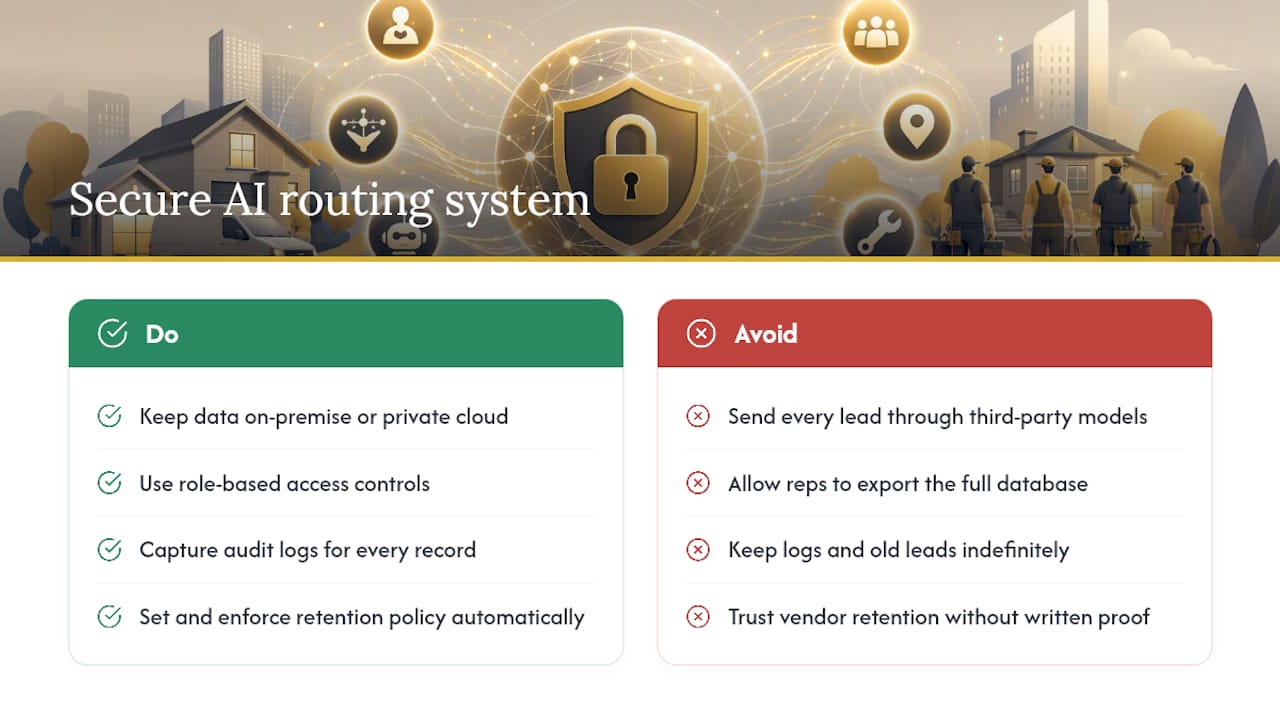
Data residency is the first decision. Routing platforms that send every lead through a third-party model provider create a data trail you don't control, and once customer data leaves your infrastructure, you're trusting someone else's retention policy and someone else's breach history. On-premise or private-cloud deployment keeps that data inside systems you own, which matters most for businesses handling sensitive fields like financial qualification or medical history.
Access controls need to be role-based, not all-or-nothing. A rep shouldn't be able to export the full lead database because they need to see their own queue. Audit logs should capture who viewed, edited, or reassigned every record, which doubles as your explainability trail when a routing decision gets questioned.
Encryption in transit and at rest is table stakes at this point, but the more common failure is retention. Old leads sitting in a routing system's logs indefinitely become a growing liability with no corresponding business value. Set a retention policy and enforce it automatically rather than relying on someone remembering to purge old records.
Vendor risk applies here too. If your routing system integrates with a third-party enrichment service or an LLM provider, understand exactly what data crosses that boundary and whether that provider retains or trains on it. Ask directly, in writing, before signing anything.
What Does AI Lead Routing Cost, and What's the Payoff?
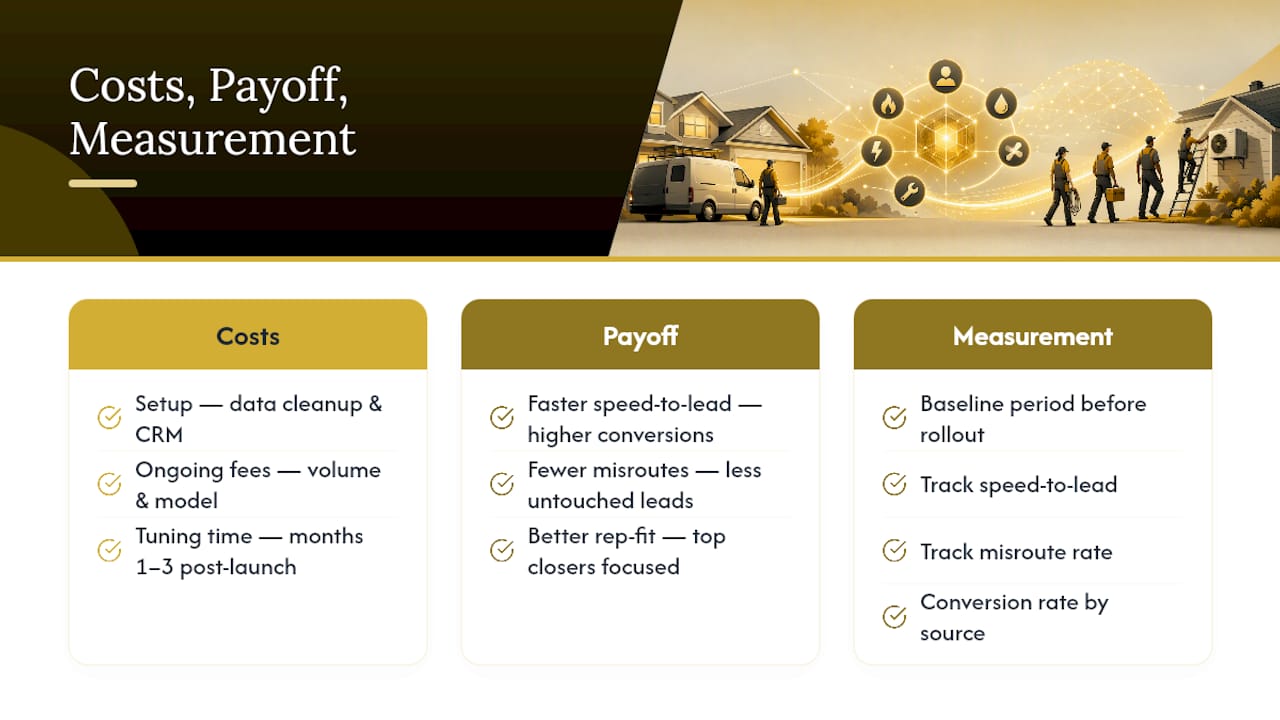
Costs break into three buckets: setup, ongoing platform fees, and the human time spent tuning the system after launch. Setup usually includes data cleanup, CRM integration work, and building the initial rule and scoring logic, which is almost always the largest one-time cost because messy historical data takes real hours to fix. Ongoing costs scale with lead volume and the complexity of your scoring model, and teams often underestimate the tuning time needed in the first two or three months after go-live.
The payoff side is where the real case gets made. Faster speed-to-lead alone typically drives measurable conversion lift, since a lead contacted within minutes converts at a meaningfully higher rate than one contacted hours later. Lower misroute rates mean fewer leads sitting untouched because two reps each assumed the other had it. Better rep-fit matching means your top closers spend more time on leads they're actually likely to win, instead of working a queue assigned by pure luck of the draw.
Building a credible ROI estimate means tracking a baseline period before rollout, speed-to-lead, misroute rate, conversion rate by source, and comparing it against the same metrics 90 days after launch. Skip this step and you're left guessing whether the system paid for itself or just moved work around. The strongest business case ties routing improvements directly to booked revenue, not just process efficiency, because a faster process that doesn't convert more leads hasn't actually solved anything.
Common Pitfalls and Pragmatic Priorities
The mistakes I see most often aren't about model accuracy. They're about bad inputs feeding a good model, skipping governance because "the pilot worked," and building SLA timers nobody actually enforces after week three.
My priority order for anyone starting out: start with a narrow pilot, instrument outcomes before you scale, require a reason code on every AI-driven assignment, and route low-confidence scores to a human instead of trusting the model blindly. Explainability isn't a nice extra. It's what keeps your sales team believing in the system after the third bad routing decision.
— Everson Gorski
How Leapify Media Helps You Put This Into Practice
Leapify Media builds this exact pipeline for home service operators: on-premise AI dispatch and intent scoring, CRM integration, and the governance layer, SLA timers, reason codes, weekly tuning, that keeps routing trustworthy after launch. Unlike agencies that route your customer data through third-party AI providers, Leapify keeps it on infrastructure the operator controls, which matters when you're handling addresses, service history, and financial qualification data at volume.
A typical engagement runs pilot, integrate, govern, scale, the same sequence covered in the implementation checklist above, but built specifically around home service constraints: emergency flags, technician certification matching, and real booking availability.
If your current routing setup is costing you booked jobs to slow response times or mismatched technicians, visit Leapify Media's services page to see the full build, or request a pilot to see what a properly instrumented routing system looks like on your own lead volume.
Sources
For deeper technical detail beyond this guide: Perspective AI's breakdown of where routing software fails, and the Pedowitz Group's analysis of AI agents as continuous decision engines across CRM and sales tools.
- AI Lead Routing Automation For B2B Sales Teams - The Workhint Blog
- Lead Routing: The Complete Operator's Guide to Assignment Logic, Models, and Optimization — The GTM Advisor Group
- AI Lead Routing Software: How It Works, Where It Breaks, and How to Pick One in 2026 | Perspective AI
- What Is Lead Routing? Strategies, Data, and Best Practices