

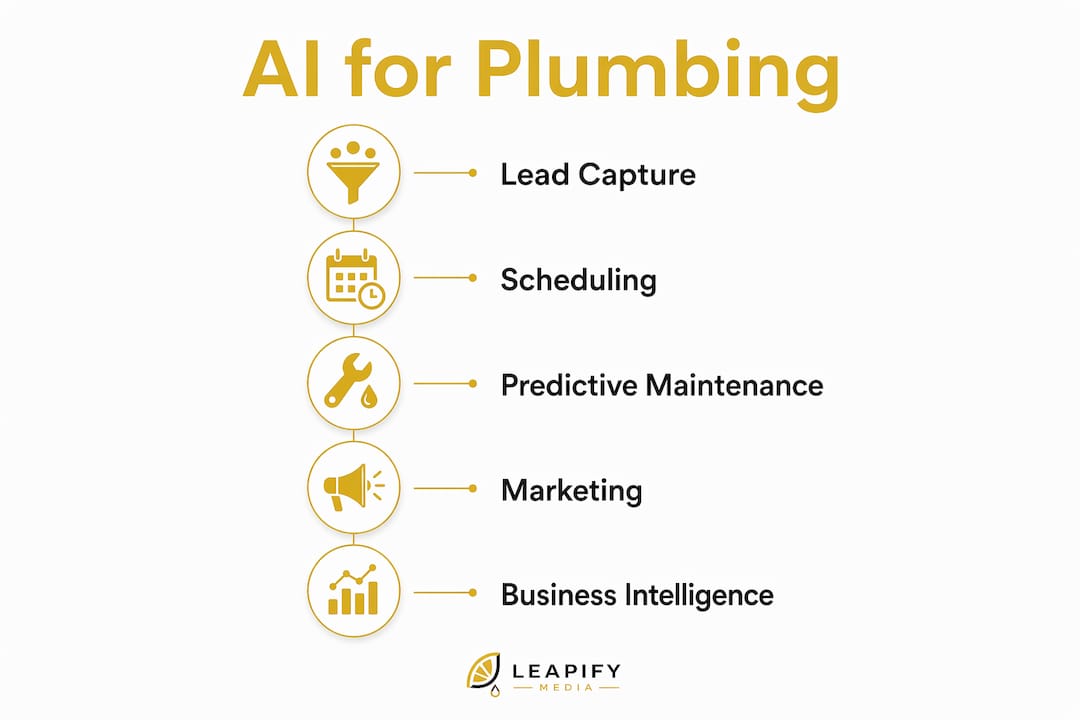
Plumbing companies lose about 25% of inbound calls, and every one of those missed calls is a job that walks straight to a competitor. AI for plumbers fixes that leak first, then keeps working across scheduling, dispatch, marketing, and customer follow-up to turn a reactive operation into a revenue machine. Leapify Media's home service clients have reported 20x return on ad spend by combining AI-optimized ads with on-premise lead conversion infrastructure. The core benefits:
- 24/7 lead capture: AI voice agents answer every call instantly, triaging emergencies and booking routine jobs without human intervention
- Automated qualification: AI scores leads by urgency and job value before a dispatcher touches the board
- Marketing ROI: AI-tested ad copy and local SEO management lower cost per lead while increasing call volume
- Reduced no-shows: AI scheduling reduces missed appointments by roughly 32%, keeping technicians billable
- Faster response: Automated follow-up sequences across SMS, email, and web chat close leads that manual processes drop
Table of Contents
- How AI-powered lead capture converts more calls into booked jobs
- How AI scheduling reduces missed appointments and maximizes technician output
- What agentic AI actually does for a plumbing operation
- Using your own data to make smarter business decisions
- How AI predicts and prevents plumbing failures before they happen
- Leapify Media turns your ad spend into booked jobs
- Key Takeaways
How AI-powered lead capture converts more calls into booked jobs
The first company to respond wins the job. That is not a philosophy; it is how homeowners with a burst pipe actually behave. They call, and if no one answers, they move on.
AI voice answering solves this by picking up on the first ring, every time, day or night. It gathers the customer's name, address, and problem description, then either books the job or flags it as an emergency for immediate callback. Solo operators benefit as much as large crews here. One truck with AI call answering has the responsiveness of a business with a full office staff, at a fraction of the cost.
Beyond the phone, AI chatbots handle inquiries across web chat, SMS, and social media simultaneously. When a homeowner messages at 10 PM about a water heater, the AI responds within seconds, qualifies the job, and books the appointment. Automated follow-up sequences then nurture leads who did not book on first contact, sending personalized reminders based on the customer's behavior.
Pro Tip: Start with AI call answering before any other tool. Recovering even a handful of missed jobs per month typically pays for the entire AI initiative, funding every phase that follows.
For marketing, AI generates and tests dozens of ad variations for Google and Meta, finding the message that converts in your specific market. It also manages your Google Business Profile, drafting review responses and generating location-specific content that builds search authority over time.
How AI scheduling reduces missed appointments and maximizes technician output
AI-driven scheduling reduces missed appointments by roughly 32%, and the downstream effect on cash flow is immediate. Fewer no-shows mean more billable hours per technician per day without adding headcount.
Dynamic dispatch goes further by reshuffling the board in real time when a priority job drops in. When a burst main hits a commercial kitchen at noon, the system instantly reassigns lower-priority jobs, notifies affected customers, and routes the nearest qualified technician, all without a dispatcher making a single phone call. Assignments factor in license type, certifications, active workload, and parts already on the truck.

Fleet route optimization compounds these gains. AI sequences work orders by analyzing job priority, technician certifications, and live traffic data, saving crews hours of windshield time across a week. When a last-minute emergency drops onto the board, the system recalculates every route dynamically rather than leaving a dispatcher to manually rebuild the day.
Automated reminders round out the scheduling layer. Confirmations and behaviorally framed reminders go out via SMS and email without anyone on your team touching a keyboard, keeping customers on track and reducing the friction that causes cancellations.
What agentic AI actually does for a plumbing operation
Agentic AI is software that makes decisions and takes action on its own, not just software that surfaces recommendations for a human to act on. In plumbing field service, that distinction matters.
Agentic AI analyzes water usage patterns and service history to diagnose likely issues, then automatically routes the best-credentialed technician without dispatcher input. A sensor flags abnormal water consumption at a commercial property at 2 AM. The system checks the service history, identifies a likely backflow issue, confirms the nearest certified technician, and schedules the visit before anyone in the office knows there is a problem.
Agentic AI marks a genuine shift from software that assists decisions to software that makes them. In field operations, this means routing, diagnostics, and scheduling happen in the background, based on rules you set, while your team focuses on the work that requires human judgment.
This proactive posture cuts emergency call volume over time. When AI catches developing issues before they become failures, customers call you for planned maintenance instead of panicking at midnight. That shift toward scheduled revenue is one of the most durable financial improvements a plumbing business can make.
AI also connects with IoT devices like smart water monitors and pressure sensors, feeding real-time data into the dispatch and maintenance models. The result is a system that gets more accurate the longer it runs on your specific customer base.
Using your own data to make smarter business decisions
AI's real power in home services comes from combining your unique operational data with industry-wide benchmarks to surface decisions you could not see before. Job value by technician, marketing channel ROI, callback rates by job type: these are the numbers that determine whether a plumbing business grows or stalls.
"The question is no longer whether AI belongs in a plumbing business. The question is how much money you are leaking every week because you have not put it to work yet." — Tommaso Maria Ricci, founder and business analyst
AI business intelligence tools let you ask plain questions about your operation and get answers in seconds. "What is my average job value by technician this month?" used to require pulling a manual report. Now it takes a text query.
Leapify Media's on-premise AI infrastructure keeps this data secure and proprietary. Rather than feeding your customer and revenue data into shared third-party platforms, on-premise servers mean your competitive intelligence stays yours. That matters when your job history, pricing patterns, and customer profiles represent years of hard-won market knowledge.
For inventory and supply chain, AI-driven analytics predict parts demand based on seasonal patterns and scheduled maintenance, reducing both stockouts and excess carrying costs. Predictive models also personalize customer communications, triggering service reminders based on equipment age and usage rather than generic calendar intervals.
How AI predicts and prevents plumbing failures before they happen
Predictive maintenance is where AI moves from operational tool to genuine competitive advantage. By analyzing equipment data, service history, and usage patterns, AI identifies components likely to fail before they do, converting emergency calls into planned visits.
A water heater with declining performance metrics, flagged by a connected sensor, becomes a proactive service call rather than a 6 AM emergency. Predictive AI spots these patterns across a fleet of properties simultaneously, something no dispatcher or technician can do manually at scale.
Computer vision adds another layer. Technicians photograph equipment nameplates in the field, and AI instantly reads manufacturer, model, serial number, and installation date, tying that data to the customer's asset history. Over time, this builds a complete equipment profile for every property you service, giving your team the data to sell maintenance agreements and schedule replacements before failures happen. The AI tools transforming plumbing operations at this level are no longer experimental; they are available to businesses of any size.
Leapify Media turns your ad spend into booked jobs
Most plumbing marketing budgets leak money the same way a bad fitting leaks water: slowly, invisibly, until the damage is obvious. Leapify Media was built specifically to stop that.
Leapify Media engineers AI-powered marketing infrastructure for home service companies, running Google Ads and Meta Ads management, local SEO, on-premise AI lead dispatch, intent scoring, CRM automation, and custom content production under one roof. The on-premise AI means your customer data never touches a shared third-party server. Home service clients have reported 20x return on ad spend, not from spending more, but from converting the leads the ad budget was already generating.
If you are running ads and watching leads go cold, or missing calls while your technicians are in the field, Leapify Media's growth infrastructure is built for exactly that problem. Get in touch to see what a purpose-built AI system looks like for your plumbing business.
Key Takeaways
AI for plumbing businesses delivers the highest returns when deployed as a layered system, starting with call capture and expanding into dispatch, marketing, and predictive maintenance.
| Point | Details |
|---|---|
| Missed calls cost real revenue | Plumbing companies lose about 25% of inbound calls; AI voice answering recovers those leads around the clock. |
| Scheduling AI cuts no-shows | AI-driven scheduling and reminders reduce missed appointments by roughly 32%, directly improving technician utilization. |
| Agentic AI acts without prompting | Agentic AI routes technicians and flags developing issues autonomously, shifting operations from reactive to proactive. |
| Data drives smarter ad spend | Combining your job history with AI analytics identifies which marketing channels produce profitable work, not just calls. |
| Leapify Media | Leapify Media's on-premise AI infrastructure converts ad spend into booked jobs, with home service clients reporting 20x ROAS. |