

AI lead scoring ranks leads by predicted conversion probability using machine learning trained on your historical outcomes, and it beats static rule-based scoring once you have clean, sufficient data behind it. Below roughly 100 closed-won records, rules still win. Above 200, teams implementing it with discipline typically see 15 to 30 percent pipeline efficiency gains within six to twelve months.
TL;DR:
- AI lead scoring outperforms rule-based systems once you have more than 200 closed-won deals, typically delivering 15 to 30 percent pipeline efficiency gains within a year.
- To build a reliable AI model, organizations need at least 200 to 1,000 historical leads with both wins and losses, complete fields, and timestamped event data.
- Implementing AI lead scoring usually takes six to twelve months, with the critical phases of data preparation, model validation, and ongoing retraining to prevent performance drift.
- A hybrid approach, using rules for initial gating and AI for ranking within qualified leads, is ideal if you have between 100 and 200 closed deals to balance explainability and performance.
- Proper metrics, including lead-to-opportunity rate increases and shrinking time-to-contact, should be tracked before and after deployment to measure real improvements.
Table of Contents
- What Is AI Lead Scoring and Who Needs It?
- How Does AI Lead Scoring Actually Work?
- Should You Use Rules, AI, or a Hybrid Model?
- What Data Do You Need Before You Start?
- How Long Does Implementation Actually Take?
- What Metrics Prove the Scoring Model Is Working?
- Why Do AI Lead Scoring Projects Fail?
- How Leapify Media Applies This for Home Service Operators
- What Should You Do Next?
- How Leapify Media Helps You Put This Into Practice
- Sources
What Is AI Lead Scoring and Who Needs It?
AI lead scoring is the practice of training a model on your past leads, their attributes, and their actual outcomes, then using that model to rank new leads by how likely they are to close. It replaces or augments manual point systems where a marketer decides that a demo request is worth 20 points and a whitepaper download is worth 5. The model learns those weights from data instead of guesswork.
Two use cases dominate. The first is net-new demand generation prioritization: ranking inbound leads from ads, forms, and calls so sales reps work the hottest ones first. The second is converting existing users, common in product-led growth, where the model flags free users or trial accounts showing behavior that predicts upgrade. A home service business chasing booked jobs cares almost entirely about the first case.
Operationally, a score does three things. It routes leads to the right rep or queue. It triggers a specific playbook, like an immediate call versus a nurture sequence. And it sets the pace of follow-up, since 98% of sales teams using AI report improved lead prioritization when scores actually change what reps do next.
Here's a concrete example: a homeowner fills out a quote form at 9 p.m. after searching "emergency plumber near me." A rules-based system might score that lead the same as a daytime cabinet-refacing inquiry. An AI model that has seen thousands of past leads recognizes the urgency signal in the search term, the timestamp, and the service category, and routes it for an immediate call instead of next-morning follow-up.
- Demand gen scoring answers: "Which of these 500 leads should we call first?"
- PQL scoring answers: "Which of these free users should sales reach out to?"
- Both feed the same downstream actions: routing, playbook selection, and nurture timing.
How Does AI Lead Scoring Actually Work?
The process runs through five distinct phases, and skipping any one of them is usually where teams get burned.
- Data collection. Pull every available signal on a lead and, ideally, on the account it belongs to: form fields, page visits, ad click source, call transcripts, CRM notes, and firmographic data like company size or industry.
- Cleaning and feature engineering. Raw data is messy. Duplicate contacts, missing fields, and inconsistent naming (three spellings of the same city) all get normalized. This phase also creates derived features, like "days since last engagement" or "number of pages visited in one session," which often predict conversion better than any single raw field.
- Modeling. A machine learning algorithm, commonly gradient boosting or logistic regression for this use case, learns the relationship between lead attributes and historical outcomes: which combinations of signals showed up disproportionately among closed-won deals versus closed-lost.
- Scoring. The trained model assigns a probability or a decile rank to every new lead as it enters the system, usually in real time or near real time through a CRM integration.
- Continuous learning. The model gets retrained as new outcomes accumulate, since a scorer trained on last year's buyer behavior degrades as market conditions shift.
The signals that feed this pipeline fall into six categories: firmographic (company size, revenue, location), technographic (what software or platforms a lead already uses), marketing engagement (email opens, ad clicks, form fills), product events (trial usage, feature adoption), third-party intent data (research activity happening off your own site), and timestamps or behavioral sequences (the order and timing of actions).
That last category matters more than most teams assume. A lead who visits a pricing page, then a case study, then requests a quote within 48 hours behaves very differently from one who visits the same three pages spread across three months. Event-level, timestamped sequences combined with account-level corroboration consistently outperform models that only look at aggregated flags like "visited pricing page: yes/no." If your data pipeline throws away timestamps or collapses multiple sessions into a single boolean, you're feeding the model a blurrier picture than it needs.
Should You Use Rules, AI, or a Hybrid Model?
The honest answer depends almost entirely on how much closed-won history you have, not on which approach sounds more advanced.
Rule-based scoring assigns fixed point values to specific actions and attributes. It's transparent, cheap to build, and doesn't need much data to function, which makes it the right default for a team with under 100 closed-won records. AI scoring, by contrast, needs enough historical outcomes to find real patterns rather than noise, but once that threshold is cleared it tends to outperform static rules, particularly at the top of the funnel.
The numbers: Industry analyses show AI scoring producing a 1.4x to 2.2x lift in top-decile conversion compared with a well-tuned rule-based model, but only once sufficient training data exists.
Use this as your rough guide:
- Fewer than 100 closed-won deals: stick with rules. There isn't enough signal for a model to learn anything a human couldn't already encode by hand.
- 100 to 200 closed-won deals: run a hybrid. Use rule-based gating to filter for basic fit (industry, deal size, geography), then let a lightweight model rank within that qualified pool.
- 200 or more closed-won deals: a full AI scorer becomes viable, especially if you also have strong engagement and product-event data.
The hybrid pattern deserves more attention than it gets. Gating leads through explainable rules first, then applying AI scoring only to the leads that pass, keeps the system auditable. A sales manager can still say "this lead scored high because it matched our ICP criteria, and then the model ranked it above similar leads based on engagement velocity." That explainability matters more than raw model sophistication once compliance or sales leadership starts asking questions.
What Data Do You Need Before You Start?
Most AI lead scoring projects fail before the model ever gets built, because the underlying data can't support one. Run this checklist before you commit budget to a build.
Volume and negative examples. You need not just closed-won deals but closed-lost ones too, since the model learns as much from what didn't convert as from what did. Vendor platforms vary in their stated minimums, but HubSpot's own documentation points to a range of roughly 200 to 1,000 historical leads, with meaningful counts of actual conversions, before predictive scoring becomes reliable in-platform.
Field completeness. Audit your CRM for the fields that actually predict outcomes: source, company size, deal size, industry, and any custom fields your sales team fills in manually. If 40 percent of leads are missing company size, that field can't carry weight in a model no matter how predictive it might theoretically be.

Event-level export capability. Check whether your marketing automation platform can export individual timestamped events (a specific page visit at a specific time) rather than only aggregated summaries. If it can't, you're stuck with weaker features regardless of how much raw volume you have.
CRM linkage. Confirm that marketing engagement data and sales outcome data actually connect to the same lead or account record. A shocking number of companies have engagement data in one system and won/lost outcomes in another, with no reliable join key between them.
- Count closed-won and closed-lost records for the past 12 to 24 months
- Check field completeness on your top 10 predictive fields
- Confirm event-level export access from your marketing automation platform
- Verify CRM linkage between engagement data and deal outcomes
Pro Tip: Before building anything, export a random sample of 50 closed leads and manually check whether you could predict their outcome from the fields alone. If you, a human, can't spot a pattern, a model probably can't either, and that's a data problem to fix before a modeling problem to solve.
How Long Does Implementation Actually Take?
Expect six to twelve months from kickoff to a mature, self-tuning system. Compressing this timeline is the single most common reason AI lead scoring projects underdeliver.
- Weeks 0 to 1: scope the project. Define what outcome the score should predict, closed-won deal, booked job, qualified opportunity, and get explicit agreement from sales leadership on what "good" looks like.
- Weeks 1 to 4: audit and baseline. Run the data readiness checklist above, then measure your current conversion rates, time-to-contact, and lead-to-opportunity ratio without any scoring change. You need this baseline to prove the model's impact later.
- Weeks 5 to 12: train and validate. Build the initial model, then run it in parallel alongside your existing process rather than replacing it outright. Compare the model's rankings against actual outcomes as they come in, and check where it agrees or disagrees with your current rules.
- Months 3 to 6: activate and tune. Once validation looks solid, start routing leads based on the new scores and building playbooks around score tiers, like immediate call for top decile, automated nurture for the bottom half. Continue tuning thresholds as real routing data accumulates.
- Ongoing: govern on a quarterly cadence. Retraining quarterly is the common minimum to prevent the model from drifting as your market, offers, or lead sources shift. Skipping this step is how a model that worked great in month four quietly stops working by month ten.
A tool like a CRM automation platform can shorten the activation phase considerably, since routing and playbook automation that already exists just needs new score thresholds plugged in rather than being built from scratch.
What Metrics Prove the Scoring Model Is Working?
Track four numbers, and track them before and after activation, not just after.
- Lead-to-opportunity rate, overall and broken out by score decile, to confirm the top-scored leads actually convert at a materially higher rate.
- Conversion by decile, checking whether decile 10 genuinely outperforms decile 1 by a meaningful margin, not just a token amount.
- Revenue per lead, since a model can rank leads correctly on conversion probability while still missing on deal size.
- Time-to-contact, which should shrink for high-score leads if routing is actually working the way it's supposed to.
Realistic expectation: teams that deploy AI lead scoring with a clean data foundation and an active feedback loop typically see 5 to 15 percent close-rate improvements on top of the pipeline efficiency gains, usually becoming measurable within six to twelve months, not weeks.
Two experiment designs separate a real signal from a lucky quarter. A parallel run keeps your existing process live while the model scores leads silently in the background, letting you compare its rankings against real outcomes with zero operational risk. An A/B routing test splits live leads between the old and new scoring logic and measures the actual conversion difference between groups. Also track agreement rate between the model and your old rules; if they agree on 95 percent of leads, the model isn't adding much, and if they agree on 40 percent, dig into why before trusting either one blindly.
Why Do AI Lead Scoring Projects Fail?
Four failure modes account for most disappointing rollouts, and each has a specific, fixable cause.
- Data quality problems. Missing fields, duplicate records, and inconsistent formatting quietly poison the training set, and the model learns noise instead of signal.
- Leakage. The model accidentally trains on information that wouldn't be available at scoring time, like a field that only gets filled in after a deal closes, which makes it look artificially accurate in testing and then fail in production.
- Drift. Buyer behavior, offers, and lead sources change over time, and a model trained on last year's patterns slowly loses accuracy if nobody retrains it.
- No feedback loop. Sales outcomes never make it back into the training data, so the model never learns from its own mistakes.
The fixes are mostly procedural rather than technical. Build a guardrail that flags scores disagreeing sharply with human judgment for manual review, rather than letting the model run fully unsupervised. Keep a human-review path on any lead the model scores in the top decile but a rep marks as clearly wrong, and feed that correction back into the next training cycle. Commit to the quarterly retraining cadence mentioned earlier as a non-negotiable calendar item, not an optional cleanup task.
Pro Tip: Keep a simple rule-based check running alongside your AI model even after full deployment. If the AI scorer and the basic rules disagree wildly on a specific lead, that disagreement itself is useful information, and it's usually cheaper to flag it for a human than to trust either system blindly.
How Leapify Media Applies This for Home Service Operators
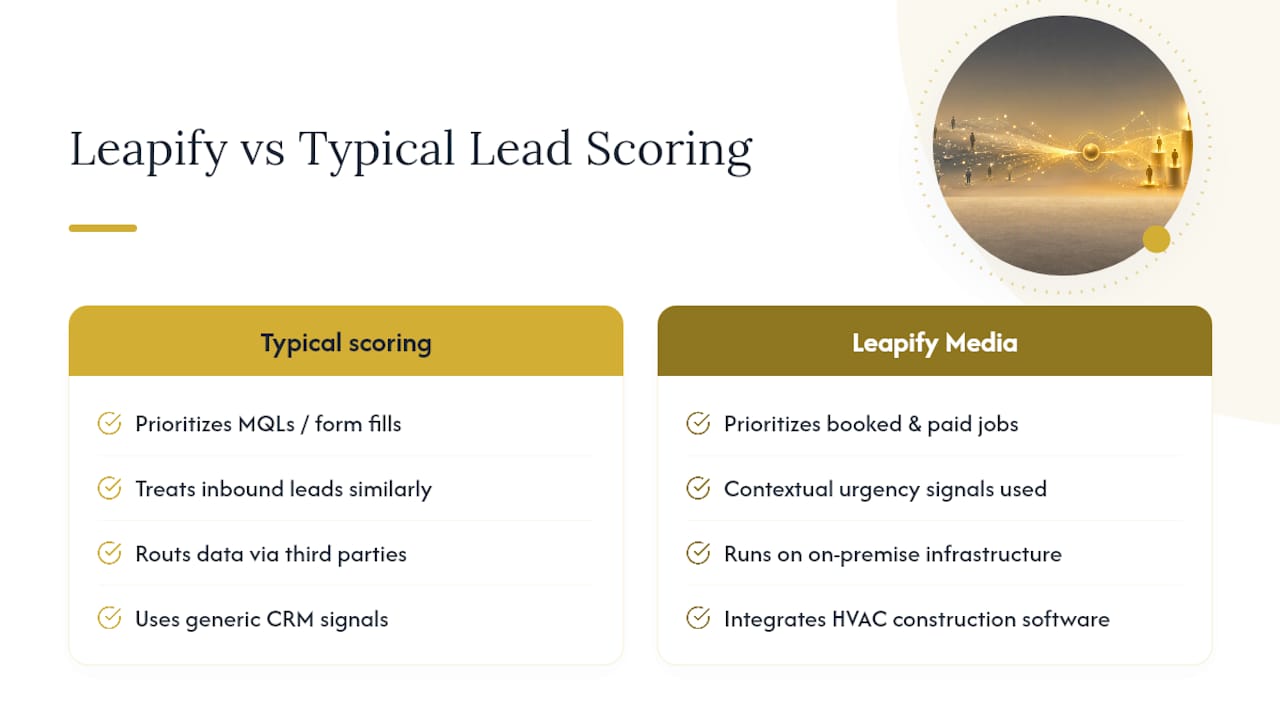
Leapify Media builds AI lead scoring around a single outcome that matters to home service operators: a booked and paid job, not a form fill or a marketing-qualified lead. That distinction changes which signals matter. A quote request at 9 p.m. for an emergency repair maps to a different urgency signal than a daytime inquiry about a kitchen remodel, and the scoring logic reflects that difference rather than treating all inbound leads the same.
Because Leapify Media runs its models on in-house engineered infrastructure and on-premise servers rather than routing client data through third-party AI vendors, a contractor's lead and customer history stays proprietary rather than becoming training data for someone else's product, leveraging specialized construction software for HVAC contractors to integrate seamlessly with home-service-specific scoring workflows. That control matters for a business whose entire competitive edge is often its customer list and service history.
Leapify Media reports partnerships with home service providers that have seen return on ad spend reach 20x after scoring and dispatch logic were tied directly to which leads actually became paid jobs, not just which ones looked good on a dashboard.
What Should You Do Next?
Start small and prove the concept before you scale it. Pull your closed-won and closed-lost counts this week, and if you're under 100, build a better rule-based system before you even think about AI. Baseline your current lead-to-opportunity rate and time-to-contact now, because you'll need that number later to prove anything worked. Then pick exactly one activation play, like faster routing for after-hours emergency leads, and run it before layering on five more.
Small teams can often get real value from a rules-based or hybrid setup on their own. Once you're managing multiple lead sources, tracking conversions across a real CRM, and need production-grade infrastructure, that's usually the point where working with a specialized provider outpaces building it in-house.
— Everson Gorski
How Leapify Media Helps You Put This Into Practice
Leapify Media exists because most home service businesses don't have a data science team, and they shouldn't need one to get the benefit of AI lead scoring.
The core offering is growth infrastructure built specifically for home service operators: Google Ads and Meta Ads management, on-premise AI lead dispatch and intent scoring, and CRM automation that connects scores directly to routing and follow-up. Because the scoring models run on in-house infrastructure instead of a third-party vendor's servers, your lead and customer history never becomes someone else's training data. That matters when your competitive edge is the list of homeowners who already trust you.
If you're an HVAC, plumbing, roofing, or restoration business doing at least $500,000 in annual revenue and losing leads to slow follow-up or flat scoring, the fastest way to see where the gaps are is a growth infrastructure audit. Request one, and you'll get a clear picture of where your current lead flow is leaking before committing to anything larger.
Sources
- Predictive Lead Scoring + AI is a Game Changer - Salesforce
- Build contact lead scores with AI — HubSpot Knowledge
- AI Lead Scoring for B2B Mid-Market: 2026 Guide — GrowWithBA