
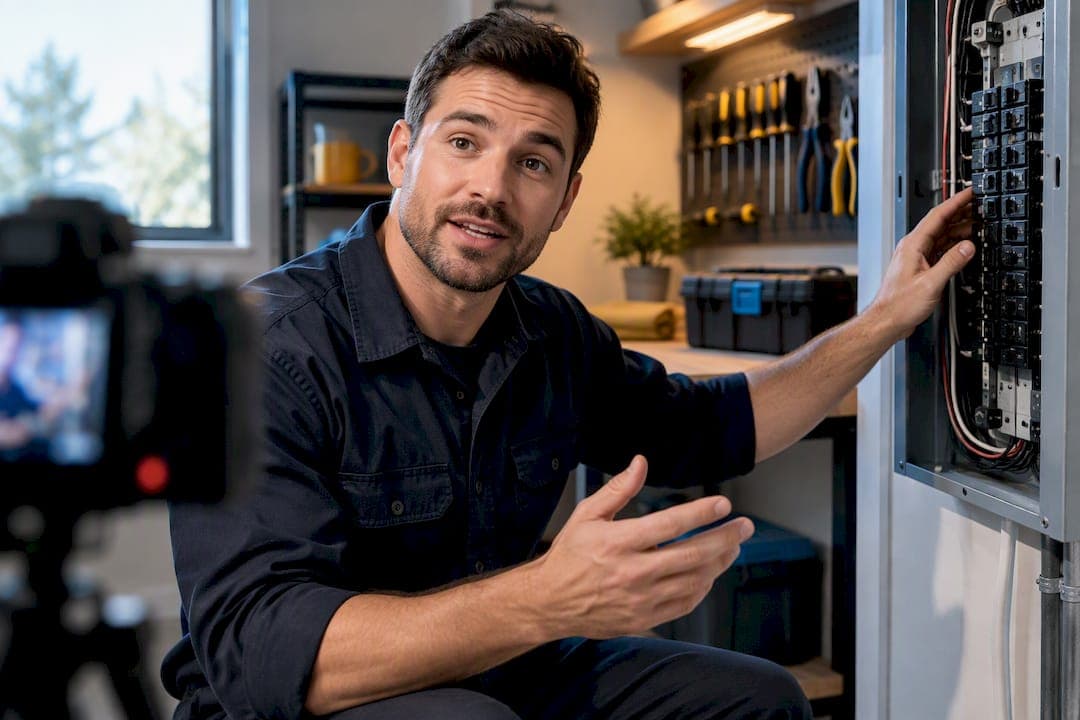
Electricians should use YouTube ads to build trust for planned, research-heavy work like panel upgrades and EV charger installs, not to chase emergency calls. The single choice that determines whether the campaign makes money is your setup: run a Leads/Conversions objective with call tracking wired into your CRM, upload a real mix of horizontal, square, and vertical creative, and optimize toward qualified calls and booked jobs, never toward views or watch time.
TL;DR:
- YouTube ads for electricians work best for planned projects like panel upgrades and EV charger installs, not urgent repairs or emergencies.
- Campaign setup should focus on leads and conversions with call tracking, optimized for qualified calls rather than views or watch time.
- Use diverse formats like skippable in-stream videos, Shorts, bumper ads, and in-feed ads, with the first five seconds focusing on the homeowner's problem.
- Target local audiences precisely within your service area, layer in scheduling controls, and limit ad frequency to avoid burnout in small neighborhoods.
- Measure success by cost per qualified call and booked job, not by views, and combine YouTube with search and local profiles for maximum lead conversion.
Table of Contents
- Which Electrician Jobs Actually Move on YouTube
- Which Ad Formats Actually Pay Off for Electricians
- Targeting Without Wasting Your Budget
- How to Measure What Actually Matters: Qualified Calls, Not Views
- Creative That Builds Trust Instead of Suspicion
- Pair YouTube With Search and Local Presence
- Leapify Media's Practical Playbook for Electrician Video Campaigns
- Is YouTube Worth It for Electricians?
- What the Trades Get Wrong About Video
- Get Your YouTube Campaign Running Without the Guesswork
- Sources
- FAQ
Which Electrician Jobs Actually Move on YouTube
Planned electrical work gets researched before it gets booked. A homeowner deciding between a 200 amp panel upgrade and a smaller fix will watch two or three videos before calling anyone. Urgent work skips that step altogether. Nobody scrolls YouTube during a power outage. That single distinction should dictate almost everything about your ad strategy.
Jobs that convert well from video:
- EV charger installation and home charging setup
- Panel upgrades and service replacements
- Whole-home rewiring and older-home safety inspections
- Generator installation and backup power systems
- Smart home and lighting retrofits
For these, a free assessment or estimate offer works because the buyer still has time to compare. For anything urgent (sparking outlets, tripped breakers, no power), skip the video funnel and route straight to click-to-call. YouTube ads electricians run for panel upgrades should never share a call-to-action script with an emergency campaign. The intent is different, and the offer needs to match it.
Which Ad Formats Actually Pay Off for Electricians
Format choice depends on what you're trying to get someone to do, not which one looks the most polished.
- Skippable in-stream works for storytelling: a homeowner's real problem, the diagnosis, the fix. Give this format 15 to 30 seconds and use it when you have an actual before-and-after story.
- Shorts carry quick social proof. A 15-second clip of a completed panel swap with a review overlay outperforms a long explainer here.
- Bumper ads exist for frequency, not persuasion. Six-second reminders of your name and service area keep you top of mind between someone's first search and their eventual call.
- In-feed ads function more like a thumbnail pitch. They reward curiosity, so a specific, benefit-driven headline (rather than a general "electrical services" label) gets more clicks.
The first five seconds carry the entire ad, regardless of format. Open on the problem, not your logo. Put the phone number or CTA on screen early and repeat it near the end. Google's own testing found that advertisers using a mixed set of video and image assets in Demand Gen campaigns saw about 20% more conversions at the same cost than video-only setups, largely because the system can surface whichever asset performs in whichever surface (YouTube, Discover, Gmail) a given viewer is on.
Targeting Without Wasting Your Budget
Electricians work a service radius, not a national market, so targeting has to be tighter than most default settings allow — leveraging tools like ZIP-code based service-area discovery can help match your ads to the right local customers.
- Set a geographic radius matched to your actual dispatch area, not your metro's full boundary.
- Layer in schedule controls: for planned work, daytime and early evening hours usually convert better than late night.
- Seed your audience with first-party data (past leads, site visitors, CRM contacts) and let Google build similar audiences from that seed rather than guessing at interest categories.
- Keep a separate remarketing pool for people who visited your site or requested a quote but didn't book.
- Cap frequency so the same household isn't seeing your bumper ad fifteen times in a week.
Small local audiences need stricter frequency discipline than national brands, since the same handful of households will see your ads repeatedly within days if you don't cap exposure.
Pro Tip: Rotate three to four creative variations on a fixed schedule, even if none of them is "underperforming" yet. A local audience burns out on a single ad faster than the algorithm will tell you.
How to Measure What Actually Matters: Qualified Calls, Not Views
Video views are the easiest metric to report and the least useful one for deciding whether a campaign works. What matters is whether the call was real, and whether it turned into a booked job.
- Turn on call reporting and set up a call conversion action, either through Google's AI-based call analysis or a minimum duration threshold around 90 seconds if you're not recording calls.
- Import your CRM outcomes (contacted, quoted, booked, completed) so Google can see which leads actually turned into revenue, not just which ones filled out a form.
- Budget in CPM or CPV depending on the format; Demand Gen mixes billing models across YouTube, Discover, Gmail, and Display surfaces, so your effective cost per lead will vary by where the ad shows.
Judge success on cost per qualified call and cost per booked job, full stop. A campaign with a low cost-per-view and zero booked jobs is not working, no matter what the dashboard implies.
Creative That Builds Trust Instead of Suspicion
Trade services live or die on trust, and video either builds it or torches it in the first ten seconds.
- Real customer testimonials work, but they need both a spoken and an on-screen disclosure if the customer received anything of value for appearing, per FTC endorsement guidance.
- Frame demonstrations as safety education, not how-to instruction. Show your electrician diagnosing a hazard and explaining why it matters, never a step-by-step walkthrough that invites a viewer to try it themselves.
- Structure: show the problem, show a qualified professional identifying or fixing it, then direct the viewer to call or book an estimate.
A pest control company selling a fairly unglamorous service ran platform-native creative on YouTube and saw a real lift in brand awareness and branded search, according to a Think with Google case study on Orkin. The lesson for electricians: tailoring creative to how people actually watch YouTube, rather than repurposing a TV spot, moves the numbers that matter.
Pro Tip: Let your electrician say the company name out loud on camera before the CTA. It reads as more credible than a voiceover and satisfies disclosure requirements at the same time.
Pair YouTube With Search and Local Presence
YouTube rarely closes a job by itself. It warms someone up, and Search or a Google Business Profile visit finishes the job.
- Run YouTube alongside Search and Performance Max campaigns, and keep your Business Profile active, since demand generated on YouTube often converts on a different channel days later.
- Feed offline and CRM conversion data back into Google Ads. This is how the AI learns which calls were real leads and which ad placements produced them.
- Confirm your landing page has one clear CTA, your call routing is staffed during ad hours, and booking availability is visible before you spend a dollar on media.
Electricians already running Google Ads by service line have an easier time layering YouTube on top, since the tracking and campaign structure are already in place.
Leapify Media's Practical Playbook for Electrician Video Campaigns
Electrician video campaigns should follow a fixed sequence: set the objective to Leads/Conversions, wire up call tracking and CRM import, upload a full mixed creative set (horizontal, square, and vertical, video and image), geo-restrict to the actual service area, then optimize to qualified-call cost, not clicks. Using in-house, on-premise AI systems rather than third-party tools can help keep client lead data proprietary.
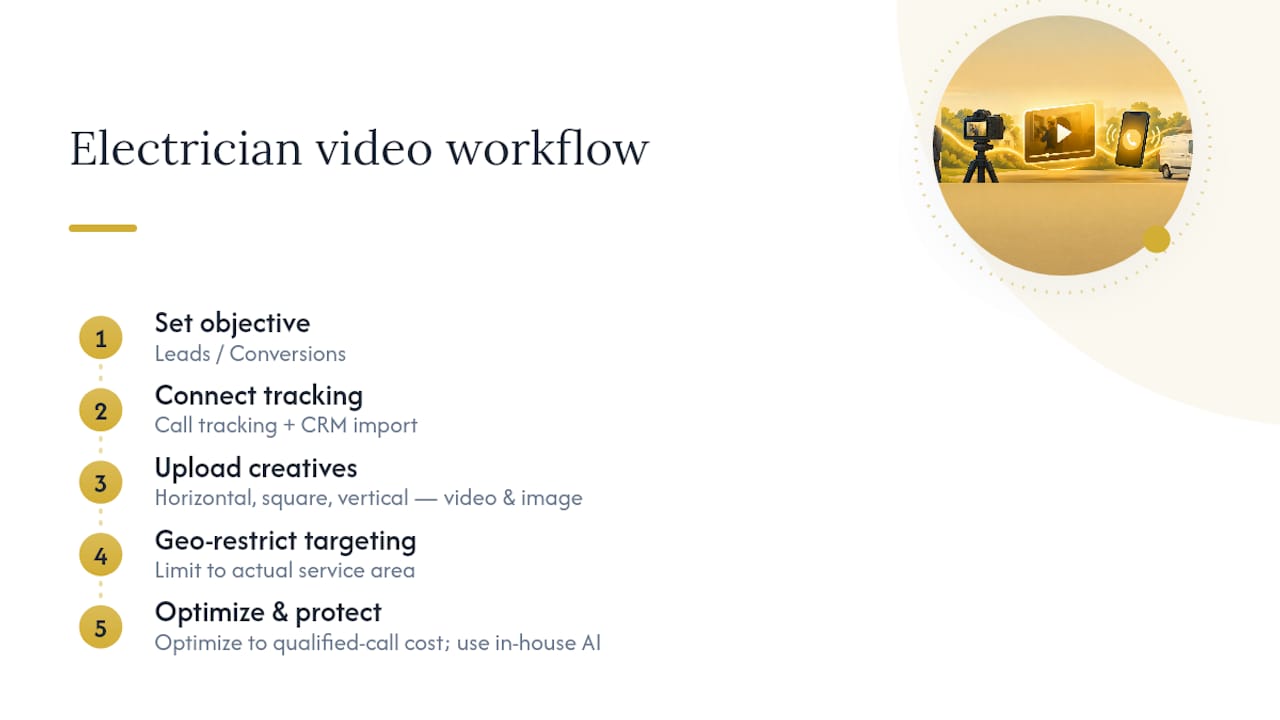
Before a discovery call, have ready: your service area, current booking flow, historical conversion data, and whatever video assets already exist. An HVAC client's $6-a-day YouTube playbook shows how modest budgets can still generate qualified volume when the tracking is built correctly first.
Is YouTube Worth It for Electricians?
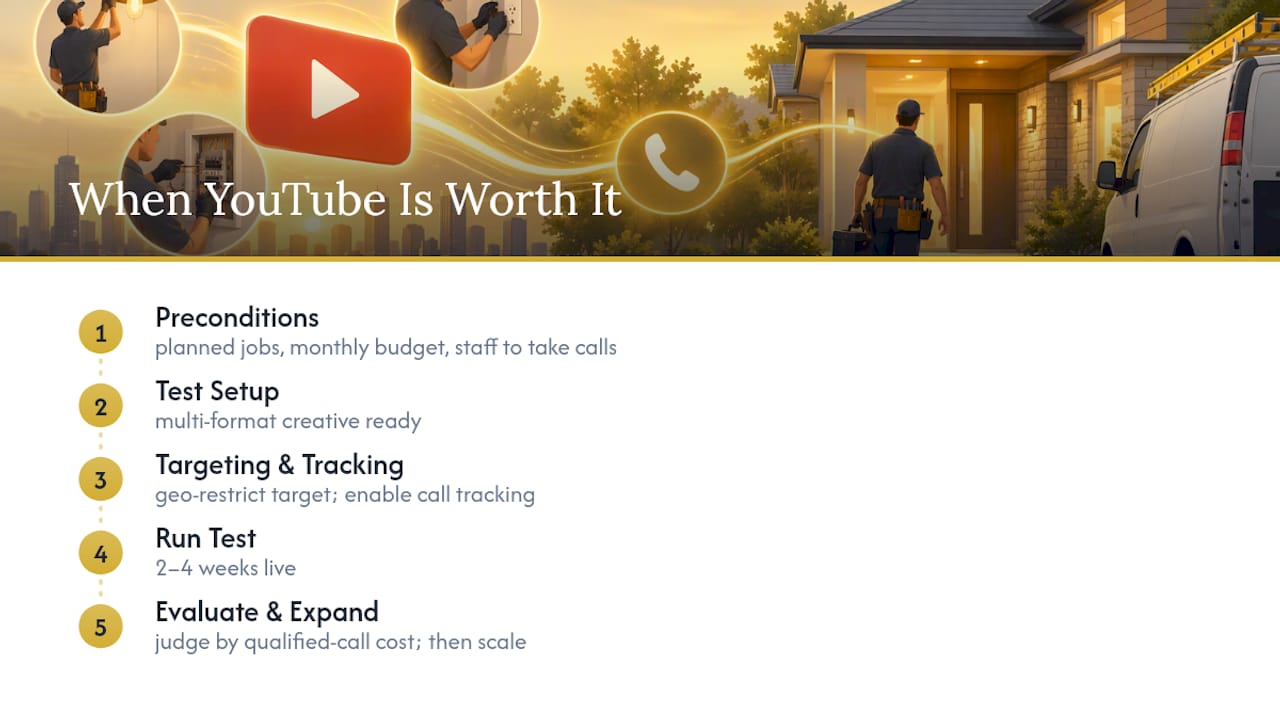
Yes, if you do planned work, can commit a real monthly budget, and have staff ready to answer and book calls. Run a minimum test: multi-format creative, geo-restricted targeting, call tracking live, two to four weeks, judged on qualified-call cost, not impressions. If that clears your cost-per-job math, expand it.
What the Trades Get Wrong About Video
Most trade businesses treat video as either pure brand fluff or a hard sales pitch, and both extremes underperform. The ones that win mix education, real social proof, and a direct ask. Build a small library once, and every future campaign gets cheaper to produce.
— Everson Gorski
Get Your YouTube Campaign Running Without the Guesswork
An alternative to hiring a traditional agency for electrician video campaigns is available, offering in-house AI infrastructure built specifically for home service lead flow, and designed to keep data proprietary rather than routed through third-party tools. This approach can address common issues with call tracking and CRM reconciliation, which frequently cause inefficiencies in electrician campaigns.
Leapify handles the pieces this article just walked through: Google Ads management for $1,500 a month, on-premise AI dispatch to route and score calls the moment they come in, CRM integration starting from $3,000 one-time, and full video production days for building out that multi-format creative set. Before you book a call, have your service area, current booking flow, and any past conversion data on hand. Full plan details, including the Foundation, Growth, Scale, and Enterprise tiers, live on the pricing page, and the full service breakdown is on the services page.
Sources
- Video Action Campaigns are being upgraded to Demand Gen - Google Ads Help
- FTC — Endorsement guides and disclosure guidance
- Orkin YouTube content strategy case study — Think with Google
FAQ
How much do 1,000 YouTube ad views cost?
Cost per view on YouTube typically runs a few cents per view depending on your targeting, competition, and format, and billing varies by placement across YouTube, Discover, Gmail, and Display. For electricians, the more useful number isn't cost per view at all. It's cost per qualified call, which is what you should actually be tracking.
Why am I suddenly seeing lots of YouTube ads?
YouTube's ad delivery adjusts based on your recent watching behavior, search history, and advertiser targeting settings, so a burst of similar ads usually means several advertisers are targeting an audience segment you fit. For electricians running their own campaigns, this same mechanism is why frequency capping matters: without it, you can flood the same households repeatedly in a short window.
How do I advertise for an electrician's business on YouTube?
Start with a Leads/Conversions campaign objective, set up call tracking and CRM import first, then build a mixed creative set across horizontal, square, and vertical formats before you geo-restrict to your service area. Leapify Media's Google Ads management service handles this setup directly if you'd rather not build the tracking stack yourself.
Who are some well-known electrician YouTubers?
Several independent electricians and trade educators have built large YouTube followings around code explanations, troubleshooting walkthroughs, and product reviews aimed at other tradespeople or DIYers. That audience skews toward other electricians and hobbyists rather than homeowners hiring for a job, which is a different audience than the one your paid ads should target.
What's the difference between YouTube ads and Search ads for electricians?
Search ads catch people who already decided to look for an electrician and are typing intent directly into Google. YouTube ads reach people earlier, while they're still researching or haven't started looking yet, which is why it works best for planned projects rather than emergencies. Running both together, alongside an active Google Business Profile, tends to outperform either channel alone.