
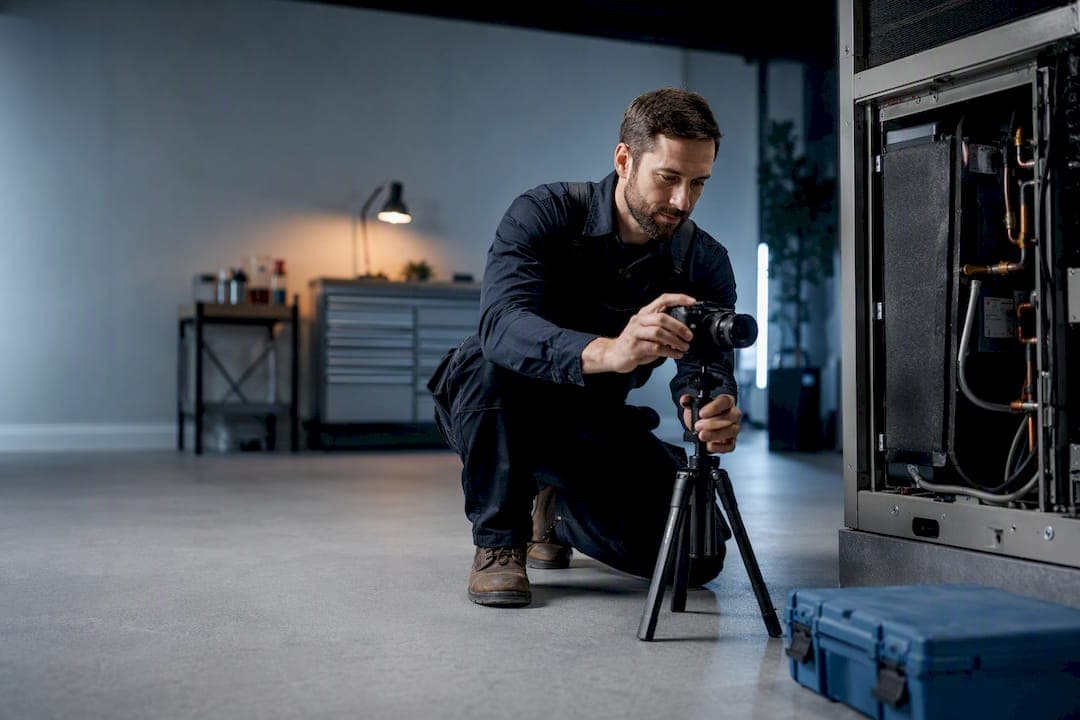
YouTube works for HVAC when you treat it as a mid-funnel and retargeting channel, not a first-responder for broken furnaces. The winning starter stack is simple: TrueView prospecting to reach homeowners planning replacements, 6-second bumpers layered on top for frequency, retargeting lists to bring warm viewers back, and conversion tracking wired before you spend a dollar. Run it correctly and expect a cost per lead in a moderate range within the first few weeks, not the first few days.
TL;DR:
- Use custom-intent audiences based on specific HVAC search terms, URLs, and comparison pages to target only prospects showing strong buying signals.
- Connect your CRM, call tracking, and offline conversion data before launching campaigns to accurately attribute booked jobs to YouTube views.
- Prioritize prospecting ads like TrueView with layered retargeting and frequency boosters, and test audiences at low budgets before scaling.
- Keep creative fast-paced with a strong hook in the first five seconds, and include a visible phone number and clear call-to-action in every ad.
- Expect cost per lead between $80 and $140, with stability needed in cost-per-view and view-through rate over two to three weeks before increasing spend.
Table of Contents
- Where Does YouTube Ads for HVAC Fit in Your Marketing Mix?
- How Do You Build Custom-Intent Audiences That Don't Waste Your Budget?
- What Creative and Format Rules Actually Convert Contractor Ads?
- What Should You Budget, and What Results Should You Expect?
- Campaign Setup Checklist: What to Wire Before You Spend
- How Do You Turn Views Into Booked Jobs?
- Two Playbooks: A $6-a-Day Micro-Test and a Mid-Market CTV Stack
- What HVAC Advertisers Get Wrong on YouTube
- How Leapify Media Runs YouTube Campaigns That Book Jobs, Not Just Views
- Sources
- FAQ
Where Does YouTube Ads for HVAC Fit in Your Marketing Mix?
Search and Local Service Ads catch the homeowner whose AC just died and who wants a truck there today. YouTube catches the homeowner three months out, researching whether to repair or replace, or comparing financing options. That intent gap means YouTube should generally follow Search and LSA, not replace them, and works best for replacement planning, financing promos, and membership pushes once your search channels are already booked solid.
Three signals tell you it's time to test YouTube: your LSA and Search campaigns are stable and profitable, your service ZIPs are clearly defined, and your CRM can import offline conversions so you can trace a view back to a booked job. Skip YouTube if any of those three are missing. It's a poor tool for emergency demand and a strong one for retargeting people who already visited your site or watched a previous ad without calling.
How Do You Build Custom-Intent Audiences That Don't Waste Your Budget?
Most HVAC advertisers lose money on YouTube because they target broad "home improvement" or "homeowner" audiences that include millions of people who will never call. The fix is a custom-intent audience built from actual buying signals, then forced into AND logic so YouTube only shows your ad when multiple conditions line up at once.
Start by seeding custom intent with:
- Service search terms your prospects use, like "AC replacement cost" or "furnace not heating"
- URLs of supply-house sites and HVAC software platforms your target customers or competitors visit
- Financing and warranty comparison pages relevant to your service area
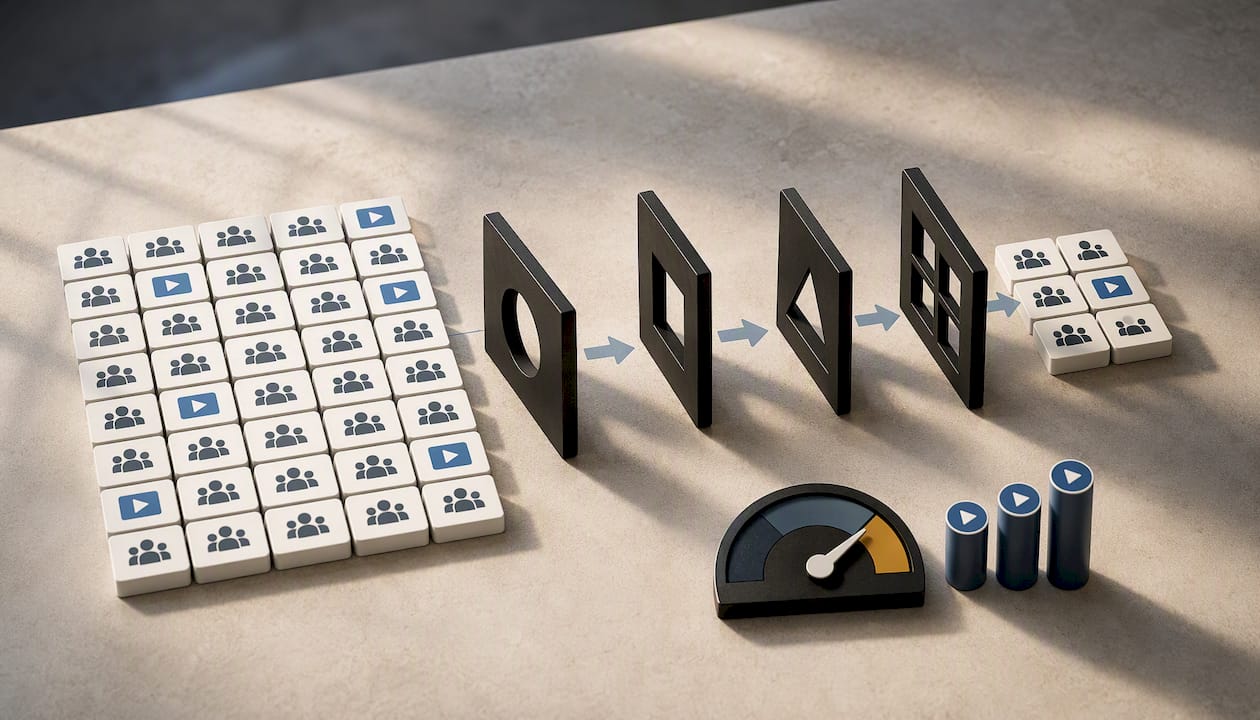
Then force AND logic by adding content keywords in the same ad group as your custom-intent audience, layered with age, income, and homeownership constraints. One documented test used exactly this method to shrink a starting pool of 3.3 billion weekly impressions down to about 25 million relevant impressions, which is the difference between paying for eyeballs and paying for prospects.
Pro Tip: Launch new audience combinations at $6 to $10 a day for the first week. Watch cost per view and view-through rate before committing real budget. If CPV creeps above $0.03 or view-through rate stays flat, the audience is too broad, not the creative.
What Creative and Format Rules Actually Convert Contractor Ads?
Skippable in-stream ads get an average of 9.4 seconds of attention before a viewer taps skip, according to contractor ad benchmarks, so your creative has almost no room for a slow build.
Five rules separate ads that convert from ads that get skipped:
- Land the hook in the first 5 seconds. Show the problem (a dead AC, a spiking bill) immediately.
- Carry one message per ad. Do not cram financing, maintenance plans, and emergency service into one 30-second spot.
- Keep the phone number on screen the entire time, not just at the end.
- Use real techs and real trucks. Stock footage reads as generic and viewers scroll past it mentally.
- Close the last 3 seconds with a direct call to action tied to the phone number or a click-to-call button.
Match format to objective:
- 6-second bumpers for pure frequency and brand recall on warm audiences
- TrueView in-stream (skippable) for prospecting new custom-intent audiences
- Non-skippable short-form for high-priority financing or seasonal tune-up promos
- CTV for ZIP-level living room reach in markets where local broadcast used to dominate
- Shorts for repurposing your best-performing 15-second cuts at near-zero extra cost
Write your thumbnail and title copy around the offer, not the brand, and A/B test at least two hook variations before scaling spend behind either one. Reference points on scripting live in this HVAC brand video guide.
What Should You Budget, and What Results Should You Expect?
YouTube CPMs across formats averaged around $11.42 in Q1 2026 contractor benchmarks, with 6-second bumpers running cheaper at roughly $9.20 CPM and TrueView in-stream landing between $0.015 and $0.025 per view. HVAC cost per lead typically settles between $80 and $140 once targeting and creative are dialed in.
| Monthly budget | Likely mix | What to expect |
|---|---|---|
| — | Bumpers only, single ZIP cluster | Frequency building, limited direct leads |
| — | TrueView + bumpers, one custom-intent audience | First qualified leads, CPL testing phase |
| — | TrueView + bumpers + retargeting, two audiences | Stable CPL, early retargeting scale signal |
Video and social platforms now reach billions of people globally, which is exactly why undisciplined targeting burns budget fast. Social network usage keeps expanding, but scale only helps you if your audience compression does its job first.
Kill a test if CPV climbs past $0.03 with no lead movement after two weeks. Keep it if view-through rate holds and even a trickle of retargeting clicks starts converting.
Campaign Setup Checklist: What to Wire Before You Spend
Skipping setup steps is the fastest way to burn a YouTube budget with nothing to show for it. Work through this order:
- Link your Google Ads account to your YouTube channel and Google Analytics property.
- Build conversion actions for calls, form fills, and booked jobs, then confirm they fire correctly with test conversions.
- Set up call tracking with dynamic number insertion so every call ties back to the specific ad and audience that generated it.
- Import offline conversions weekly so booked jobs, not just calls, feed back into optimization.
- Build your landing page with a click-to-call button above the fold and a financing CTA visible without scrolling.
- Build your custom-intent audiences and retargeting lists before launch, not after.
- Set initial bids at target CPV plus 15% and cap daily pacing so no single audience burns the week's budget in a day.
Pro Tip: Do the offline conversion import before you launch, not after your first invoice. Retrofitting attribution after the fact means weeks of unusable data you can never get back.
How Do You Turn Views Into Booked Jobs?
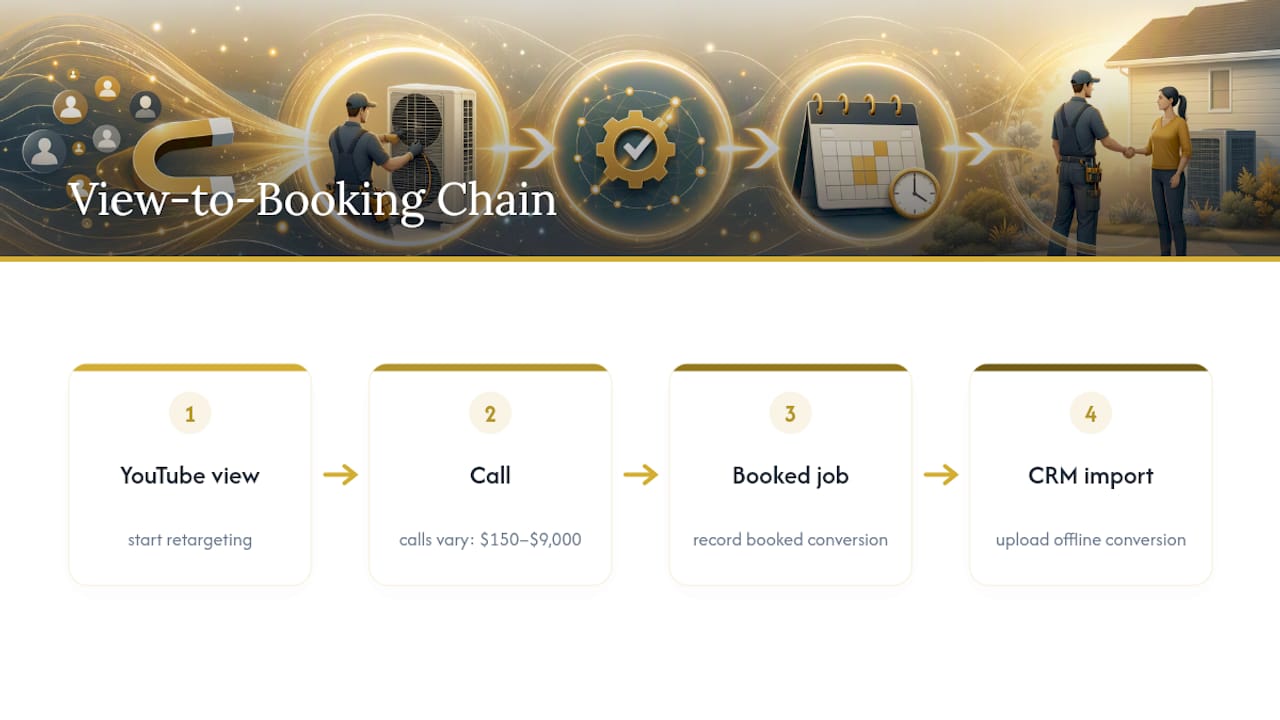
The chain you're optimizing is view, then call, then booked job, and the only way to see the full chain is importing CRM data back into Google Ads as offline conversions. Optimize toward booked-job value once you have enough volume, not just call count, because a $150 tune-up call and a $9,000 system replacement call look identical in raw call data.
Retargeting windows of 14 to 30 days generally outperform longer windows for HVAC, since replacement decisions move faster once a homeowner starts actively comparing quotes. Add bumpers or CTV once your TrueView retargeting CPL is stable, since that's the signal your creative and audience are working, not just novel.
Scale only when two things are both true: CPV has held steady for two to three weeks, and retargeting CPL is trending down, not just holding flat.
Two Playbooks: A $6-a-Day Micro-Test and a Mid-Market CTV Stack
The micro-test recipe: seed a custom-intent audience with supply-house URLs and financing-comparison content, layer in service-related content keywords to force AND logic, and run $6 to $10 a day. One documented case using this exact structure generated 53 qualified prospects for $6.68 in spend, built from one-hour shoots cut into several short variations.
The mid-market stack fits budgets between $2,000 and $4,000 a month:
- Roughly 40% to CTV at $14 to $18 CPM for ZIP-level living room reach
- Roughly 40% to TrueView prospecting on custom-intent audiences
- Roughly 20% to bumpers for frequency against your warmest retargeting list
Push for a frequency of 3 to 5 impressions per week per household, and expect the first booked job attributable to the stack within 3 to 5 weeks once call tracking and offline import are both live.
What HVAC Advertisers Get Wrong on YouTube
Broad "homeowner" audiences and missing offline conversion tracking are why most HVAC YouTube tests fail quietly, spending steadily while nobody can say which view led to a booked job. Custom-intent targeting, call tracking, and CRM import should be built as one connected system from day one. If you're planning a test, start with the tracking, not the creative.
— Everson Gorski
How Leapify Media Runs YouTube Campaigns That Book Jobs, Not Just Views
An alternative to piecing together a YouTube test yourself or hoping an agency's generic playbook fits HVAC is to use infrastructure built specifically for home service businesses, where custom-intent audiences, call tracking, and offline conversion import run on a tailored system rather than a template lifted from a retail account.
For HVAC businesses with working Search and LSA campaigns ready to add a retargeting and replacement-planning layer, a full stack can be built, including managed YouTube campaigns, AI lead dispatch that scores intent before a call reaches the team, and call tracking integrated into the CRM so every booked job traces back to the ad that started it. A $6-a-day in-house test is worth running to learn the mechanics. A managed partner is worth it once you're ready to scale past that test without guessing which audience or creative actually drove the bookings.
Ready to see what a measurement-ready YouTube campaign looks like for your service area? Request a quick audit from Leapify Media and get a straight answer on what your budget should look like.
Sources
- How We Micro-Targeted HVAC Business Owners on YouTube for $6 a Day
- Number of worldwide social network users
FAQ
Is HVAC Advertising Becoming Oversaturated on YouTube?
Not yet in most markets. Because custom-intent targeting compresses YouTube's inventory down to a narrow, relevant audience, competition among HVAC advertisers in any single ZIP cluster still stays manageable compared to Search, where bidding wars are far more direct.
What Is the Best Way to Advertise an HVAC Business?
The strongest mix pairs Search and Local Service Ads for emergency and near-term demand with YouTube for replacement planning and retargeting once those search channels are stable. Skipping straight to YouTube without working search foundations wastes budget on views that never convert.
Who Is the Best HVAC YouTuber to Learn From?
There's no single dominant HVAC YouTuber that functions as an advertising benchmark. Advertisers get more value studying documented case playbooks, like the micro-targeting tests referenced above, than following any one creator's channel.
What Is Happening With YouTube Ads Lately?
Costs have shifted by format: 6-second bumpers now run cheaper than standard in-stream CPMs, while CTV inventory has opened up ZIP-level targeting that used to require local broadcast buys. That shift makes YouTube more accessible for HVAC budgets in the $2,000 to $4,000 monthly range than it was a few years ago.
Do I Need Call Tracking Before Running YouTube Ads for HVAC?
Yes. Without call tracking and offline conversion import tied to your CRM, you can count views and clicks but never confirm which ad actually produced a booked job.