

Most full-service HVAC businesses should set their primary category to HVAC Contractor, not the generic "Contractor" listing many owners default to. Specialty operators (an AC-only shop, a heating-only crew) do better naming that specialty as the primary category instead. From there, the rule for secondaries is simple: add only categories describing work you actually perform and staff. Get verification, service area, and business type settings right, and category choice becomes one of the highest-leverage, lowest-cost changes you can make to your map-pack visibility.
TL;DR:
- Choosing "HVAC Contractor" as the primary category significantly boosts local search rankings if your business installs or repairs both heating and cooling systems year-round.
- Only add secondary categories that match services you actively invoice for and staff, with three to five targeted options generally outperforming nine loosely related ones.
- Ensuring your website, service list, and Google Business Profile categories are aligned improves relevance signals and ranking stability over time.
- Avoid category violations such as name stuffing, claiming unserviced trades, or using fake addresses, which can lead to suspension or ranking drops.
- Testing seasonal category swaps may cause temporary ranking fluctuations, but maintaining a stable primary category with active seasonal content usually offers safer, sustained visibility.
Table of Contents
- How Do I Choose the Right Primary Category for HVAC?
- How Should You Stack Secondary Categories for an HVAC Business?
- Do Your Services List and Website Need to Match Your Categories?
- Should You Change Your Primary Category by Season?
- What GBP Mistakes Put Your HVAC Listing at Risk?
- How Do You Update and Verify HVAC Categories in Google Business Profile?
- What Should You Track After Changing Your Categories?
- When Should HVAC Owners DIY Versus Hire a GBP Specialist?
- What One Move Should You Make First, and How Should You Test It?
- How Leapify Media Handles GBP Category Audits and Local Visibility
- Sources
- FAQ
How Do I Choose the Right Primary Category for HVAC?
Pick the primary category that matches the highest-volume, highest-value work your business books, not the broadest label that technically fits. Google only lets you set one primary category, and it carries more ranking weight than every secondary combined. Getting it wrong is the single most common reason otherwise solid HVAC listings underperform in the map pack.
Run this test before you touch the dashboard: list your last 100 service calls and see which job type shows up most and pays best. That answer, not your business name or your own sense of identity, should drive the category.
When "HVAC Contractor" is correct: if you install, repair, and maintain both heating and cooling systems for residential or light commercial customers, this is your category. It's the broadest accurate label and it signals to Google that you're a full-service shop capable of handling furnace, heat pump, air conditioner, and ductwork jobs alike. A Whitespark analysis of 1.8 million Google Business Profiles found that profiles using specific trade categories like "HVAC contractor" consistently outranked those left under a generic "Contractor" label, which tells Google almost nothing about the actual service.
When a specialty category wins instead:
- Air Conditioning Contractor fits a business that installs and services cooling systems exclusively, with no furnace or boiler work on the books.
- Heating Contractor is the better call if your revenue comes almost entirely from furnaces, boilers, or radiant heat, and you don't touch air conditioning.
- Duct Cleaning Service suits a company built around indoor air quality and duct work rather than full equipment installs, even if you occasionally handle a repair.
- A commercial-only mechanical contractor may find Air Conditioning Contractor or Heating Contractor more accurate than "HVAC Contractor" if residential jobs make up a small fraction of the book, since Google weighs category against actual service history and reviews.
Licensing matters too. If your state license restricts you to a specific trade class, your GBP category should never claim broader scope than your license allows. Beyond the legal exposure, a mismatch between claimed category and actual capability tends to produce thin service pages and generic reviews, both of which Google's ranking systems can detect indirectly through weak relevance signals.
A real-world split: a Denver company running two crews, one for install and one for service, on both furnaces and AC units, correctly sits under HVAC Contractor. A three-truck outfit in Phoenix that only touches cooling systems, because heating demand barely exists there, is better served picking Air Conditioning Contractor as primary and adding heating-adjacent secondaries only if they genuinely do a handful of heat pump jobs each year.
How Should You Stack Secondary Categories for an HVAC Business?
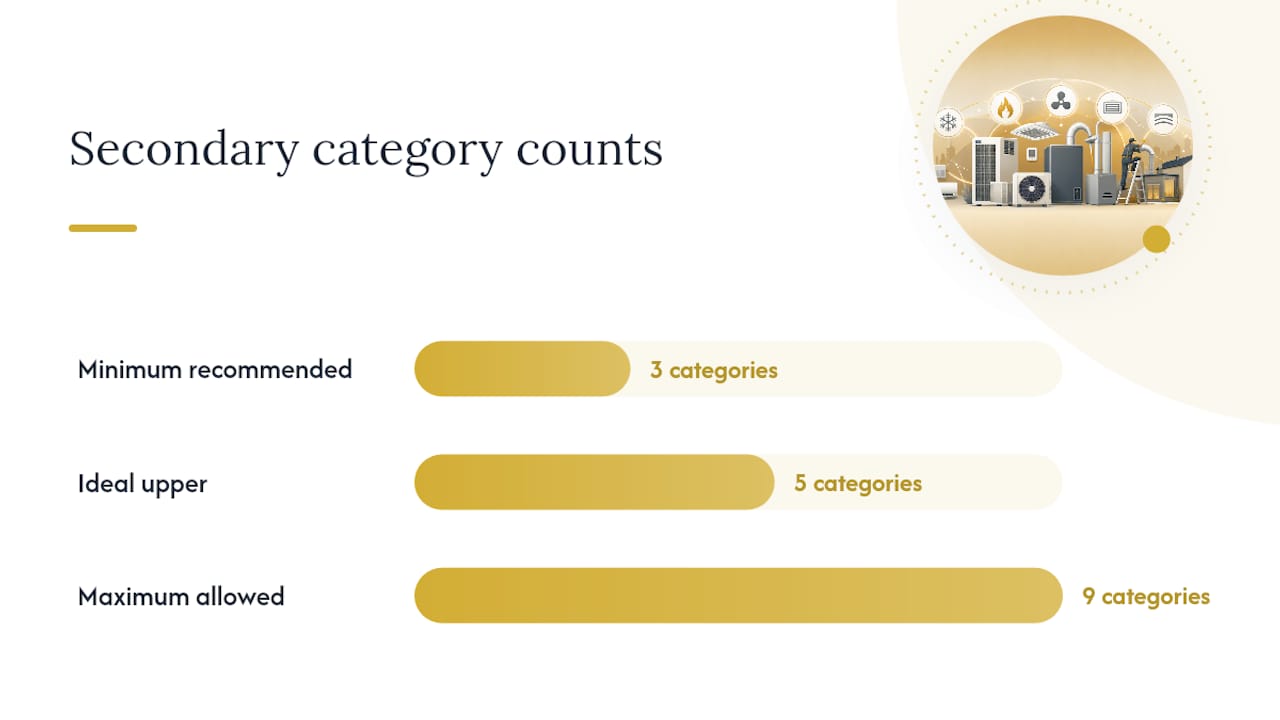
Add secondary categories only for services you actually staff and invoice, and stop once you've described your real capability, not your aspirational one. Google allows up to nine secondary categories on a Business Profile, but using all nine rarely helps and often hurts if half of them don't match what your technicians actually do.
The most consistently useful secondary categories for HVAC operators include:
- Air Conditioning Repair Service for shops that handle cooling breakdowns as a distinct revenue line.
- Furnace Repair Service when furnace service calls are common enough to warrant their own visibility.
- Heat Pump Installation Service for companies pushing into the electrification and heat pump conversion market.
- Air Duct Cleaning Service if indoor air quality work is a real, bookable service, not a rare add-on.
A category-to-query mapping used in HVAC-specific GBP guides shows each of these secondaries unlocks a distinct cluster of search queries. "Furnace Repair Service" surfaces for searches like "furnace won't turn on near me," while "Air Duct Cleaning Service" catches queries an HVAC Contractor label alone would never trigger.
As a rule of thumb, three to five well-chosen secondaries beat nine loosely related ones. Every category you add should correspond to a real line item on your invoices from the last twelve months.
Sample stacks that hold up:
- Full-service shop: HVAC Contractor (primary), Air Conditioning Repair Service, Furnace Repair Service, Heating Contractor.
- AC-focused business: Air Conditioning Contractor (primary), Air Conditioning Repair Service, Air Conditioning Installation Service.
- Heat pump specialist: Heating Contractor (primary), Heat Pump Installation Service, Air Conditioning Contractor.
Adding categories like "Appliance Repair Service" or "Construction Company" because they seem loosely adjacent dilutes your relevance signal rather than expanding it. Whitespark's data on additional-category pairing shows the best-performing secondary combinations are tightly related to the primary, not broad enough to catch unrelated traffic. A generic category grabbing you a handful of irrelevant impressions costs you relevance where it actually counts.
Do Your Services List and Website Need to Match Your Categories?
Yes, and the mismatch between GBP categories and what your website actually says is one of the more overlooked reasons profiles stall in the rankings. Google cross-references your Business Profile against your website, citations, and review content to judge whether your claimed categories reflect reality.
Follow this sequence to tighten alignment:
- Map each GBP category to a services entry. If "Heat Pump Installation Service" is a secondary category, there needs to be a corresponding entry in your GBP services section with pricing or a price range, plus a dedicated page on your site.
- Write service descriptions that reinforce the category language naturally. A two or three sentence description mentioning "heat pump installation" in plain language does more for relevance than a vague blurb about "quality HVAC solutions."
- Add Service schema markup to key service pages. This gives Google structured confirmation of what a page covers, beyond what it can infer from prose alone, and it pairs well with dedicated service area pages built for each city or county you cover.
- Run a consistency check across GBP, website, and citations quarterly. Confirm that the services listed in your profile match the services listed on your homepage navigation and that your NAP (name, address, phone) is identical everywhere it appears.
Pro Tip: Search your own business name plus "reviews" in Google and read what customers actually describe. If half your five-star reviews mention duct cleaning and it isn't a secondary category yet, that's a signal you're leaving relevance on the table.
A practitioner guide on HVAC GBP optimization puts services-list completeness on par with category selection as a top ranking factor, and the two reinforce each other. A category with no matching service entry looks unverified; a service entry with no matching category is invisible to category-based search filters.
Should You Change Your Primary Category by Season?
Some HVAC operators swap their primary category between "Air Conditioning Contractor" in summer and "Heating Contractor" in winter, chasing the seasonal query spike. The logic makes sense on paper: align your strongest category with the season generating the most search volume.
In practice, the upside is real but modest, and the risk is churn. Changing a primary category resets some of the relevance signal Google has built up around your profile, and rankings can dip for days or weeks before settling into a new pattern. One industry guide on seasonal category tactics notes that swapping primary categories carries genuine ranking churn risk, and that many operators get similar seasonal lift more safely through other levers.
Before swapping anything, weigh these guidelines:
- If your business is genuinely full-service year-round, don't swap at all. Keep HVAC Contractor as primary and let seasonal Google Posts, updated service descriptions, and seasonal Google Ads pushes carry the seasonal weight instead.
- If you're a true single-service specialist whose demand genuinely flips (rare, but it happens in extreme climates), a seasonal swap is defensible, but plan it as an annual calendar event, not a reactive move.
- Always track rankings for two weeks before and four weeks after any swap using the same keyword set, so you have a real before/after comparison rather than a gut feeling.
- Have a rollback plan. If rankings for your core terms drop and don't recover within three to four weeks, revert to the prior primary category rather than waiting it out.
For most companies, a stable primary category paired with active seasonal content beats the swap entirely.
What GBP Mistakes Put Your HVAC Listing at Risk?
Category mistakes are the fastest way to trigger a ranking drop or an outright suspension, and most of them are self-inflicted. Google's own policy documentation is explicit about what counts as misuse.
The violations to watch for:
- Name stuffing: adding "HVAC Contractor" or a city name into your business name field when that's not your legal, signed name. Google's category guidance treats this as a policy violation that can get a listing suspended outright.
- Claiming categories you don't service: listing "Commercial HVAC" when you've never done a commercial job invites a suspension if a competitor or customer flags it.
- Fake or virtual addresses: using a UPS box or a residence you don't actually work from as your business address violates Google's location guidelines for service-area businesses.
- Duplicate listings: creating a second profile instead of claiming your existing one splits your reviews and confuses your category signals.
Run a quick audit every quarter: pull up your live listing, compare every category and service entry against your actual invoicing history, and fix anything that's aspirational rather than factual.
If a competitor is misusing categories (claiming commercial HVAC work they don't do, or stuffing keywords into their business name), you can flag the listing through Google's suggest-an-edit tool. If your own profile gets flagged or suspended, the reinstatement process starts with a clean, honest audit and a straightforward appeal citing your actual license and service history.
How Do You Update and Verify HVAC Categories in Google Business Profile?
Before changing anything, confirm you're editing the right listing. Search your business name plus city in Google Maps first; if a profile already exists, claim it rather than creating a duplicate, since duplicates split your review count and confuse category signals across two competing listings.
Here's the walkthrough:
- Sign in at your Google Business Profile dashboard using the Google account tied to your business, not a personal account you rarely check.
- Navigate to "Edit profile," then "Business information," then the "Categories" tab. This is where both your primary category (a single dropdown selection) and up to nine secondary categories live.
- Set your primary category first, save, then add secondaries one at a time so you can confirm each saves correctly.
- Check your business type and service area settings under the same "Business information" tab. Service-area businesses should list every city or county actually served, not a padded list meant to capture more searches.
- Submit for verification if prompted. Google typically verifies via a postcard, phone call, email, or video verification depending on your business type and history.
If verification stalls, the most common culprits are a mismatched address, a phone number that doesn't match public records, or a business name that doesn't match your legal filing. Video verification tends to move faster than postcard mail, which can take one to two weeks to arrive.
The stakes for getting this right are higher than most owners assume. Whitespark's analysis of 1.8 million profiles found category accuracy correlated more strongly with landing in the top 10 local results than almost any other single profile attribute measured, ahead of factors owners tend to obsess over instead, like photo count.
What Should You Track After Changing Your Categories?
Give any category change at least four to eight weeks before drawing conclusions, since Google needs time to re-crawl and re-rank your profile against the new signal. Watch four things in GBP Insights and Search Console:
- Impressions in Maps and Search, broken out by branded versus discovery queries, to see if you're showing up for new, category-relevant terms.
- The specific search queries triggering your listing, which tells you whether the new category is actually pulling in the query clusters you expected.
- Map-pack clicks and direction requests, the clearest downstream signal that visibility is translating into actual interest.
- Calls and message clicks, since a ranking bump that doesn't move calls isn't doing its job.
Document a simple before/after: screenshot your Insights dashboard the day you make a change, then again at the four-week and eight-week marks. Compare the same date ranges year-over-year if you have the history, since HVAC demand swings seasonally regardless of what you touch in GBP.
Pro Tip: Pair every category change with a fresh push for reviews mentioning the new service, since review velocity and content compound with category signals rather than working in isolation.
If eight weeks pass with no movement in impressions or query variety, the category probably wasn't the bottleneck. That's usually the point to bring in outside eyes on your broader local SEO setup rather than keep tweaking categories in isolation.
When Should HVAC Owners DIY Versus Hire a GBP Specialist?
Most owners can handle the basic category swap themselves in fifteen minutes. What gets outsourced is the harder part: a full audit across categories, services, website copy, and schema markup, done together rather than piecemeal. That's where a specialist earns the fee, because category changes only pay off when they're backed by matching service pages and structured data, not left to sit alone in the dashboard.
An agency worth paying should tie category optimization to what happens after the click, not just the ranking. That means connecting map-pack visibility to a CRM that scores incoming leads and routes them to the right technician before the call ends. When vetting a vendor, ask specifically how they measure category changes against booked jobs, not just impressions. Insights that never turn into revenue aren't worth chasing.
What One Move Should You Make First, and How Should You Test It?
The verdict hasn't changed since the top of this article: set HVAC Contractor as your primary category unless your business is genuinely a single specialty, and add secondaries only for work you can show on an invoice. Everything else is sequencing.
Give yourself a 30/60/90 window. In the first 30 days, audit your current categories against your last 100 invoices and fix any mismatch immediately. By day 60, make sure every category has a matching service entry and landing page, with schema in place. By day 90, pull your Insights data and compare it against your baseline screenshot from day one.
Document what changed and what didn't. The owners who get real lift from category work are the ones who treat it as a measured test, not a set-and-forget setting.
— Everson Gorski
How Leapify Media Handles GBP Category Audits and Local Visibility
A specialist runs the category and service alignment audit described above as a standard part of getting an HVAC client's local presence in shape, then ties the results directly into lead handling instead of leaving them as a standalone ranking exercise.
That's the practical gap most HVAC owners hit: a category change can lift impressions, but without a system to catch and qualify the calls that follow, the extra visibility partly goes to waste. Leapify Media's on-premise AI dispatch scores incoming leads and routes them before a competitor picks up the phone, and its CRM integration work connects that scoring directly to your booking pipeline instead of a spreadsheet nobody checks. The SEO & content service covers exactly the services-page and schema alignment this article walks through, priced from $2,000 a month, so category work never sits disconnected from your website again. If you want a straight answer on what a full category and local visibility audit would cost for your business, the Leapify Media pricing page lays out every package, from the Foundation tier up, so you can see where an HVAC-specific engagement fits before you commit to anything.
Sources
- What 1.8 million Google Business Profiles tell us about local SEO success
- Choose a business category - Google Business Profile Help
FAQ
What Category Does HVAC Fall Under?
HVAC businesses fall under the broader "Contractor" and "Home Services" industry umbrella, but within Google Business Profile, the accurate category is a specific one like HVAC Contractor, Air Conditioning Contractor, or Heating Contractor, never the generic "Contractor" label.
What Are the Google Business Categories?
Google Business Profile offers thousands of categories, more than 4,000 by Whitespark's count, covering every industry from retail to trades. Each profile picks one primary category and up to nine secondary categories that describe the business's actual services.
What Are the Four Basic Categories of HVAC Systems?
HVAC systems are generally grouped into heating systems (furnaces, boilers), cooling systems (central air, ductless mini-splits), ventilation systems (ductwork, exhaust fans), and heat pump systems that handle both heating and cooling in one unit. These distinctions matter for GBP category selection because a business focused on just one or two of these groups often ranks better under a specialty primary category than under the broad "HVAC Contractor" label.
What Business Industry Is HVAC Considered?
HVAC is considered part of the construction and building trades industry, specifically within mechanical contracting. On Google Business Profile, it sits under home services and contracting categories rather than retail or professional services classifications.
How Many Secondary Categories Should an HVAC Business Add?
Three to five secondary categories tend to work better than filling all nine available slots, as long as each one matches a service you genuinely staff and invoice for. Adding categories loosely related to HVAC work, rather than tightly related to it, tends to dilute relevance instead of expanding it.