
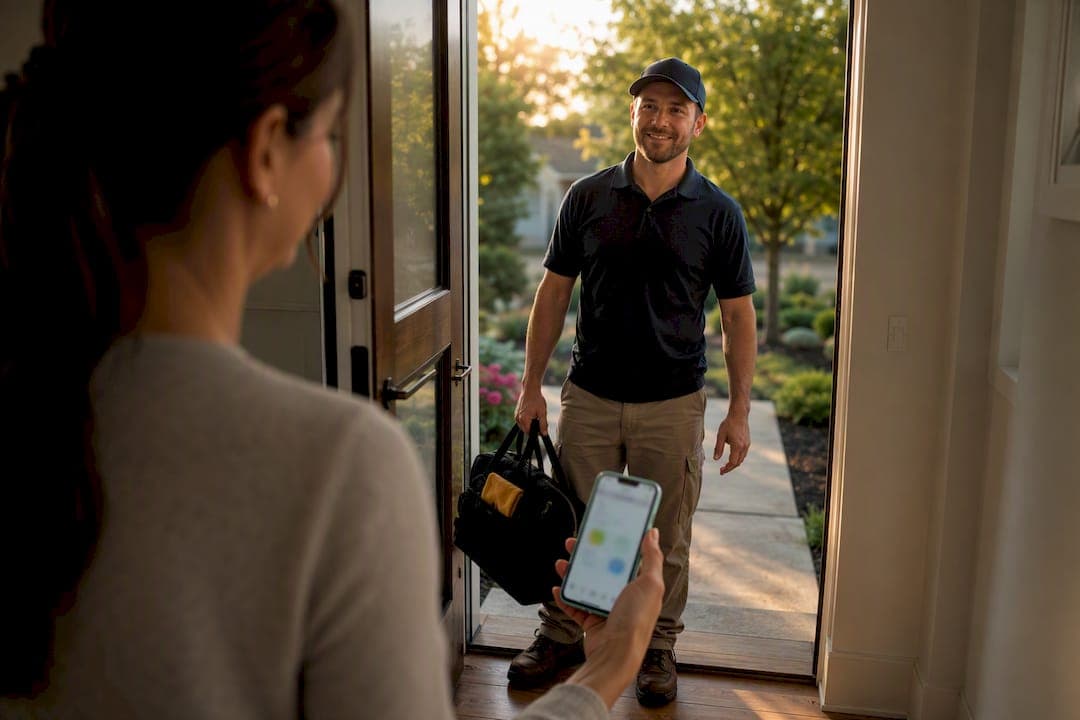
The highest-converting move is a tech-signed on-site ask, followed within minutes by an SMS with a direct review link, routed through a quick private survey before it hits Google. BrightLocal and field data behind Leapify Media's own client work both back this cadence.
TL;DR:
- Sending review requests within 2 to 24 hours of job completion significantly increases response rates, especially when combined with personal, in-person asks.
- Automating review requests through a system that tracks job completion and technician attribution can triple review velocity without sacrificing personalization.
- Google remains the top review platform for visibility and local search, but diversifying to Facebook, Apple Maps, Bing, and industry directories improves overall review volume and influence.
- Eliciting specific feedback—technician name, repair details, and outcome—creates more valuable reviews that enhance future customer trust and search ranking.
- Responding to every review promptly, especially within 24 hours, with personalized messages improves ratings and customer relations over time.
Table of Contents
- How to Get More HVAC Reviews With a Repeatable Ask Sequence
- Which Review Platforms Should HVAC Companies Prioritize?
- Timing and Scripts That Actually Get HVAC Reviews Written
- Automating Review Collection Without Losing the Personal Touch
- How to Respond to HVAC Reviews, Especially the Bad Ones
- Setting Review Targets: A Simple 90-Day Plan
- What Leapify Media Has Learned Building This for HVAC Companies
- Why Steady Cadence Beats the One-Time Review Push
- Let Leapify Media Run the Review Engine for You
- Sources
How to Get More HVAC Reviews With a Repeatable Ask Sequence
Most HVAC companies lose reviews at the ask, not the platform. A technician finishes the job, shakes hands, and leaves. Nobody mentions Google. That gap is fixable with a sequence, not a single tactic.
Here's the flow that works:
- The tech asks in person, by name. Before leaving, the technician says something like: "If you were happy with the work today, a quick Google review would mean a lot. I'll text you the link." This face-to-face moment matters more than any automation because it's the only point where a real person makes the request feel personal.
- An SMS or email goes out within minutes, not hours. The message includes the tech's name, a one-line job summary, and a direct link. Momentum dies fast. A homeowner who's already moved on to dinner or a Netflix queue is far less likely to click a review request that arrives at 9 p.m. after a morning appointment.
- A single reminder goes out 48 to 72 hours later if there's no response. One follow-up. Not three. Repeated nagging tanks response rates and annoys customers who were otherwise happy.
The routing step is what separates a good sequence from a risky one. Route customers to a short private survey first, asking them to rate the experience 1 to 5. Scores of 4 or 5 get an immediate public invite to Google or Facebook. Scores of 1 to 3 route to a private resolution flow instead, where a manager reaches out before any public review gets posted. This isn't about hiding bad experiences. It's about fixing them before they become permanent one-star reviews, and ReviewFire's HVAC playbook documents this exact routing model as one of the biggest levers for review velocity.
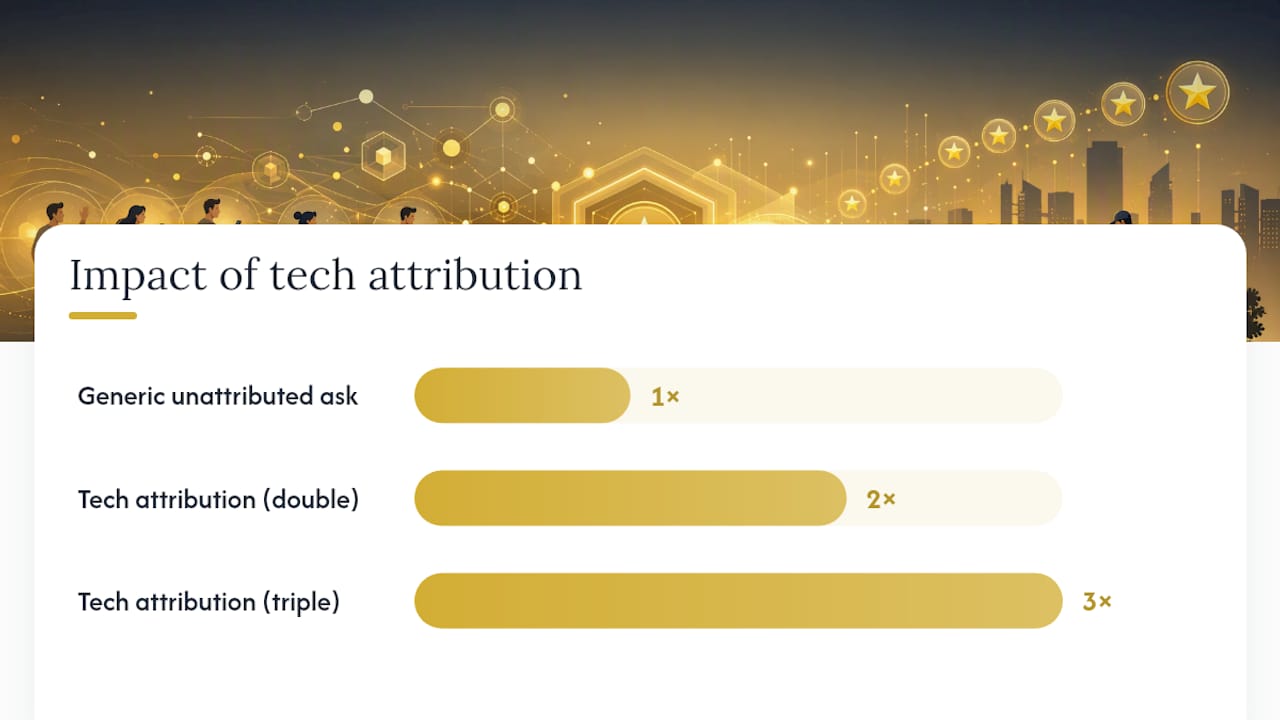
Attribution matters just as much as timing. When techs know their name is attached to the request, and when owners run a simple monthly leaderboard tracking review counts per technician, response rates climb noticeably. ReviewFire's research found tech attribution alone can double or triple review velocity compared to generic, unattributed requests.
Pro Tip: Give techs a script card laminated on their clipboard or tablet. "Ask, mention the review, say thanks" takes ten seconds and removes the awkwardness that keeps techs from asking at all.
Office staff play a role too. Whoever schedules the follow-up call or sends the invoice can reinforce the ask with a line like, "Did [tech name] take good care of you today? We'd love a quick review if so." Two touchpoints, one consistent message.
Which Review Platforms Should HVAC Companies Prioritize?
Google Business Profile comes first, without question. It's still the platform most homeowners check before calling a contractor, and it directly affects local search rankings. But treating Google as the only platform that matters is a mistake that's gotten more expensive over time.
BrightLocal's Local Consumer Review Survey 2026 found consumers now consult an average of six different sources before choosing a local business, and AI assistants have climbed to the third most-used source for local recommendations, after Google and Facebook. Google's own share of use dropped but remains dominant though no longer close to exclusive.
Prioritize in this order:
- Google Business Profile for search visibility and the platform most likely to influence a phone call.
- Facebook, especially in markets where neighborhood groups and local recommendation threads drive referrals.
- Apple Maps and Bing Places, which feed increasingly into AI assistant recommendations and voice search results.
- Angi and industry-specific directories, useful for capturing homeowners who research contractors specifically, not businesses in general.
The AI angle deserves attention most HVAC owners haven't caught up to yet. When a homeowner asks ChatGPT or another AI assistant for HVAC recommendations, that assistant pulls from aggregated review data and listing accuracy across multiple platforms. An inconsistent business name, outdated phone number, or thin review profile on a secondary platform can knock a company out of consideration before a human ever sees the result.
Rotate your ask across platforms rather than funneling every request to Google. A simple system: every third or fourth request goes to Facebook or Angi instead of Google. This keeps profiles active everywhere, which matters more now that reviews function as data for both people and machines.
Timing and Scripts That Actually Get HVAC Reviews Written
Timing is the single biggest lever most companies get wrong. The window that converts best is 2 to 24 hours after job completion, while the fix is still fresh and the relief is still real. For emergency repairs, same-day requests convert even better because the customer's gratitude is at its peak.
Vague requests get vague, low-value responses. Full Stack HVAC's analysis of 600,000-plus HVAC reviews found that nearly half, 49.7%, contain no text at all, just a star rating. That's a wasted opportunity, because text reviews mentioning a specific technician and job type carry far more weight with future customers and with search algorithms than a bare five-star rating ever will.
Ask customers to mention three things: the technician's name, what was fixed, and how it turned out. That's it.
Here are templates that work:
- SMS, immediate: "Hi [Name], this is [Company]. [Tech] wanted to make sure everything's running well after today's [job type]. If you have 30 seconds, a quick review here would mean a lot: [link]"
- SMS, reminder (48-72 hours): "Hi [Name], just a quick follow-up, if you have a minute to share how [Tech] did on your [job type], we'd really appreciate it: [link]"
- Email, immediate: Subject line: "How did we do?" Body: "Thanks for choosing [Company]. [Tech] completed your [job type] on [date]. If everything's working well, a short review helps other homeowners in [area] find us. Here's the link: [link]"
- Email, reminder: Subject line: "One quick favor" Body: "We know life gets busy. If you have 60 seconds, we'd love your feedback on the [job type] [Tech] handled last week: [link]"
For in-person jobs, a printed QR code card left on the counter or clipped to the invoice works as a backup channel, especially for older customers less comfortable with SMS links. Print the tech's name on the card itself, not just a generic company logo.
Pro Tip: Keep every template under 40 words. Long review requests read like homework. Short ones read like a favor between two people who just had a good interaction.
Automating Review Collection Without Losing the Personal Touch
Manual review requests don't scale past a handful of jobs a day. Once a company is running five, ten, or twenty jobs daily, the ask needs to trigger automatically off the job-completion event in the dispatch or CRM system, not off memory.
What to automate:
- Send triggers fired the moment a job status changes to "complete" in the dispatch system.
- Monitoring and alerts that flag any new review under 4 stars within minutes, so a manager can respond before the customer moves on.
- Response templates pre-drafted for common scenarios, ready to personalize and send rather than write from scratch every time.
- Attribution tracking, using unique links or QR codes per technician so leaderboards and performance data stay accurate without manual entry.
The integration point that trips up most companies is the handoff between CRM, dispatch, and the review request tool. If those three systems don't talk to each other, someone ends up manually exporting completed job lists and sending requests a day or two late, right when the timing window has already closed. A CRM built for automation closes that gap by firing the request the moment a technician marks a ticket closed.
Smart routing has to stay compliant while it's automated. The private survey step can never be used to suppress bad reviews from reaching the public platform, and platforms increasingly police this. BrightLocal's research on fake and filtered reviews found 97% of consumers want businesses caught manipulating reviews to face consequences. Routing should redirect unhappy customers to a resolution process, not block them from ever leaving a review if they still want to.
Before choosing software or building automation in-house, check for these capabilities: job-completion triggers, multi-platform routing, technician-level attribution, and low-score alerting. Anything missing one of those four is going to create manual work somewhere down the line.
How to Respond to HVAC Reviews, Especially the Bad Ones
Reply to every review. Not most. Every one. Harvard Business Review's study found that businesses which respond to reviews see improved ratings over time compared to those that stay silent, and the effect holds regardless of whether the original review was positive or negative.
Speed matters almost as much as content. Aim for same-day replies, with 24 to 48 hours as the outer limit.
- Positive reviews: Thank the customer by name, mention the technician if named, and keep it under three sentences. "Thanks, Maria! We'll pass this along to Jake, glad the AC's running smooth again."
- Negative reviews: Acknowledge the issue without getting defensive, take it offline immediately. "We're sorry the repair didn't hold, please call us at [number] so we can make it right."
- Escalation: A manager calls within 24 hours, resolves the issue, and only then asks if the customer would consider updating or adding a new review reflecting the resolution.
- Fake or fraudulent reviews: Report through the platform's official dispute process rather than arguing publicly in the comments.
Pro Tip: Never copy-paste the same reply twice in a row on a public profile. Google flags patterns, and customers notice generic responses faster than you'd think.
Setting Review Targets: A Simple 90-Day Plan
Track four numbers monthly: new reviews collected, average review recency, average reply time, and request-to-review conversion rate. Everything else is noise.
Benchmarks worth targeting:
- 5 or more new reviews per month, sustained, not in bursts. BrightLocal's research consistently shows steady velocity outperforms occasional pushes for both trust signals and search visibility.
- 50 total reviews as the threshold where a profile starts competing seriously in local map results.
- 150 total reviews as the point where volume alone starts building consumer trust independent of individual review content.
- Under 24 hours for average reply time on new reviews.
For a 90-day plan, weeks one through two focus on setting up the ask sequence and automation triggers. Weeks three through six focus on training every technician on the script and tracking attribution. Weeks seven through twelve shift to monitoring conversion rates, adjusting timing, and reporting monthly numbers to the team. Companies that hit 5+ reviews a month consistently for a full quarter typically see a measurable uptick in inbound calls tied to search visibility, since local search rankings respond directly to review recency and volume.
What Leapify Media Has Learned Building This for HVAC Companies
Leapify Media builds the infrastructure behind this exact playbook for home service companies, and the pattern holds across every client running it seriously: automation without a human touchpoint fails, and a human touchpoint without automation doesn't scale.
The companies that see the fastest movement in review counts are the ones where the technician ask, the SMS trigger, and the smart routing logic all live inside one connected system, tied to the same dispatch and CRM data that already tracks job completions. When that connection exists, review requests fire the same day a job closes, every time, without an office manager remembering to run a report.
Early months with any properly built system look the same: a spike in review volume in the first 30 days as backlog customers get caught up, followed by a steadier climb as the automation catches new jobs in real time. The evaluation question worth asking any partner isn't "can you send review requests." It's whether the system routes by satisfaction score, attributes requests to individual technicians, and integrates with the dispatch software already in use, because those three details are what separate a review bump from a permanent shift in review velocity.
Why Steady Cadence Beats the One-Time Review Push
Most HVAC owners still treat reviews like a project: run a campaign, get a burst of five-star ratings, move on. That instinct is understandable and mostly wrong. Full Stack HVAC's analysis of over 600,000 reviews found recency matters more than raw star count, which means a company with 40 reviews from the last six months often outperforms a competitor sitting on 200 reviews from three years ago.
The conventional advice, ask happy customers, ignore the rest, misses the bigger lever: process. A five-star rating with no text tells a future customer almost nothing. A three-sentence review naming a technician and a specific repair tells them everything. That's the gap between a review count and a review that actually converts.
What I'd prioritize first isn't a tool or a template. It's getting one technician fully bought into the ask, running it consistently for two weeks, and measuring the conversion rate before rolling it out company-wide. Most companies skip that step and wonder why company-wide automation underperforms. Fix the ask at the individual level first. Automation just multiplies whatever habit already exists.
— Everson Gorski
Let Leapify Media Run the Review Engine for You
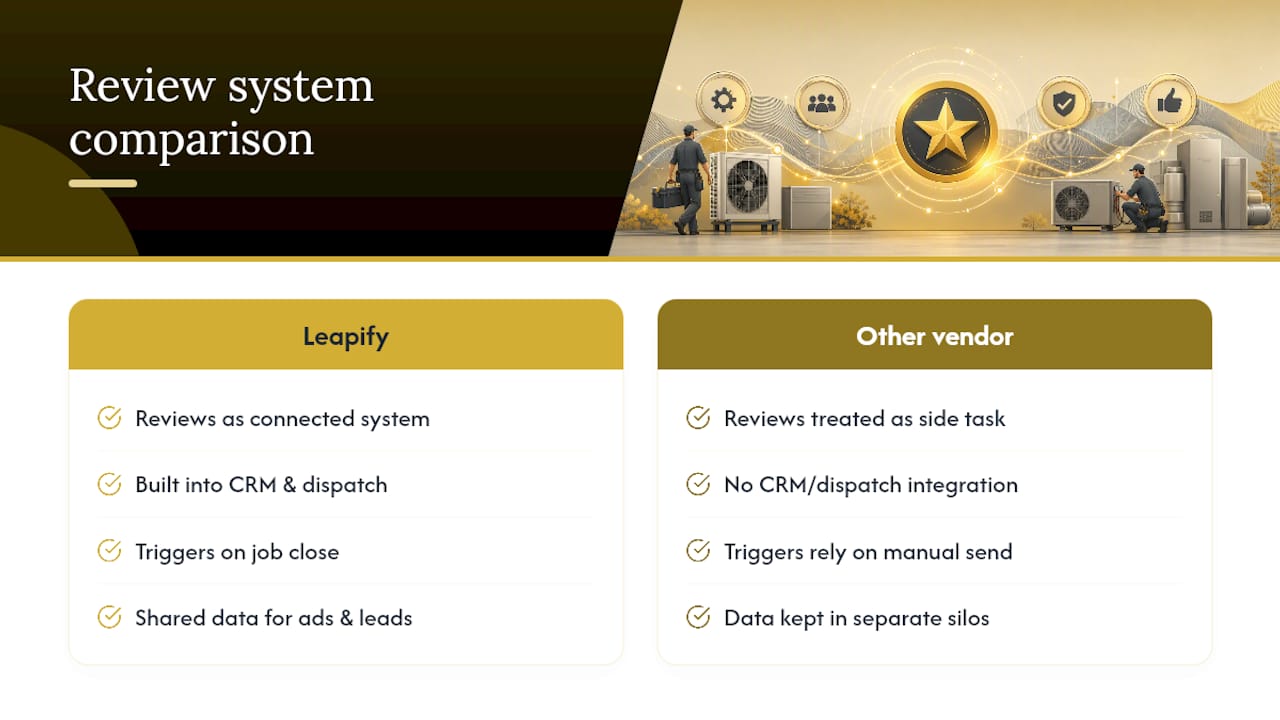
Leapify Media is the alternative to hiring another marketing vendor to manage reviews as a side task, because reviews are treated here as one connected system with dispatch, CRM, and lead scoring, not an isolated campaign someone runs once a quarter.
Home service companies working with Leapify Media get review-request automation built directly into the same CRM and dispatch integration that handles lead routing and job tracking, so review triggers fire the moment a job closes rather than depending on someone remembering to send a text. That same infrastructure powers the AI lead dispatch and intent scoring Leapify runs for HVAC, plumbing, and electrical clients, meaning a review push and a paid ad campaign draw from the same data instead of operating in separate silos.
Typical engagement starts with an audit of current review platforms, technician attribution setup, and automation triggers tied to the existing dispatch system, usually delivering the first automated request sequence within the opening weeks. Visit Leapify Media's services page to see how the full infrastructure fits together, or head to Leapifymedia to start a conversation about what a review and lead system built for your shop specifically would look like.
Sources
BrightLocal's Local Consumer Review Survey 2026 is the best annual benchmark for how consumers actually use reviews, including platform preference shifts and the growing role of AI assistants in local search.
Full Stack HVAC's analysis of 600,000-plus HVAC reviews offers the clearest industry-specific data on why recency and review text outperform raw star ratings for HVAC contractors specifically.
ReviewFire's field-tested HVAC playbook breaks down the operational side, tech attribution, smart routing, and timing windows, in more tactical detail than most general review-management guides cover.
For companies also building out broader contractor marketing, ways suppliers find consistent contractor clients covers adjacent business development tactics worth reviewing alongside a review strategy.
- Local Consumer Review Survey 2026 — BrightLocal
- Five-star rating means nothing — Full Stack HVAC
- Study: Replying to customer reviews results in better ratings — Harvard Business Review