

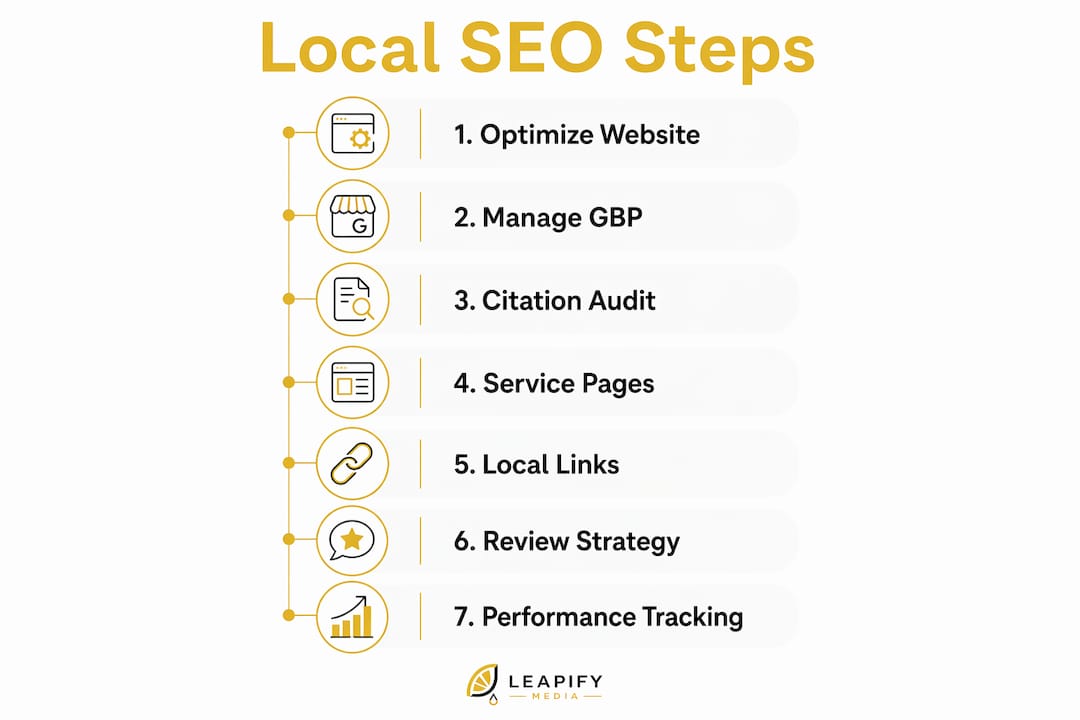
Local SEO for contractors is the practice of optimizing your online presence so your business appears when nearby homeowners search for services like roofing, plumbing, HVAC, or electrical work. It is not the same as general SEO. The goal is hyper-local visibility: showing up in the Google Map Pack, ranking for "[service] in [city]" searches, and getting your phone to ring from people who are ready to hire today.
GBP signals account for 32% of local pack ranking weight in 2026. That single figure tells you where to spend your energy first. But GBP is only one piece. A complete local search strategy for contractors rests on five pillars working together:
- Google Business Profile: Fully completed, with correct categories, real photos, and weekly posts
- Website: Dedicated service pages, fast mobile load times, and LocalBusiness schema markup
- Citations: Consistent NAP (name, address, phone) across every major directory
- Reviews: A steady, automated stream of recent reviews with genuine keywords
- Local backlinks: Links from chambers of commerce, local news, and trade associations
Miss any one of these and the others underperform. The contractors dominating local search in 2026 are not doing anything exotic. They are executing these fundamentals every single week.
Table of Contents
- 1. How to optimize your contractor website for local SEO
- 2. Maximizing local visibility through your Google Business Profile
- 3. Building authoritative and consistent local listings
- 4. Creating city and location-specific service area pages
- 5. Implementing local link-building strategies for contractors
- 6. How to generate and manage customer reviews
- 7. Tracking and improving your local SEO performance
- 8. Advanced local SEO techniques to stay competitive in 2026
- 9. The critical role of Google Business Profile signals in local rankings
- Key Takeaways
- Leapify Media turns your local SEO into booked jobs
1. How to optimize your contractor website for local SEO
Your website is the second signal Google checks after your GBP. A weak site drags down your map pack position even when your profile is perfect.
The architecture that works is called hub-and-spoke. Each major service gets its own dedicated page, and those pages link back to a central services hub. "Drain Cleaning in Austin" is a page. "Water Heater Repair in Austin" is a page. A single catch-all "Services" page ranks for nothing specific.
Here is what each service page needs to do the job:
- Title tags and H1 headings: Include the service and city naturally ("AC Repair in Denver, CO")
- NAP in the footer: Your business name, address, and phone number must match your GBP exactly, on every page
- LocalBusiness schema: Schema markup signals your category, address, and hours to both traditional search engines and AI systems
- Internal links: Service area pages should link to your main service pages and vice versa
- Page speed: Mobile "near me" searches with purchase intent have grown more than 500%, and pages that load in over 3 seconds bleed rankings and conversions
Pro Tip: Run your site through Google's PageSpeed Insights and fix every critical issue flagged there. Most contractor sites fail on image compression and render-blocking scripts. Both are fixable in an afternoon.
2. Maximizing local visibility through your Google Business Profile
Your GBP is not a directory listing. It is your most valuable local SEO asset. GBP management ranks as the highest-ROI local SEO activity, influencing 8 of the top 10 map pack ranking signals.
The most common mistake contractors make is treating GBP setup as a one-time task. Google rewards active, complete profiles. Here is what "complete" actually means in practice:
- Primary category: The single most impactful field. "HVAC Contractor" beats "Contractor" every time. Be specific.
- Secondary categories: Add every relevant service type. An HVAC company should add "Air Conditioning Repair Service," "Heating Contractor," and "Air Conditioning Installation Service."
- Services section: List every specific service you offer. These directly affect which searches trigger your profile.
- Business hours: Keep them accurate, including holidays. Accurate business hours now function as a hard ranking filter. Google's "Openness" signal means businesses shown as open at search time rank higher for that query.
- Photos: Upload real project photos weekly. Before-and-after shots, your crew on-site, your trucks. Google's AI recognizes stock imagery.
- Posts: Publish at least one update per week. Seasonal tips, completed projects, service area announcements. Weekly posts signal that your business is active.
- Q&A: Populate your own Q&A section with common questions before customers ask them.
Pro Tip: Respond to every review within 48 hours. When you respond to a positive review, mention the specific service and city: "Thanks, Mike! Glad we could handle that emergency furnace repair in Columbus so quickly." This adds local keywords to your profile organically.
3. Building authoritative and consistent local listings

Citations are any online mention of your business name, address, and phone number. Google uses them to verify that your business is real, active, and located where it claims. Inconsistencies across directories create a low-confidence signal that suppresses your rankings.
The rule is simple: one version of your NAP, used everywhere, forever. "Johnson Plumbing LLC" on Google but "Johnson Plumbing" on Yelp and "Johnson Plumbing Co." on Angi creates confusion the algorithm penalizes.
Start with these core citation sources:
- Google Business Profile (your anchor)
- Bing Places for Business
- Yelp
- Facebook Business
- Better Business Bureau (BBB)
- Angi (formerly Angie's List)
- Your state's contractor licensing board
- Trade-specific directories relevant to your specialty
Run a citation audit at least once a year. Tools like BrightLocal or Moz Local surface inconsistencies and duplicate listings that quietly erode your trust signals. Fix mismatches before they compound.
One thing worth knowing: the weight of generic directory citations has decreased in 2026. Industry-specific citations from the BBB, trade associations, and niche contractor directories carry more ranking value than bulk submissions to low-authority general directories. Quality over volume.
4. Creating city and location-specific service area pages
If you serve multiple cities, you need a dedicated page for each one. Not a template with the city name swapped out. Generic service area pages with only city name substitutions hurt rankings and can trigger penalties. Google's AI is good at detecting thin, duplicated content.
What a strong location page actually contains:
- Local specifics: Reference actual neighborhoods, landmarks, and housing types in that area. A roofing page for Miami should mention hurricane-rated shingles, salt-air corrosion, and local building codes.
- Past project examples: Photos and brief descriptions of real jobs completed in that city or zip code
- Local FAQs: Questions specific to that area's climate, permit requirements, or common housing stock
- Local schema markup: Include geo coordinates and service area data in your structured data
- Unique content: Every page must read differently from every other location page
For contractors expanding to multiple service areas, this page structure is how you scale local visibility without cannibalizing your existing rankings. Each location page builds its own topical authority for that geography.
5. Implementing local link-building strategies for contractors
Backlinks from local sources carry weight that generic directory links simply cannot match. A single link from your local chamber of commerce or a city news outlet signals geographic relevance more effectively than 50 links from random web directories.
The most reliable link-building tactics for contractors:
- Chamber of Commerce membership: High-authority, locally trusted sites that Google values for geographic relevance
- Local event sponsorships: Sponsoring a youth sports team, a 5K, or a school fundraiser typically earns you a link on their "Supporters" page
- Complementary business partnerships: A roofing contractor and a gutter company serve the same homeowners. Cross-link where it makes sense.
- Local news coverage: A completed community project or a comment on a local housing story can earn a mention in a local publication
- Trade association directories: Being listed on your state's HVAC association or plumbing guild site adds both authority and trust
Avoid mass directory submissions. The diminishing returns are real. One legitimate local link from a real organization outperforms 50 generic directory entries, and the latter can trigger spam signals if pursued aggressively. Build links the way you build a reputation: one relationship at a time.
6. How to generate and manage customer reviews

97% of consumers read reviews before choosing a local contractor, and 57% won't call a business with fewer than 4 stars. Reviews are not a soft signal. They are a direct conversion lever and a hard ranking factor.
The key insight most contractors miss: review velocity matters more than total count. Ten new reviews per month consistently outperforms a business that accumulated 200 reviews two years ago and stopped. Google rewards recent, steady activity. A spike of 30 reviews in one week followed by silence looks suspicious and can be penalized.
Here is how to build a review system that runs without you thinking about it:
- Automate the request: Contractors who send review requests within 2 hours of job completion see 42% response rates versus 6% when the request is delayed by a day. Set up automated texts that fire the moment a job is marked complete in your CRM.
- Personalize the message: Include the customer's name and the technician's name. Generic requests get ignored.
- Use a direct link: Send a link straight to your Google review page. Every extra step kills conversion.
- Respond to every review: Thank positive reviewers with a specific mention of the service and location. Address negative reviews professionally and offer to make it right. Google treats response rate as an engagement signal.
- Diversify platforms: Reviews on Google, Facebook, and Angi together signal broader credibility than Google alone.
Pro Tip: When asking for a review, try: "If you have a moment, we'd love a review mentioning the [specific service] we did for you." This naturally encourages service-specific keywords in reviews, which strengthens your relevance for those search terms.
7. Tracking and improving your local SEO performance
You cannot improve what you do not measure. Most contractors track the wrong things, like total website traffic, when what actually matters is call volume from local search.
Track these metrics monthly:
- Map Pack rankings for your primary service and location keywords
- GBP calls and direction requests (available in your GBP Insights dashboard)
- Review quantity, velocity, and average rating across all platforms
- Website traffic from organic search via Google Analytics, segmented by city and service page
- Click-through rate (CTR) from Google Search Console for your key service pages
- Conversion rate on individual service pages (form fills and tracked calls)
When rankings drop, audit your GBP first. Check for outdated hours, missing photos, or a category that shifted. Then check your citation consistency. A single changed phone number cascading across directories can suppress rankings within weeks.
Ongoing content is what separates contractors who plateau from those who keep climbing. Publishing one blog post per month, linked to your relevant service pages, builds domain authority and signals to Google that your site is active. Topics like "How Much Does a Roof Replacement Cost in [City]?" or "When to Call an Emergency Plumber" capture long-tail searches and feed your topical authority.
8. Advanced local SEO techniques to stay competitive in 2026
The contractors who will dominate local search in 2026 are the ones adapting to how AI systems discover and recommend businesses, not just how traditional search algorithms rank pages.
Voice search and conversational queries are now a meaningful share of local search volume. When a homeowner asks their phone "Who's the best-rated HVAC contractor near me?", the answer comes from the same signals that drive map pack rankings: verified entity data, review sentiment, and structured local signals. Optimize your content for full-sentence questions, not just keyword phrases.
AI-friendly content means depth and transparency. AI models favor businesses that provide clear pricing information, because it helps consumers make decisions. Publishing cost guides with "starting from" ranges, typical price factors, and example job costs makes your site more likely to be cited in AI-generated answers.
Mobile-first indexing is not optional. Google indexes the mobile version of your site first. If your mobile experience is slow or hard to navigate, your rankings suffer regardless of how good your desktop site looks.
Additional tactics worth building into your workflow:
- Behavioral signals: Photos and posts that drive clicks and engagement on your GBP improve your profile's activity score
- Social media consistency: Active profiles on Facebook and Nextdoor that reference your service areas reinforce your local entity signals
- FAQ schema: Adding FAQ structured data to your service pages lets your answers appear directly in search results, increasing click-through rates without requiring a higher ranking position
- Correct service categories: Mismatched categories between your GBP and your website service pages create data conflicts that reduce AI confidence in your business
9. The critical role of Google Business Profile signals in local rankings
GBP signals represent 32% of local pack ranking influence in 2026, making it the single largest controllable ranking factor. No other individual channel comes close.
Here is what that 32% actually breaks down into:
- Primary category: The most impactful single field in your entire GBP. Getting this wrong means competing in the wrong pool.
- Profile completeness: Google reports that businesses with complete information are significantly more likely to attract location visits. Every empty field is a missed relevance signal.
- Review velocity: Steady monthly review acquisition outperforms a large accumulated total. A business with a steady stream of new reviews will often outrank competitors with a larger but older total review count.
- Photo activity: Businesses with a large number of photos on their GBP receive more calls and direction requests than those with few photos.
- Post frequency: Weekly posts signal an active, engaged business. Monthly or sporadic posting does not produce the same effect.
- Accurate hours: Openness is now a hard ranking filter. A business shown as closed at search time is filtered out of results for that query, regardless of how strong its other signals are.
Key stat: GBP signals alone account for nearly a third of what determines your map pack position. A fully optimized, actively managed profile is not a nice addition to your local SEO strategy. It is the foundation.
The practical implication: treat your GBP like a second website. Update it weekly. Respond to every review. Add photos after every job. The contractors winning local search are not doing anything complicated. They are just showing up consistently while everyone else chases paid channels.
Key Takeaways
Local SEO for contractors in 2026 is won or lost on Google Business Profile completeness, review velocity, and consistent NAP data across every platform where your business appears.
| Point | Details |
|---|---|
| GBP signals dominate rankings | GBP signals account for 32% of local pack ranking weight, making profile completeness your highest-ROI activity. |
| Review velocity beats total count | Ten new reviews per month outperforms a large accumulated total; automated requests within 2 hours yield 42% response rates. |
| Location pages need real content | Generic city-swap pages trigger penalties; each location page needs unique local references, past project examples, and local FAQs. |
| NAP consistency is non-negotiable | Your business name, address, and phone must match exactly across Google, Yelp, BBB, Angi, and every other directory. |
| Leapify Media builds the full system | Leapify Media provides AI-powered local SEO, GBP management, and lead conversion infrastructure built specifically for home service contractors. |
Leapify Media turns your local SEO into booked jobs
Most contractors who invest in local SEO get rankings. Fewer get revenue. The gap is usually in what happens after someone finds you: a slow website, no automated follow-up, and a review system that depends on someone remembering to ask.
Leapify Media is built specifically for home service businesses that want the full infrastructure, not just a higher ranking. That means AI-powered lead dispatch that scores and routes inbound calls before they go cold, GBP management that keeps your profile active and optimized every week, and automated review systems that send requests promptly after job completion. The result is a pipeline where your local SEO investment converts into scheduled appointments, not just impressions.
If your current setup generates leads but loses them before they book, that is the problem Leapify Media solves. See how it works and find out whether your market has availability.