

Map Pack ranking comes down to three inputs Google names directly: relevance, distance, and prominence. You cannot control distance beyond your listed address, but you can control your primary category, review velocity, and website relevance, and those three levers produce most of the visible rank movement local businesses see in 2026.
TL;DR:
- Improving primary category accuracy and completing all Google Business Profile fields can generate visible ranking movement within two to four weeks.
- Focusing on review recency and velocity over total review count is key, with a target of matching or surpassing your top competitors' recent review pace.
- Listing more suburbs in your service-area does little; instead, build dedicated location pages and consider opening additional staffed locations for genuine reach expansion.
- Website schema markup, local backlinks, and citation consistency profoundly influence prominence signals, with progress often visible over a three- to six-month period.
- Regularly tracking rank patterns through geogrid scans reveals whether distance, relevance, or prominence limits your rankings, guiding targeted improvements.
Table of Contents
- What Are Google's Map Pack Ranking Factors?
- Google Business Profile Optimization: Fields, Verification, and Eligibility
- How Should You Match Categories to Search Intent?
- Review Signals: How Many, How Recent, and How to Ask
- Proximity and Service-Area Realities
- Website Signals and Structured Data That Support Prominence
- Links, Citations, and Local Mentions Worth Chasing
- Behavioral Signals: Clicks, Calls, and Direction Requests
- How Do You Run a Geogrid Scan to Diagnose Your Ranking?
- Prioritized Action Checklist by Time-to-Impact
- What Leapify Media Sees Across Home-Service Clients
- Common Mistakes and Realistic Timelines
- Get Help Running the Map Pack Playbook
- Sources
- FAQ
What Are Google's Map Pack Ranking Factors?
Google's own guidance is refreshingly unambiguous: local results are filtered by relevance, distance, and prominence, full stop. There's no fourth secret ingredient, no algorithm update that quietly adds a new bucket. Everything else you do, from picking a category to earning a review, feeds into one of those three.
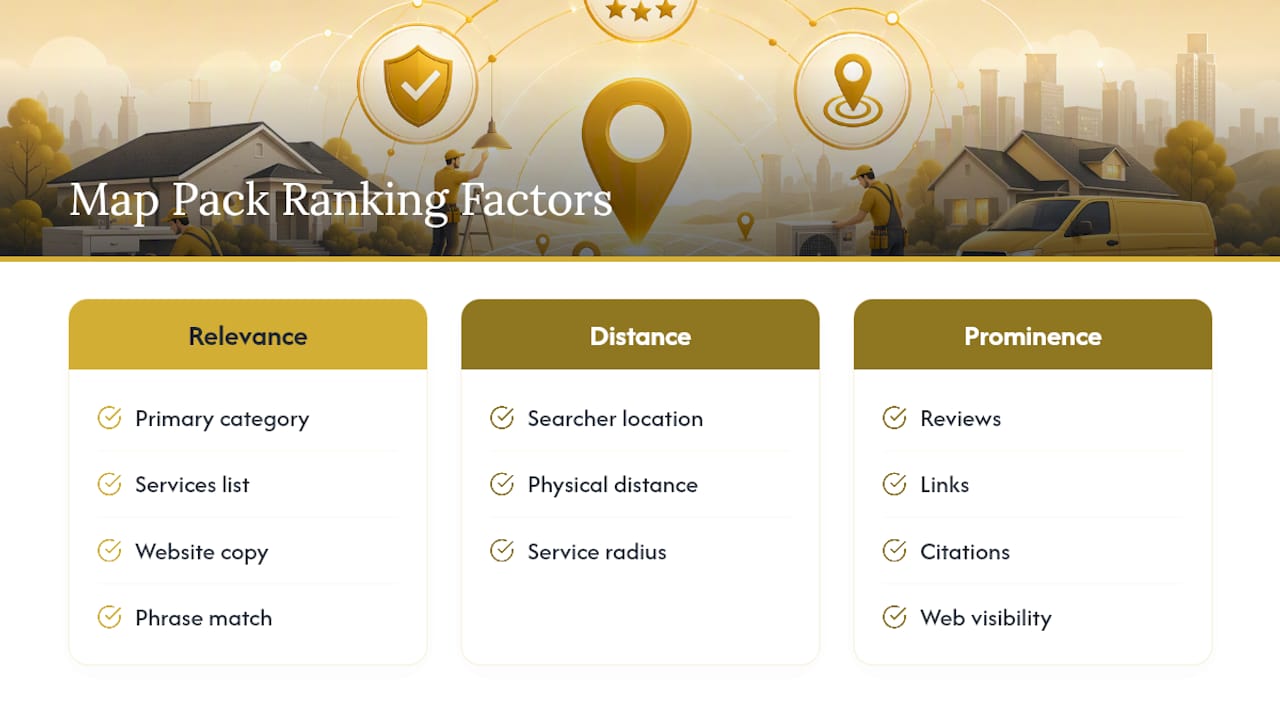
Relevance measures how well your business matches what someone searched. A plumber ranking for "emergency drain cleaning" needs that phrase reflected somewhere Google trusts, whether that's your primary category, your services list, or your website copy.
Distance is the physical or service-radius gap between the searcher (or the location they typed) and your business address. It's the one factor you genuinely cannot buy your way around.
Prominence is your reputation, expressed through reviews, links, citations, and general web visibility. Google treats a well-reviewed, well-linked business as more trustworthy than an obscure one, even if both are equally close and equally relevant.
Here's the practical part: Whitespark's 2026 Local Search Ranking Factors survey puts Google Business Profile signals, primarily your primary category, at roughly a third of total local-pack influence. That single field probably outweighs everything else you'll do this quarter. Meanwhile, Search Engine Land's analysis of Google Maps' internal architecture counts more than 70 individual signals, but nearly all of them roll up into that same three-factor model. Knowing there are 72 signals is interesting; knowing which eight of them move the needle is what pays your rent.
Google Business Profile Optimization: Fields, Verification, and Eligibility
Your Google Business Profile is the fastest lever you own, and most businesses leave it half pulled. Get the primary category wrong and you can do everything else perfectly and still lose to a competitor who picked the narrower, more accurate label.
Primary category selection should match the exact service your ideal customer searches for, not just maximize reach. For example, if roof repairs generate more local search volume than solar leads, a roofing company that sells solar installs should pick "Roofing Contractor" as primary rather than "Solar Energy Company". Test both in Google's category picker and see which one Google itself associates with your competitors' top-ranking listings.
A complete profile checklist worth running regularly includes:
- Business name matching your storefront signage exactly, without keyword stuffing
- NAP (name, address, phone) consistent across your website and citations
- Current hours, including holiday hours, reviewed periodically
- Primary category as the narrowest accurate match; several relevant secondary categories
- Services list accurately representing what you offer, using customer language
- Fully completed attributes such as wheelchair accessibility or free estimates
- Multiple recent, geotagged photos showing real work
- Website URL linking to a live, relevant page
Business title edits deserve caution. Google flags accounts that append city names or service keywords to the business name ("Smith Plumbing Chicago Emergency Repair") as a policy violation, and profiles have been suspended over it. Verification, done through a postcard, phone call, or video, confirms your address is real; skip it or let it lapse and your listing can silently drop from the pack even if every other field looks perfect.
Pro Tip: Google's completeness scoring rewards profiles that are updated regularly, not just filled out once. Set a recurring 30-minute calendar block to refresh photos, check for suggested edits, and confirm your hours are still accurate.
How Should You Match Categories to Search Intent?
Primary category weight and secondary category selection work together, but they're not equal. Your primary category tells Google what you are; secondary categories tell it what else you do. Whitespark's data consistently ranks primary category as the single heaviest GBP signal, which means guessing here costs you more than any other mistake on your profile.
Start by listing your 3 to 5 highest-value search queries, the ones that actually convert into booked jobs. Then map each one to a specific category and service pairing. "Water heater installation" maps to a specific service listing under Plumbing, not a vague "Home Repair" category. If a query doesn't have a clean category match, that's often a sign you need a dedicated service page on your website instead of trying to force GBP to cover it.
This is also where location pages earn their keep. If you serve six suburbs from one physical address, don't try to solve that with a longer service-area list in GBP. Build individual, genuinely useful location and service area pages on your website instead, each with unique content about that specific market.
A few real-world category swaps and their typical effects:
- Switching from "Contractor" to "General Contractor" as primary often improves relevance for renovation searches within weeks
- Adding "Emergency Plumber" as a secondary category, when true, can lift visibility for urgent, high-intent searches without diluting your primary category's focus
- Removing an outdated secondary category (like "Appliance Repair" for a company that stopped offering it) reduces irrelevant clicks that hurt engagement metrics
Review Signals: How Many, How Recent, and How to Ask
Review count still matters, but recency and velocity have pulled ahead of it. Measured grid-scan data shows review recency and 90-day velocity climbing in weight through 2025 and into 2026, which means a business with 40 reviews earned steadily this quarter can outrank one sitting on 200 reviews from three years ago.
Four metrics worth tracking every month:
- Total review count relative to your top three local competitors
- 90-day velocity: how many new reviews you've earned in the trailing quarter
- Average rating, with attention to any recent dip below 4.3 stars
- Keyword mentions in review text, since customers naturally use service and location language Google can parse
Request reviews through varied channels: a text message sent within an hour of job completion, a follow-up email three days later, and a printed card left with the invoice. Diversifying request timing and channel produces a more natural-looking review pattern than blasting every customer the same automated link on the same day.
Response cadence matters more than most business owners assume. Reply to every review, positive or negative, within 48 hours, and never offer compensation or discounts in a public reply since that violates Google's review policies and risks removal of the entire thread.
Pro Tip: Pull up the Google Business Profile of whoever currently holds the third spot in your local pack and count their reviews from the last 90 days. That number is your realistic velocity target, not some arbitrary round figure.
Proximity and Service-Area Realities
Distance calculations work differently depending on your business model, and this is where a lot of frustration comes from. For a storefront business, Google anchors distance to your verified physical address. For a service-area business (SAB) with no public storefront, Google estimates a rough centroid based on your service area settings and the searcher's location or the location implied by their query, sometimes referred to by its UULE parameter.

Here's the part that surprises people: piling more suburbs into your service-area list does not meaningfully expand where you rank. Practitioner data shows service-area entries rarely extend real eligibility in Maps, no matter how many towns you list.
Legitimate ways to expand your realistic reach:
- Open or lease a second real, staffed location if the market justifies it
- Build organic, genuinely useful location pages rather than thin doorway pages
- Form partnerships with complementary local businesses that generate real citations and mentions
Grid scans, covering a city in a grid of test points, reveal exactly where your proximity envelope ends and where prominence or relevance could still win you the pack despite distance. That map is more useful than any guess.
Website Signals and Structured Data That Support Prominence
Your website acts as supporting evidence for everything your GBP claims, and BrightLocal's research on Google's local algorithm confirms that on-page relevance and backlinks feed directly into prominence. A thin, generic homepage undercuts a perfectly optimized profile.
The checklist that actually matters:
- NAP printed in plain HTML text in the footer, matching your GBP exactly, not buried in an image
- Schema.org/LocalBusiness markup with correct name, address, phone, hours, and geo coordinates
- A dedicated page per core service with real, specific copy, not a single paragraph repeated across five pages
- Local landing pages that mention neighborhoods, landmarks, and service specifics naturally
Common mistakes worth avoiding: mismatched phone numbers between schema markup and visible text, duplicate LocalBusiness schema blocks on multiple pages, and copying a competitor's schema template without updating the geo coordinates.
Pro Tip: Run your homepage through Google's Rich Results Test after adding schema. A markup error there can quietly cancel out every other prominence signal you've built.
A weak, slow, or thin website caps how much your GBP can achieve, no matter how many reviews you collect. Google treats your website as a credibility check, not a formality.
Links, Citations, and Local Mentions Worth Chasing
Not all citations are created equal, and chasing volume wastes time better spent elsewhere. Geogrid's research recommends a focused cleanup of your top eight citation sources over spending weeks submitting to fifty low-authority directories.
Prioritize in this order:
- Data aggregators and top platforms most search engines pull from directly, since errors here propagate everywhere
- Industry-specific directories relevant to your trade, which carry more topical trust than general listings
- Local editorial mentions, like your regional newspaper covering a community event you sponsored, which function as both a citation and a trust signal
- Local supplier and partner mentions, the kind you get from genuine business relationships, like a regional supplier referencing your project work
Run a NAP consistency audit across your top eight citations first. Fix any mismatched suite numbers, old phone numbers, or dropped business names before touching anything further down the list, since inconsistency at the top erodes trust more than absence at the bottom. For a full remediation walkthrough, a dedicated citation cleanup process saves hours of manual checking.
Long-tail citation volume, the fortieth or fiftieth directory listing, produces marginal returns once your top eight are clean and consistent. Spend that time earning one local editorial mention instead.
Behavioral Signals: Clicks, Calls, and Direction Requests
Google Business Profile Insights tracks how people interact with your listing, and that engagement data feeds back into your ranking as a feedback loop. A listing that earns more clicks, calls, and direction requests per impression signals to Google that it's satisfying searchers, which reinforces its position.
Track these metrics monthly inside Insights:
- Click-to-call rate, especially from mobile devices where most local searches originate
- Direction requests, which indicate genuine intent to visit or book
- Website clicks from the profile itself
- Booking or quote-request actions where you've enabled them
Photos, an accurate products or services list, and a clearly placed booking button all lift click-through rate without touching your website. Google Posts and a filled-out Q&A section give searchers more reasons to engage before they even reach your site, and answered questions reduce the chance of a competitor planting a misleading answer in that space.
Run small experiments: swap your primary photo for 30 days and compare click-through rate, or add a limited-time offer and track whether calls increase. Small, measured tests beat guesswork.
How Do You Run a Geogrid Scan to Diagnose Your Ranking?
A single rank check from your office tells you almost nothing useful, since Google localizes results heavily based on the searcher's exact position. A geogrid scan checks your rank from a grid of points spread across your service area, revealing patterns a single check hides completely.
- Set up a grid, typically 5x5 or 7x7 points, spaced to cover your realistic service radius
- For each point, capture your rank, the UULE or simulated location, your review count and rating, and estimated distance from that point to your listed address
- Run the scan monthly for the first quarter, then quarterly once your position stabilizes
- Compare patterns: if you rank well near your address but fall off sharply at the edges, you're distance-limited; if you underperform even at close points, you're relevance or prominence limited
| Pattern observed | Likely limiting factor | Primary fix |
|---|---|---|
| Strong rank near address, sharp drop at grid edges | Distance | Consider a second location or local content pages |
| Weak rank even at close points | Category or relevance | Audit primary category and service page copy |
| Rank fluctuates with review count changes | Prominence | Increase review velocity and citation consistency |
| Rank improves after profile edits, then plateaus | GBP completeness ceiling | Shift focus to website and links |
You don't need enterprise software to start. A spreadsheet tracking rank by point, updated monthly, gives you enough data to see the pattern within one quarter.
Prioritized Action Checklist by Time-to-Impact
Not every fix deserves equal urgency. Here's the order that produces the fastest measurable movement based on the factors above.
Immediate (this week):
- Audit and correct your primary category
- Fill every empty GBP field and confirm verification is active
- Fix any glaring NAP mismatches on your top three citations
Short-term (30 to 90 days):
- Launch a 90-day review request plan targeting your calculated velocity gap
- Add schema.org/LocalBusiness markup and confirm it passes Google's Rich Results Test
- Clean up your top eight citation sources completely
Medium-term (3 to 6 months):
- Pursue one or two genuine local editorial links or community mentions
- Sustain review velocity as an ongoing program, not a one-time push
- Run behavioral experiments on photos, posts, and CTA placement
| Timeframe | Focus area | Realistic KPI |
|---|---|---|
| Week 1 | GBP completeness and category | full field completion |
| Days 30 to 90 | Review velocity and schema | Match competitor's 90-day review count |
| Months 3 to 6 | Links and behavioral testing | Measurable click-through rate lift in Insights |
Expect early GBP fixes to show movement within two to four weeks. Review and citation work tends to take a full quarter before rank shifts become obvious, and prominence built through links compounds slower but lasts longer, according to the local SEO blueprint many contractors follow for staged rollouts.
What Leapify Media Sees Across Home-Service Clients
Home-service businesses that integrate GBP optimization, structured review programs, and website relevance work together, rather than tackling them in isolation, tend to see the fastest combined lift in Map Pack visibility and booked jobs. Leapify Media tracks lead conversion uplift and booked-job volume as the real success metrics, not just rank position, since a rank gain that doesn't convert to phone calls isn't worth much to an HVAC or roofing company paying for marketing.
Typical engagements show measurable movement within the same 30 to 90 day windows outlined above, provided the GBP and review fundamentals are addressed first.
Common Mistakes and Realistic Timelines
Chasing long-tail citations or posting to Google daily rarely moves rank; it just feels productive. Prominence compounds slowly, and a steady review program beats a burst of activity every time. If the checklist above feels like more than your team can sustain alongside actual service work, that's usually the signal to bring in specialist help rather than let the profile drift back into neglect.
— Everson Gorski
Get Help Running the Map Pack Playbook
Leapify Media exists for home-service businesses that read a checklist like this and think, correctly, that they don't have the hours to run it consistently while also running service calls. Some firms provide generic reports, while others manage GBP field management and category audits, automated review request flows, monthly geogrid tracking, and local content with schema built specifically for your service area.
Some clients see the review velocity and website relevance work compound into more booked jobs within the same quarterly windows described above, tracked against lead conversion and revenue, not just rank position. Everything in this article can be run in-house if you have the bandwidth; if you'd rather have it managed, visit Leapify Media to see how the GBP, review, and local SEO systems fit together for your specific trade.
Sources
- Google Business Profile Help — How local search works
- Local Search Ranking Factors (Whitespark) — 2026 survey
- Google Maps Ranking Factors 2026: The 8 That Actually Move the Grid | Geogrid Blog
- Inside Google Maps: 72 ranking signals and the architecture behind local search (Search Engine Land)
FAQ
What Are the Three Main Map Pack Ranking Factors?
Relevance, distance, and prominence, as Google's own local search guidance states directly. Every other tactic, from category selection to review requests, feeds into one of these three.
How Long Does It Take to Improve Map Pack Rank?
GBP completeness fixes can show movement in two to four weeks; review and citation work typically needs a full 90-day cycle before rank shifts become clear.
Does Adding More Service-Area Suburbs Help My Ranking?
Rarely. Listing additional suburbs in your service-area settings does not meaningfully extend where Google ranks you; a real location or genuine local content pages work better.
How Many Reviews Do I Need to Rank in the Map Pack?
There's no fixed number. Recency and 90-day velocity matter more than total count, so benchmark against your closest competitor's recent review pace rather than an arbitrary total.
Can Website Speed and Mobile-Friendliness Affect Map Pack Rank?
Yes, indirectly. A slow or non-mobile-friendly site undermines the relevance and prominence signals your website is supposed to reinforce, which caps how much your GBP profile can achieve on its own.