

Yes, Facebook ads work for roofers, but only under one condition: you have a system that contacts every lead in under five minutes. Roofing companies that pair Meta campaigns with instant CRM routing see lead-to-quality conversion jump 44%, while roofers who dump leads into a shared inbox burn budget on prospects who book with the first competitor who calls back. Meta remains a fit for roofing because most U.S. adults use the platform and browse it mostly on their phones, which is exactly where a homeowner discovers hail damage or a sagging gutter line.
Facebook ads earn their keep in three specific situations:
- Storm response, when a hail or wind event creates a surge of homeowners actively noticing damage.
- Roof replacements, where video creative and financing offers outperform search ads on cost per lead.
- Retargeting, warming up website visitors and video viewers who weren't ready to call on their first visit.
Watch cost per booked inspection first, not cost per lead. It's the number that tells you whether the campaign is actually filling your calendar.
Key Takeaways
Facebook ads convert into booked roofing jobs only when fast CRM-driven follow-up and storm-aware creative work together, not when either runs alone.
| Point | Details |
|---|---|
| Speed to lead decides outcomes | Contacting leads within five minutes can multiply qualification rates dramatically compared to a thirty-minute delay. |
| Fix tracking before scaling spend | Install Pixel and Conversions API on landing pages, since many roofing advertisers run with no tracking at all. |
| Reserve budget for storms | Hold 15% to 25% of monthly spend for storm-window campaigns, where CPLs can drop far below always-on rates. |
| Video creative outperforms static images | Vertical before/after Reels and time-lapse footage drive stronger engagement than photo ads for roofing offers. |
| Leapify Media builds the full stack | Leapify wires Meta ads, on-premise AI dispatch, and CRM automation together, with clients reporting up to 20x ROAS. |
Table of Contents
- How Facebook Ads for Roofers Actually Work
- How Do You Set Up a Facebook Ad Campaign for a Roofing Company?
- Who Should You Target With Roofing Facebook Ads?
- What Creative Actually Converts for Roofing Ads?
- What Should Roofers Budget for Facebook Ads?
- How Fast Should You Follow Up on Facebook Leads?
- What Does a Working Setup Look Like in Practice?
- Is Facebook the Right Channel or Just One Piece of the Plan?
- Get Your Facebook Ad System Built and Wired to Your CRM
- Frequently Asked Questions About Facebook Ads for Roofers
- Sources
How Facebook Ads for Roofers Actually Work
Meta's Advantage+ system doesn't target homeowners the way an old-school demographic filter did. It learns from conversion signals, purchases, form submissions, calls tracked through the Conversions API, and it hunts for more people who look like your best customers. Feed it garbage signals (a landing page with no pixel, or a form that never syncs to your CRM), and it optimizes toward nothing useful. Feed it clean data, and it gets sharper every week.
That's why 73% of roofing advertisers running with no Meta Pixel firing on their landing page are quietly wasting money. The algorithm can't learn from a signal that doesn't exist.
Two ad formats dominate roofing campaigns, and each has a real tradeoff:
- Lead Ad instant forms load inside Facebook itself, cutting friction to almost zero. You get volume, but a chunk of those leads are curious clickers, not ready buyers.
- Landing pages ask homeowners to leave the platform and fill out a form on your site. Fewer submissions, but higher intent, and you can layer on trust elements like reviews or before/after galleries.
Creative decides more of your outcome than targeting does. Vertical video that shows real roof damage, a crew mid-tear-off, or a homeowner's reaction to a finished job consistently beats static photo ads for roofing offers, because the format matches how people actually scroll Facebook and Instagram on a phone.
Pro Tip: Run both formats simultaneously in the same campaign for two weeks. Compare cost per booked inspection, not cost per lead, before deciding which one earns your budget.
How Do You Set Up a Facebook Ad Campaign for a Roofing Company?
Launching a roofing campaign in the right sequence saves you from rebuilding tracking after you've already spent money on traffic that nobody measured correctly.
- Pick your objective. Start with Leads if you want fast, low-friction submissions inside Facebook. Switch to Conversions once you have a tested landing page, since it optimizes for actions that happen off-platform, like a call or a scheduled inspection.
- Install the Meta Pixel and Conversions API together. Server-side tracking through CAPI catches events that browser-based pixels miss due to ad blockers or iOS privacy settings. This pairing is exactly what drove the 15% lower cost per quality lead in Meta's own testing across hundreds of advertisers.
- Verify events are firing before you spend a dollar. Use Meta's Events Manager test tool to confirm form submissions and calls register correctly, and set up a backup event in case the primary one drops.
- Design your instant form with only the fields you need. Name, phone number, and address are enough. Every extra field costs you completion rate. Add a qualifying question like "Is this for storm damage or a scheduled replacement?" to help routing later.
- Wire the form to your CRM in real time. The moment a lead submits, an automated SMS should go out, a call task should generate for your team, and the lead should land in a pipeline stage that tracks it through to a booked inspection.
- Test the full chain yourself. Submit a fake lead, and time how long it takes before you get a text. If it's more than five minutes, fix the automation before you turn on real spend.
If you're weighing landing pages against instant forms for this setup, review some HVAC landing page examples built for the same speed-to-lead logic, since the layout principles carry over directly to roofing.
Pro Tip: Set up a dedicated phone number just for Facebook leads. It lets you track call volume by source without relying on self-reported answers on the form.
Who Should You Target With Roofing Facebook Ads?
Targeting for roofers isn't about building the cleverest audience. It's about sequencing the right audiences at the right moments and giving Advantage+ enough real customer data to work with.
- Storm geo-targeting should be pre-built before a hail event, not assembled the day after. Set a radius around affected zip codes, load in your creative library, and reserve a separate storm budget so you're not pulling funds from always-on campaigns mid-event.
- Lookalike audiences seeded from insurance-claim customers and past closed jobs outperform generic homeowner interest targeting, because Meta learns the actual profile of someone who filed a claim and signed a contract, not just someone who "likes home improvement."
- Retargeting should run continuously against three groups: website visitors, anyone who reached your estimate or quote page without submitting, and anyone who watched 50% or more of a video ad. These warmer audiences typically convert at a lower cost than cold prospecting.
- Avoid broad radius targeting with no filters. A 25-mile ring around your office pulls in renters, condo dwellers, and people two states from a decision. Use Advantage+ Audience with homeowner-proxy signals (age bands typical of homeownership, plus your seed audiences) instead of manual interest stacking.
Sequence matters more than most roofers assume. Cold prospecting introduces your brand, retargeting closes the loop, and lookalikes scale what's already working. Running all three with zero prioritization just splits your budget thin across audiences that need different messages at different funnel stages.
What Creative Actually Converts for Roofing Ads?
The account with the best targeting in the world still loses to a mediocre account running better creative. Roofing is a visual, high-stakes purchase, and people need to see the problem before they'll act on the offer.
- Vertical 9:16 Reels built as 15 to 30 second before/after sequences consistently pull attention better than static images, because the format mirrors what people already watch in their Reels and Stories feed.
- Time-lapse tear-off and install footage works as social proof without needing a script. Watching a crew strip and replace a roof in 20 seconds is inherently satisfying to watch, and it signals competence.
- Customer testimonials, even short 15-second clips filmed on a phone, outperform polished studio interviews for this category, since homeowners trust a neighbor's genuine reaction more than a produced spot. For scripts and structure, a set of testimonial ad swipe files can shortcut the trial and error.
- Insurance-guidance clips explaining how a claim works, what an adjuster looks for, or what "storm damage" actually means, position you as the expert before the sales pitch even starts.
Open every ad with a hook in the first two seconds: "Is your roof missing shingles after last week's storm?" or "Here's what an adjuster looks for before they approve your claim." Pair that with a free inspection offer and a clear next step.
Pro Tip: Shoot every video in both vertical and square formats during the same session. You'll need the vertical crop for Reels and Stories, but square still performs better in some Feed placements, and reshooting later costs you a crew day.

What Should Roofers Budget for Facebook Ads?
Cost expectations swing hard depending on whether you're running always-on campaigns or reacting to a storm.
Always-on roofing campaigns typically land in the $40 to $80 cost-per-lead range, with well-optimized accounts sometimes reaching closer to $21.98. Storm-response campaigns behave completely differently.
Storm campaigns launched within the first 72 hours after a hail event can produce CPLs between $10 and $22, roughly a third to a half of what the same market costs on an average week, because search intent and local urgency spike simultaneously.
Regional storm activity tracked by NOAA makes clear that severe weather events aren't rare outliers in most markets, they're a recurring part of the annual planning calendar.
Split spend roughly this way as a starting point:
- 50% to prospecting (cold audiences, lookalikes) to keep the top of the funnel full.
- 30% to retargeting warm visitors and video viewers, since this typically produces your lowest cost per booked inspection.
- 20% held for storm reserve, ready to deploy the moment a weather event hits your service area.
Scale spend only after cost per booked inspection stabilizes below your target for two consecutive weeks. Scaling on lead volume alone, before you know inspections are actually happening, is how roofers end up with a full CRM and an empty install schedule.
How Fast Should You Follow Up on Facebook Leads?
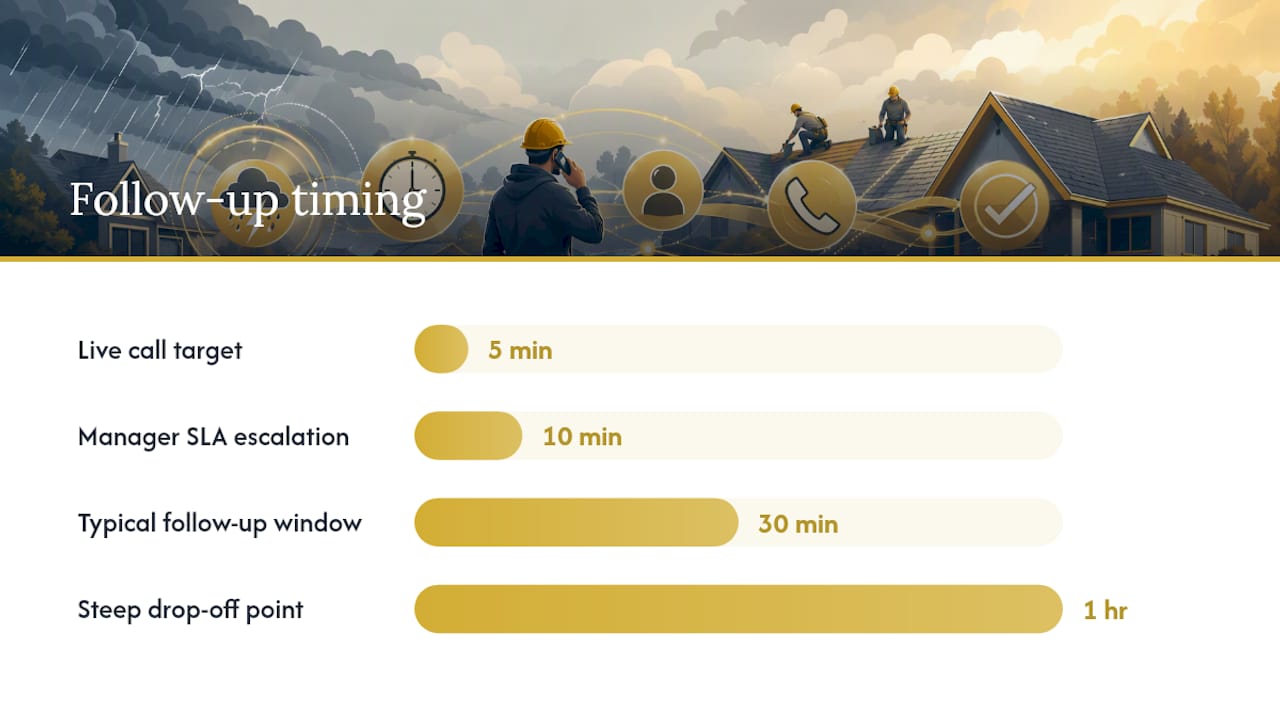
Speed to lead is the single biggest lever in this entire playbook, and it's the one roofers most often get wrong. Historical research on lead response found that contacting a web lead within five minutes rather than thirty minutes can multiply qualification rates by roughly 21 times, and the drop-off after the first hour is steep. Your ad creative and targeting can be flawless, but if follow-up lags, you're paying for leads that convert with your competitor instead.
- Fire an automated SMS within seconds of form submission. Something as simple as "Thanks for reaching out about your roof, we'll call you in the next few minutes to schedule your free inspection" keeps the lead warm while a human catches up.
- Attempt a live call within five minutes during business hours. Route this to whichever estimator or CSR is next in your call queue, not to whoever happens to check email first.
- Follow with a Messenger reply if the lead came through Facebook natively, since some homeowners respond faster there than by phone.
- Layer in a multi-day nurture sequence for anyone who doesn't answer, mixing texts, calls, and a final email offering a specific inspection time slot.
- Use an AI qualification script to confirm storm damage versus routine repair versus new construction, then route qualified leads straight to an estimator's calendar instead of a general queue.
Track the full chain: lead source, time to first contact, booked inspection date, and signed job value. Without that end-to-end view, you're optimizing ad spend based on lead volume alone, which tells you almost nothing about revenue.
Pro Tip: Set an internal SLA that flags any lead untouched after ten minutes and escalates it to a manager. A missed lead costs you the same ad dollars as a converted one, but returns nothing.
What Does a Working Setup Look Like in Practice?
Leapify Media builds this exact system for roofing clients from day one, not as an add-on months later. That means on-premise AI handling lead dispatch and intent scoring (so client data never routes through third-party servers), CRM wiring that connects instantly to Meta's Conversions API, and automated SMS and call routing configured before the first ad ever goes live.
A typical onboarding checklist looks like this:
- Pixel and Conversions API installed and verified on every landing page, not just the homepage.
- CRM stages mapped from "lead" to "inspection booked" to "job signed," with source attribution preserved at every step.
- Automated SMS and call-routing rules tested with dummy leads before real spend turns on.
- Storm-response campaign templates pre-built and ready to activate within hours of a weather event.
Leapify has reported client outcomes as high as a 20x return on ad spend, achieved specifically through this combination of clean tracking and fast follow-up, not creative alone.
Is Facebook the Right Channel or Just One Piece of the Plan?
Facebook works best as your lead engine when storm season hits or when you're pushing full replacements with video-driven trust. Google Ads still wins for homeowners actively searching "roof repair near me" right now, since that's intent Facebook can't replicate. If your follow-up system can't hit that five-minute window, fix that first. No targeting fix outperforms a fast callback.
Get Your Facebook Ad System Built and Wired to Your CRM
Everything in this playbook, the storm-window timing, the Pixel and CAPI setup, the five-minute follow-up automation, is exactly what Leapify Media builds for roofing companies from the first week of onboarding. Instead of handing your ad account to an agency that treats every home service business the same way, Leapify runs on-premise AI systems built specifically for roofing lead behavior, so your data stays private and your dispatch logic actually reflects how storm leads and replacement leads behave differently.
Clients working with Leapify have seen returns as high as 20x return on ad spend, driven by the combination of clean Meta tracking, CRM automation, and sub-five-minute lead response built into the system rather than bolted on afterward. If your current setup is missing any piece of this chain, from Pixel verification to instant SMS routing, that gap is likely costing you booked jobs every week. Visit Leapify Media's growth infrastructure page to see how the full system maps onto your existing ad account and CRM.
Frequently Asked Questions About Facebook Ads for Roofers
Do Facebook ads actually work for roofing contractors? They work reliably when paired with fast CRM follow-up and storm-aware creative, but underperform when leads sit unanswered or tracking is broken.
How much should a roofing company budget for Facebook ads?
What's the difference between Lead Ads and landing pages for roofing? Lead Ads generate higher volume with less friction, while landing pages typically produce higher-intent leads since homeowners choose to leave Facebook to submit information.
How fast do roofing leads need a response? Aim for contact within five minutes. Response speed is one of the strongest predictors of whether a Facebook lead turns into a booked inspection.
Should roofers run Facebook ads or Google Ads? Facebook tends to work best for replacements and storm response through video and retargeting, while Google Ads captures homeowners already searching for repair services right now. Many roofing companies run both.
Sources
- Roofing Facebook Ads Statistics & Benchmarks (2026) | Web Tonic™
- PipelineOn Quarterly Home Service Meta Ads Review: Q2 2026 | PipelineOn
- Americans' social media use (2025) | Pew Research Center