

A testimonial Facebook ad puts real customer voice at the center of your creative: a quote, a short clip, or a creator endorsement that proves a specific outcome rather than just claiming one. The one-line playbook: lead with a concrete transformation or measurable result, show a real person saying it, and include clear disclosure plus written usage consent before you spend a dollar.
Run these through Meta (Facebook) Ads Manager, follow FTC guidance on incentivized reviews, and you have a format that outperforms generic brand copy because it borrows credibility from someone the audience already trusts more than you. Leapify Media uses this exact framework for home service clients, and the sections below give you every format, script, compliance checkpoint, and swipe file you need to replicate it.
Pro Tip: Before building your first testimonial ad, pull the Facebook Ads Library and search your category. The testimonial formats competitors are scaling at volume tell you more about what works in your niche than any benchmark report.
Table of Contents
- What formats do testimonial ads take on Meta, and when should you use each?
- How do Meta's platform rules and features affect your testimonial ads?
- What FTC and state rules apply to testimonial ads, and what consent do you need?
- How do you collect, vet, and get permission for testimonials you can actually run as ads?
- What creative and copy patterns make testimonial ads actually convert?
- Where in your funnel should testimonial ads run, and which audiences work best?
- How do you measure testimonial ad performance and run A/B tests that give real answers?
- Ready-to-use testimonial ad swipe files with specs and disclosure snippets
- Why testimonial ads work: evidence and a Leapify Media client example
- Key Takeaways
- The part most marketers skip until it costs them
- Leapify Media builds the testimonial infrastructure home service companies need
- Official references and further reading
What formats do testimonial ads take on Meta, and when should you use each?
The format you choose should match your objective, your funnel stage, and how much production budget you have. Here are the formats that consistently earn their spend on Meta.
Video UGC (Reels and Feed): A customer films themselves on a phone, describing a before-and-after. Raw, slightly imperfect, and shot in portrait. This format works for prospecting because it looks like organic content and survives the scroll. Authentic UGC-style content tends to outperform polished corporate testimonials because viewers recognize peer-to-peer recommendation and don't immediately register it as an ad.

Short creator endorsement clips (15–30 seconds): A creator or micro-influencer delivers a testimonial tied to a specific result. Pair this with Meta's Partnership Ads to run it from the creator's handle, which adds a layer of credibility that brand-page ads can't replicate.
Static quote cards: A clean graphic with a customer quote, name, and photo. Best for retargeting audiences who already know your brand. They need less context, so a strong one-liner does the work.
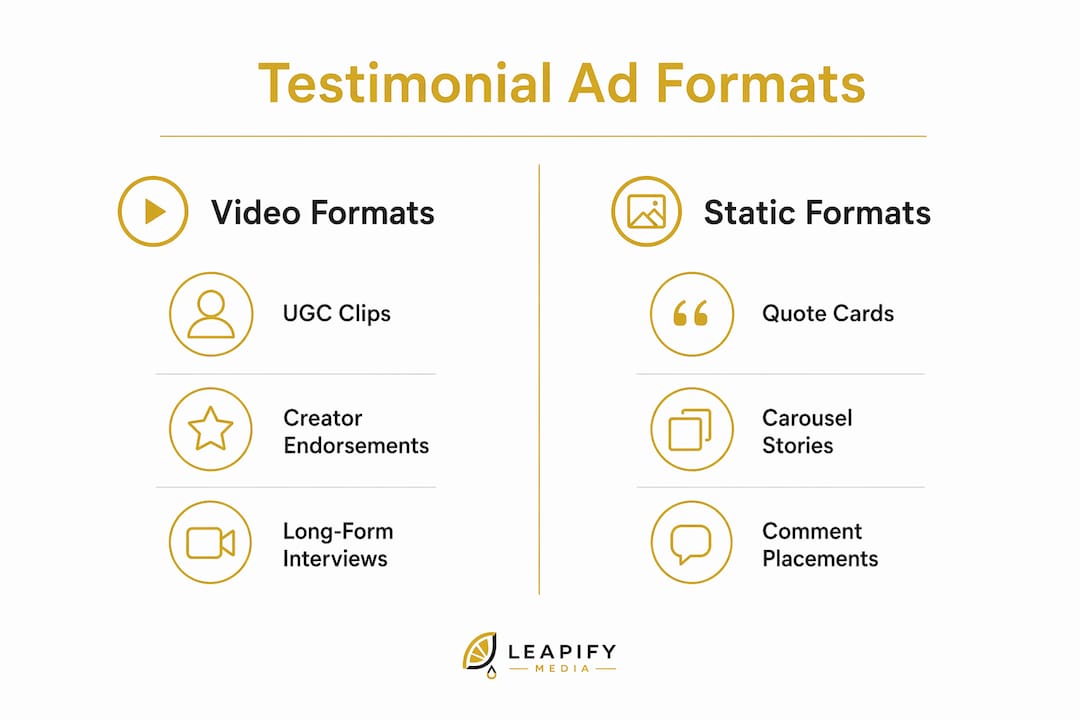
Carousel of micro-stories: Three to five cards, each featuring a different customer and a different result. Useful for products or services with multiple use cases. Each card handles a different objection.
Comment-testimonial placements: Pinning a strong customer comment under a paid post so it appears as the first visible response. Low production cost, high authenticity signal.
Creator endorsement via Partnership Ads testimonial field: Meta's dedicated testimonial field in Ad Setup displays the endorsement text directly under the CTA on Reels placements. This is the most structured format Meta offers for creator-backed social proof.
Format-to-objective mapping at a glance:
- Reels UGC and creator clips: top-of-funnel awareness and prospecting
- Static quote cards: mid-funnel retargeting and near-purchase nudges
- Carousel micro-stories: consideration stage, multi-objection audiences
- Partnership Ads testimonial field: creator-backed campaigns with paid disclosure
- Comment testimonials: always-on trust layer for any placement
Pro Tip: Long-form customer interviews are a goldmine. Pull the 15–30 second clip where the customer states the result most concisely, and use that as your lead hook. The full interview can live on YouTube or your website for E-E-A-T; the clip does the ad work.
How do Meta's platform rules and features affect your testimonial ads?
Meta has built specific infrastructure for testimonial-style advertising, and knowing where to find it saves you from running testimonials as generic ad copy when a dedicated placement exists.
The Partnership Ads testimonial field lives inside Ad Setup in Meta Ads Manager. When you run a Partnership Ads campaign with a creator, you can attach a short testimonial text that displays under the CTA on Reels placements. Meta's guidance recommends keeping this copy short and front-loaded, with the core value proposition in the first few words. The creator testimonial feature also integrates with collection ads, so you can combine a creator endorsement with a product catalog for shopping-oriented campaigns.
Required disclosures for paid partnerships: When a creator is compensated, Meta requires the "Paid partnership" label to appear on the post. This is non-negotiable and applies whether the creator is a major influencer or a local micro-creator. Skipping it risks ad removal and account restrictions.
Platform enforcement: Meta's Community Feedback policy explicitly addresses fake and incentivized reviews. Violations can result in review removal, loss of product tag access, and account suspension. Repeat offenders face permanent bans. The platform removed many fake review groups recently, and enforcement has only tightened since.
Steps to attach a testimonial in Meta Ads Manager:
- Open Ads Manager and create or edit a Partnership Ads campaign.
- In Ad Setup, look for the "Testimonial" field (available when a creator handle is linked).
- Enter your testimonial copy. Keep it under 125 characters and lead with the result.
- Confirm the "Paid partnership" label is active on the creator's end.
- Preview the Reels placement to verify the testimonial text appears under the CTA.
Pro Tip: If you don't have a creator partnership yet, you can still use the static quote card format in a standard ad. The Partnership Ads testimonial field is the premium version, but it requires a creator relationship first.
What FTC and state rules apply to testimonial ads, and what consent do you need?
The FTC's rules on testimonials are specific and enforceable. The FTC guide for marketers prohibits conditioning incentives on positive sentiment. You cannot tell a customer "leave us a five-star review and get 10% off." You can offer an incentive for leaving a review, but the incentive must be available regardless of whether the review is positive, negative, or neutral.
The FTC's 2024 final rule expanded enforcement tools to cover fake reviews, fake social indicators (purchased likes, followers, engagement), and insider reviews posted without disclosure. An employee who reviews their own employer's product without disclosing the relationship is in violation, even if the review is genuine.
The Consumer Review Fairness Act adds another layer: you cannot include contract clauses that penalize customers for honest reviews. Review your client agreements and service contracts to make sure nothing in the fine print restricts a customer's right to post an honest opinion.
Testimonial release agreement: essential clauses
- Identity confirmation: Full name, contact information, and confirmation that the person is a real customer.
- Authenticity representation: Statement that the testimonial reflects their genuine experience.
- Usage rights: Specific platforms, ad formats, and geographic scope where the testimonial may appear.
- Duration: The license term (start and end date, or "perpetual" if negotiated).
- Compensation disclosure: Any payment, discount, or free product received in exchange.
- Disclosure obligation: Agreement that any paid or incentivized use will carry required FTC disclosure language.
Disclosure best practices:
- For creator partnerships: "Paid partnership with [Brand]" label via Meta's native tool, plus verbal or on-screen disclosure in video.
- For incentivized customer reviews used in ads: add a line like "Customer received a discount in exchange for this review" in the ad copy or caption.
- For employee or insider testimonials: disclose the relationship clearly ("Our team member shares their experience").
Pro Tip: Start with a short-term usage license (90 days) when testing new testimonial creative. If the ad scales, negotiate an extension or perpetual rights. This keeps upfront costs low and avoids paying for long-term rights on creative that never performs.
How do you collect, vet, and get permission for testimonials you can actually run as ads?
A testimonial that can't be verified or doesn't have written consent is a liability, not an asset. Here's a workflow that gets you from outreach to ad-ready in a structured way.
Step-by-step collection workflow:
- Identify candidates: Pull recent customers with strong satisfaction signals (high NPS scores, repeat purchases, positive support interactions, or organic social mentions).
- Outreach: Send a short, personal message explaining you'd like to feature their experience in an ad. Be upfront about the format (video, quote, or both) and any compensation.
- Capture: Provide a simple submission method. A Loom or selfie video prompt works well for UGC. A short Google Form with open-ended questions works for written quotes. Avoid leading questions.
- Verify: Confirm the person is a real customer. Cross-reference their name and contact info against your CRM or purchase records. Timestamped receipts or order confirmations are your best documentation.
- Review for specificity: A good testimonial names a result ("my energy bill dropped $80 a month"), a timeframe, or a before-and-after. Generic praise ("great service!") rarely converts.
- Secure written consent: Send the release agreement before any ad goes live. Cover platforms, duration, compensation, and disclosure language.
- File and tag: Store consents with the creative assets. Tag by platform, license term, and expiration date so you know when to refresh or renegotiate.
Vetting checklist for authenticity:
- Purchase or service record on file
- Timestamped content (video metadata, form submission date)
- Verifiable contact details that match your customer database
- No scripted language that sounds like marketing copy
- No paid actor without explicit disclosure in the ad
What to avoid: Scripted responses written by your marketing team and delivered by a customer, paid actors presented as real customers without disclosure, and composite testimonials that blend multiple people's experiences into one fictional account.
Pro Tip: For home service businesses, the best testimonial capture moment is right after job completion, when satisfaction is highest. A simple follow-up text with a video prompt ("Can you share a quick 30-second video about your experience?") catches the emotion before it fades.
What creative and copy patterns make testimonial ads actually convert?
The formula that works across formats is: hook → result → evidence → CTA. The hook stops the scroll. The result tells the viewer what changed. The evidence (the real person, the specific detail) makes it believable. The CTA tells them what to do next.
Three swipe-copy examples by objective:
Lead generation (home services): "My AC was out in July. [Company] had someone here the same day and fixed it for less than I expected. If you need fast HVAC service, call them first." CTA: "Get a free same-day estimate."
Free trial (SaaS or service): "I was skeptical, but after two weeks I stopped using the old tool completely. The switch took 20 minutes." CTA: "Start your free 14-day trial."
Purchase (e-commerce): "I've tried four other brands. This one actually lasts. Worth every dollar." CTA: "Shop now — free shipping on orders over $50."
20–30 second video testimonial script template:
- 0–3 seconds (hook): Customer states the result immediately. "I saved $200 on my first month's energy bill."
- 4–12 seconds (problem): Brief context. "My old system was running constantly and I had no idea why."
- 13–22 seconds (result + evidence): Specific outcome with a detail. "They diagnosed it in an hour and replaced the part the same day. Bill dropped immediately."
- 23–28 seconds (CTA): Natural handoff. "If you're dealing with the same thing, just call them. I wish I had done it sooner."
Visual guidelines:
- Reels: 9:16 aspect ratio, 15–30 seconds, captions on (85% of videos are watched without sound)
- Feed: 1:1 or 4:5 for static quote cards, high-contrast text, customer photo or video thumbnail
- Text overlay: keep it to the key result stat or quote fragment, not a full paragraph
- Logos and offer callouts: place in the lower third, small enough not to compete with the customer's face or words
Pro Tip: For home service companies, showing the job site in the background of a video testimonial adds instant credibility. A homeowner standing in front of their new door, new HVAC unit, or freshly painted exterior tells the story before they say a word.
Where in your funnel should testimonial ads run, and which audiences work best?
Testimonial ads belong at every funnel stage, but the format and message should shift depending on how warm the audience is.
Funnel placement:
- Top of funnel (prospecting): Reels UGC and creator endorsements. The goal is awareness, so lead with the most dramatic transformation. Audiences here don't know you, so the testimonial does the introduction.
- Mid-funnel (consideration): Carousel micro-stories and static quote cards targeting people who've engaged with your content or visited your site. Address specific objections each customer had before buying.
- Bottom of funnel (near-purchase): Single strong testimonial with a direct offer. Retarget people who viewed a product or service page but didn't convert. One compelling result plus a clear CTA is enough.
Three audience recipes:
- Lookalike from converters: Build a 1–2% lookalike audience seeded with your best customers (highest LTV or most recent purchasers). Run your strongest UGC testimonial here for prospecting.
- Website engagers (30–180 days): Segment by behavior. People who visited a specific service page get a testimonial relevant to that service. Don't show a roofing testimonial to someone who only looked at HVAC pages.
- Recent visitors who didn't convert: Retarget with a short, punchy testimonial that addresses the most common objection for that page. Pair it with a time-sensitive offer if your margin allows.
For home service businesses, HVAC lead generation campaigns that use testimonial retargeting consistently outperform generic brand retargeting because the social proof closes the trust gap that price alone can't close.
Budget distribution guidance: Allocate a notable portion of your creative-testing budget to testimonial variations. Once a testimonial creative hits your target CPA threshold, shift more budget toward it and reduce spend on non-testimonial variants.
Pro Tip: Don't run the same testimonial ad to cold and warm audiences simultaneously. Cold audiences need context and transformation. Warm audiences need a nudge and a result. Same creative rarely serves both.
How do you measure testimonial ad performance and run A/B tests that give real answers?
Primary KPIs to track:
- Click-through rate (CTR): baseline signal for whether the hook is working
- View-through rate (for video): tells you if people are watching past the first few seconds
- Conversion rate: the real measure of whether the testimonial is persuasive
- Cost per acquisition (CPA): compare against non-testimonial creative in the same campaign
- Incrementality signals: use Meta's conversion lift studies when budget allows
Secondary engagement metrics: saves, shares, and comment sentiment. A testimonial ad that generates comments like "I had the same experience" is building social proof in real time.
A/B test recipes:
- Testimonial vs. no-testimonial: Same offer, same CTA, same audience. One ad features a customer quote or clip; the other leads with a product/service benefit. This isolates the social proof effect.
- UGC-style vs. polished: Same testimonial content, two production levels. Raw phone video vs. edited studio version. Most categories favor UGC, but test your specific audience.
- Pinned testimonial field vs. comment highlight: For Partnership Ads, test whether the structured testimonial field outperforms a pinned comment testimonial on the same creative.
Measurement checklist:
- Run each test for at least 7 days with enough impressions to reach statistical significance
- Don't change the audience or budget mid-test
- Account for attribution windows: Meta's default 7-day click / 1-day view may overcount for longer consideration cycles
- Refresh testimonial creative every 4–6 weeks to avoid creative fatigue
Benchmark sanity-check table:
| Metric | Conservative Benchmark | Notes |
|---|---|---|
| CTR (Feed) | — | Higher for strong UGC hooks |
| CTR (Reels) | — | Video format typically outperforms static |
| CPC | — | Varies by industry and objective |
| CPM | — | Audience and placement dependent |
| CPA | $20–$40 | Wide range by vertical |
| Video view-through (high rate) | 30–50% | Benchmark for 15–30 second clips |
Pro Tip: Don't declare a winner after 48 hours. Meta's algorithm needs time to optimize delivery. A testimonial ad that looks weak on day two often outperforms on day seven once the system finds the right sub-audience.
Ready-to-use testimonial ad swipe files with specs and disclosure snippets
Creative specs reference table:
| Placement | Aspect Ratio | Recommended Video Length | Max Testimonial Field (Meta) | Disclosure Placement |
|---|---|---|---|---|
| Reels | 9:16 | 15–30 seconds | ~125 characters | On-screen text + "Paid partnership" label |
| Feed (video) | 1:1 or 4:5 | 15-30 seconds | N/A (ad copy field) | Caption or on-screen |
| Feed (static) | 1:1 or 4:5 | N/A | N/A (ad copy field) | Caption below quote |
| Stories | 9:16 | 5–15 seconds | N/A | On-screen text overlay |
Swipe file templates:
1. Home services lead (Reels UGC) Objective: Lead generation | Placement: Reels Script: "I called [Company] on a Monday morning. They were at my house by noon and fixed the problem the same day. I've used three other companies before — none of them were this fast." CTA: "Book a free estimate today." Disclosure: "Customer shared their experience. Results may vary."

2. Static quote card (Feed retargeting) Objective: Conversion | Placement: Feed Copy: "[Customer Name], [City]: 'Saved $150 on my first service call. Wish I'd found them sooner.'" CTA: "See if we serve your area." Disclosure: "Real customer. No incentive provided."
3. Creator endorsement (Partnership Ads testimonial field) Objective: Awareness/prospecting | Placement: Reels Testimonial field copy (under 125 characters): "Best home upgrade I've made this year. Fast install, fair price, and they cleaned up after." Disclosure: Meta "Paid partnership" label active.
4. Carousel micro-story (Consideration) Objective: Consideration | Placement: Feed carousel Card 1: "[Name]: 'The quote was lower than I expected.'" Card 2: "[Name]: 'They finished in half the time they quoted.'" Card 3: "[Name]: 'I've already referred three neighbors.'" CTA on final card: "Get your free quote." Disclosure: "Real customers. Experiences may vary."
5. Video testimonial with offer callout (Bottom of funnel) Objective: Purchase/booking | Placement: Feed video Script: "I was going to wait until spring, but they had a winter special. Ended up saving $300 and the job was done before the holidays." Lower-third text: "Limited-time offer: $X off your first service." CTA: "Claim your discount." Disclosure: "Customer received a promotional rate. Offer subject to availability."
6. Stories quick-hit (Retargeting) Objective: Retargeting nudge | Placement: Stories Copy: "Still thinking about it? Here's what [Name] said after booking: 'Best decision I made this year.'" CTA: "Book now." Disclosure: "Real customer review."
Disclosure snippet library:
- Paid creator: "Paid partnership with [Brand name]" (Meta native label + on-screen)
- Incentivized customer: "Customer received [discount/free product] in exchange for this review."
- Organic customer, used with permission: "Real customer. Used with permission. Results may vary."
- Employee/insider: "[Name] is a [role] at [Company]. Their experience reflects their own views."
Pro Tip: Keep a living swipe file folder in Google Drive or Notion with your top-performing testimonial scripts, consent forms, and disclosure snippets. When a new campaign starts, you pull from the folder instead of starting from scratch. The best-performing creative usually just needs a new hook, not a full rebuild.
Why testimonial ads work: evidence and a Leapify Media client example
Social proof works because people use others' decisions as a shortcut for their own. When someone sees a real person describe a specific result, the cognitive load of evaluating a product drops. Meta's own platform guidance emphasizes that testimonials focused on transformation or specific outcomes drive stronger conversion signals than generic endorsements, because specificity makes the claim credible and the outcome imaginable.
The mechanism is straightforward: a vague claim ("great service!") requires the viewer to do interpretive work. A specific claim ("they replaced my water heater in four hours and it cost $400 less than the other quote") does the work for them.
Leapify Media applied this framework for a home service client running Meta campaigns. The campaign replaced generic brand creative with UGC-style video testimonials focused on same-day service and cost savings. The client reported a very high return on ad spend across the campaign period, with testimonial creative driving the majority of booked jobs. Measurement used Meta's conversion tracking tied to CRM job records, with a 7-day click attribution window. The result reflects a specific client outcome and individual results will vary based on market, service type, and ad spend.
For contractors and home service operators, the combination of testimonial creative and precise audience targeting consistently outperforms broad brand awareness campaigns because the purchase decision is local, high-stakes, and trust-dependent.
Pro Tip: When presenting a case study internally or to a client, always note the attribution method and window. "20x ROAS" means something different with a 28-day view-through window than with a 7-day click window. Transparency about measurement builds more credibility than the number alone.
Key Takeaways
Testimonial Facebook ads convert when they lead with a specific result, feature a verifiable real person, and carry proper disclosure — everything else is execution detail.
| Point | Details |
|---|---|
| Lead with a specific result | Vague praise doesn't convert; name a number, a timeframe, or a before-and-after outcome. |
| Use Meta's Partnership Ads testimonial field | Keep copy under 125 characters, front-load the value, and activate the "Paid partnership" label for creator campaigns. |
| Follow FTC rules on incentivized reviews | Never condition an incentive on positive sentiment; disclose any compensation clearly and conspicuously in the ad. |
| Collect written consent before running ads | Capture identity, usage rights, platforms, duration, and compensation in a signed release before any creative goes live. |
| Leapify Media's approach | Leapify Media builds testimonial-driven Meta campaigns for home service businesses, combining UGC sourcing, AI lead tracking, and creative testing to drive booked jobs. |
The part most marketers skip until it costs them
Most marketers spend 90% of their time on creative and 10% on consent. That ratio should be closer to 70/30, especially now that the FTC has a final rule with real enforcement teeth and Meta's platform policies have caught up with the regulatory direction.
The authenticity-versus-scale tension is real, but it's not the dilemma it looks like. You don't need 50 perfect testimonials. You need three to five that are specific, verified, and properly licensed. One strong UGC clip with a real result and a 90-day usage license will outperform a library of vague five-star quotes every time. Accept imperfect production. Reject imperfect consent.
For small teams, the practical shortcut is a two-document system: a one-page release template and a swipe file of disclosure snippets. Both live in a shared folder. Every testimonial that comes in gets processed through both before it touches an ad account. That's the whole compliance workflow.
On measurement: resist the urge to attribute every booked job to the testimonial creative. Run a clean A/B test, track incrementality where you can, and report what the data actually supports. Overclaiming ROAS on testimonial ads is how you lose trust with clients and with yourself.
Leapify Media builds the testimonial infrastructure home service companies need
Home service businesses sit in one of the highest-trust-required categories in advertising. A homeowner letting a stranger into their house to fix their HVAC or replace their doors needs more than a good offer. They need proof from someone who already took that risk and came out ahead.
Leapify Media's Meta Ads management for home service operators is built around exactly this: sourcing real customer testimonials, producing UGC-style creative, running structured A/B tests, and tracking results through on-premise AI lead dispatch tied directly to CRM job records. The result for one client was a reported 20x return on ad spend, with testimonial creative driving the majority of conversions. For a One Day Doors & Closets dealer, that kind of social proof is the difference between a scroll and a booked appointment.
If you're running Meta ads for a home service business and your testimonial creative isn't pulling its weight, see what Leapify Media builds for operators who want booked jobs, not just impressions.
Official references and further reading
- Meta Partnership Ads and the testimonial field — explains where the testimonial field appears in Ad Setup and how it displays on Reels placements.
- Meta Partnership Ads creator testimonial updates — covers the full scope of creator testimonial features including collection ad integration.
- FTC guide: soliciting and paying for online reviews — the primary compliance reference for any marketer running incentivized testimonial campaigns.
- FTC final rule on fake reviews (2024) — explains expanded enforcement tools and what now qualifies as a deceptive testimonial practice.
- Consumer Review Fairness Act overview — explains what contract clauses are prohibited and how to audit your service agreements.
- Meta's fake review crackdown — platform-level enforcement context and the consequences of policy violations.
- Facebook Ads cost benchmarks — CPC, CPM, and CPA ranges for sanity-checking testimonial ad performance against industry norms.