
Run Local Services Ads alongside high-intent Search campaigns and call-only ads, and put call tracking plus a dedicated emergency landing page behind all three before you spend another dollar. That mix catches homeowners the moment water hits the floor, when they're searching on a phone and deciding who answers first. Cost per click will run higher than in most home-service categories, but close rates climb fast once tracking and lead qualification are dialed in.
TL;DR:
- Prioritize Local Services Ads and call tracking with dedicated emergency landing pages, as they convert most effectively on mobile during urgent water damage searches.
- Split ad campaigns by service and urgency, using tight match types and clear naming conventions to optimize quality score and cost-efficiency.
- Allocate roughly 20-25% of your budget to discovery, 50-60% to proven exact keywords, and 10-15% to retargeting, adjusting bids based on time and device during peak hours.
- Focus on call-answer rates, fast landing page loads, and robust call tracking to ensure leads translate into booked jobs rather than just calls.
- Regularly audit search terms, utilize dayparting and geofencing, and incorporate competitor insights and proper compliance to reduce waste and improve campaign performance.
Table of Contents
- Which Google Ad Products Actually Book Water Damage Jobs?
- How Should You Structure Restoration Ad Accounts?
- What's a Smart Budget Split for Restoration PPC?
- Ad Copy and Phone Workflow: Turning Clicks Into Booked Jobs
- Landing Pages and Conversion Tracking That Protect Expensive Clicks
- What KPIs Actually Tell You If Your Campaigns Are Profitable?
- Scaling Without Wasting Budget: Negatives, Dayparting, Geofencing
- How Leapify Runs This Playbook in Practice
- Competitor Analysis and Differentiation for Restoration Ads
- Compliance and Legal Considerations for Emergency Service Ads
- How Do Seasons Change Water Damage Ad Bidding?
- Fast Priorities When Auditing a Restoration Ad Account
- Get This Playbook Running Without Managing It Yourself
- Sources
Which Google Ad Products Actually Book Water Damage Jobs?
Not every ad product deserves the same budget, and treating them as interchangeable is how restoration companies burn cash chasing clicks that never convert. Each one solves a different piece of the emergency-lead puzzle.
Local Services Ads (LSAs) sit above regular Search results and are built for exactly this kind of urgent, local intent. They charge per lead instead of per click, and Google's own research on near-me and immediate-intent searches shows these queries convert heavily on mobile because the searcher wants someone on-site within the hour, not a quote next week. LSAs also weight ranking toward providers with strong ratings and fast response, so a restoration company with solid reviews often outranks a bigger competitor with a thin profile. Prioritize LSAs first if your Google Business Profile has real reviews and you can staff phones around the clock.
Search campaigns give you the message control LSAs don't. You write the headline, control the landing page, and can bid aggressively on phrases like "water damage restoration near me" or "emergency flood cleanup" without waiting on Google's lead-matching algorithm. Search is where you test urgency-driven copy and route traffic to service-specific pages.
Call-only ads strip out the click-through step entirely. On mobile, the ad itself is the phone call button. These work best when:
- Your team can answer calls in under 20 seconds during business hours
- After-hours calls route to a live answering service, not voicemail
- You're bidding on the most transactional terms, not research-phase queries
Performance Max and Smart campaigns work as data-gathering engines rather than precision tools. Google's automated bidding pulls from your entire conversion history to find patterns, which sounds appealing but often blends emergency leads with lower-value branded or informational traffic. Run Performance Max only after your Search and LSA data is mature, and cap its budget until you can see which segments it's actually pulling from.
How Should You Structure Restoration Ad Accounts?
Account structure determines whether Google understands your business or just sees a pile of loosely related keywords. Restoration companies that lump "water damage," "mold remediation," and "fire cleanup" into one campaign dilute their Quality Score and make it nearly impossible to tell which service line is actually profitable.
- Split campaigns by service and urgency. A basement flood is a different buyer than someone researching mold remediation for a home sale. Separate "Emergency Water Damage" from "Mold Remediation" from "Storm Damage Cleanup" so each campaign can carry its own budget, bid strategy, and ad copy tuned to how urgently that customer needs help.
- Build tight ad groups around match type discipline. Start new keywords in phrase or exact match rather than broad match, then mine the search-terms report weekly to promote winning queries into their own exact-match ad groups. This is the harvesting step that keeps CPCs from drifting upward as Google's algorithm tries to "help" by broadening reach.
- Map every conversion action to its campaign. A phone call from the Emergency Water Damage campaign should be tagged distinctly from a form fill on the Mold Remediation page. Without that separation, you can't tell which service line is generating your best revenue per lead, only a blended average that hides winners and losers.
Naming conventions matter more than most owners think. A campaign labeled "WaterDamage_Emergency_Search_US" tells you at a glance what it is, what it targets, and which product it runs on, which saves real time once you're managing five or six campaigns instead of one.
What's a Smart Budget Split for Restoration PPC?
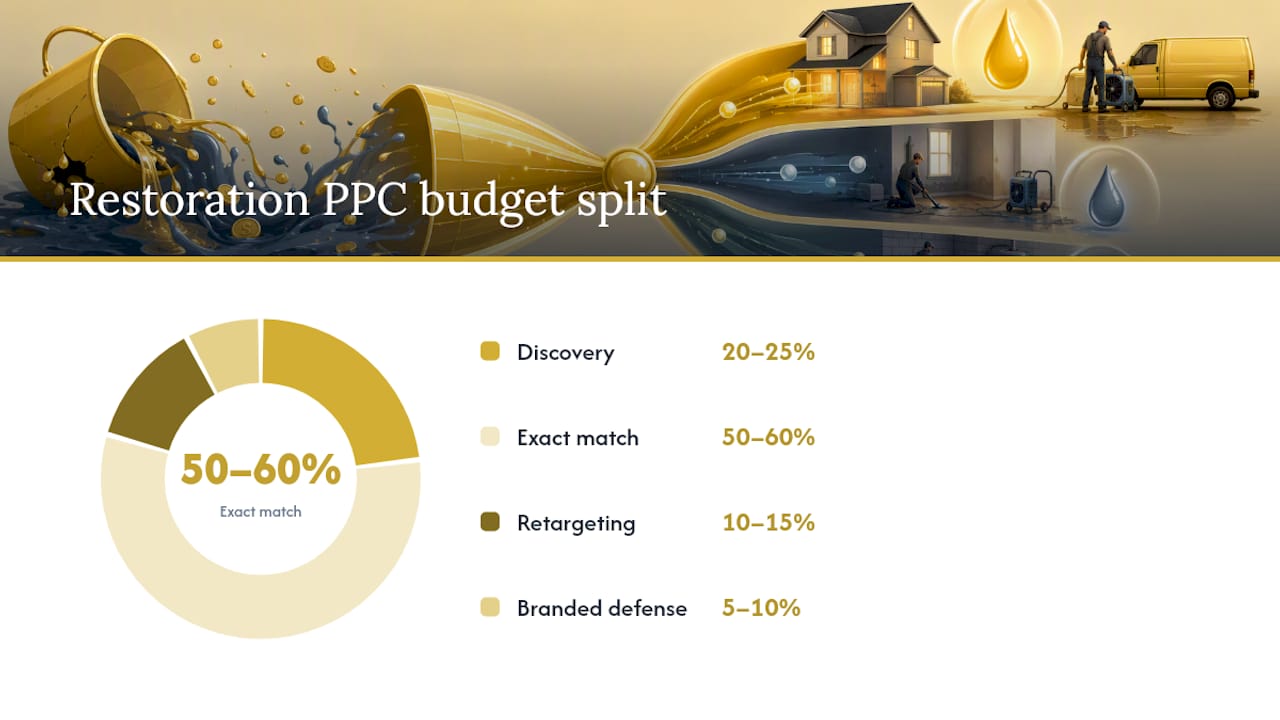
Budget allocation for restoration PPC should follow a discovery-to-exact model rather than dumping everything into your top five obvious keywords. Roughly a quarter of budget goes toward discovery (broader match testing to surface new high-intent phrases), the bulk toward proven exact-match terms once they're validated, and a smaller slice toward retargeting people who called but didn't book.
- Discovery (20 to 25%): Test phrase-match variations and new geographic terms to find what actually converts in your market.
- Exact match, proven winners (50 to 60%): Once a keyword shows a consistent cost-per-lead, move most of your spend behind it.
- Retargeting and remarketing (10 to 15%): Recapture the homeowner who called during a chaotic moment and hung up before booking.
- Branded and reputation defense (5 to 10%): Protect your business name from competitors bidding on it.
Emergency terms deserve bid multipliers tied to time and device. A basement flood at 2 a.m. is worth more per click than the same search at 2 p.m., because fewer competitors are actively bidding and the searcher is closer to booking. Increase bids during overnight hours if your team actually answers overnight, and raise mobile bid adjustments since most emergency searches happen on a phone in a wet basement, not at a desktop.
and 8 a.m. Most restoration companies get outbid during exactly the hours when competitors go to sleep.*
Quality Score has an outsized effect on what you actually pay. Restoration keywords already run expensive, with published cost analyses reporting top-of-page bids between $90 and $250-plus in competitive metros, and a low Quality Score can push your real CPC well past even those numbers. LocaliQ's search-advertising benchmarks give a useful baseline for expected click-through and conversion rates across home-service verticals, which helps you tell whether your account is underperforming or simply operating in an expensive category.
Ad Copy and Phone Workflow: Turning Clicks Into Booked Jobs
The click is the cheap part. What happens on the call decides whether that $150 lead becomes a $4,000 job or a wasted line item.
Urgency language works when it's specific, not generic. "We respond in 60 minutes, 24/7" beats "Fast, reliable service" because it gives the searcher a number to trust. Response-time promises in headlines and descriptions consistently pull more calls than vague reassurance copy, largely because the searcher is already panicking and wants a concrete answer.
Extensions matter more in restoration than almost any other home-service category:
- Call extensions on every Search ad, so desktop users can still click to call
- Sitelinks pointing to service-specific pages: water extraction, mold remediation, storm damage
- Structured snippets listing certifications, insurance work, and 24/7 availability
- Location extensions to reinforce local presence and build trust with map-pack visibility
Call-only ads should be reserved for the most transactional keyword set, since they remove the option to browse your site first, and structure them so the display line reads like a promise, not a slogan.
The phone script itself feeds your optimization loop. Every call should capture disposition data: was it an emergency, a booked job, a price-shopper, a wrong number? That data, fed back into your CRM and imported as offline conversions, tells Google Ads which keywords produce real revenue instead of just phone activity. Without disposition tracking, you're optimizing toward calls, not toward booked jobs, and those are not the same thing.
Landing Pages and Conversion Tracking That Protect Expensive Clicks
At $90 to $250 per click, a landing page that loads slowly or buries the phone number is lighting money on fire. Every emergency click needs a page built for one decision: call now or leave.
The anatomy of a page that actually converts looks like this:
- Click-to-call button above the fold, visible without scrolling on mobile
- One or two qualifier questions ("Is water actively flowing?" "Is this a health hazard like sewage backup?") that help your team triage before they even pick up
- Social proof placed high, not buried at the bottom: review counts, response-time stats, before-and-after completion photos
- Certification badges, since credentials from a body like the IICRC signal professional standards to a homeowner who has no idea how to evaluate a restoration company under stress
Call tracking is non-negotiable at this price point. A dynamic number insertion setup tells you exactly which campaign, ad group, and keyword generated each call, and importing those calls as offline conversions back into Google Ads and Analytics lets the platform's bidding algorithms actually learn from real outcomes instead of guessing from click data alone.
Page speed and mobile experience aren't cosmetic concerns here, they're Quality Score inputs. A page that takes four seconds to load on a 4G connection in a flooded basement loses the click before the phone number even renders. Structured data (LocalBusiness schema, service-area markup) doesn't just help SEO, it reinforces the relevance signals Google uses to determine your ad rank and real cost per click.
What KPIs Actually Tell You If Your Campaigns Are Profitable?
Clicks and impressions are vanity numbers in restoration PPC. The metrics that matter measure whether ad spend is turning into revenue.
| KPI | What it measures | Why it matters |
|---|---|---|
| Cost per lead (CPL) | Total spend divided by qualified calls/forms | Tells you the real price of a lead before it's a job |
| Close rate | Booked jobs divided by qualified leads | Reveals whether your phone team is converting what ads deliver |
| Revenue per booked job | Average job value from CRM data | Connects ad spend to actual dollars, not just lead volume |
| Blended ROAS | Total revenue divided by total ad spend | The final scorecard across all campaigns combined |
CPL alone can be misleading. Attribution has to connect the phone call all the way through to the invoice, which means your CRM and your ad platform need to talk to each other, not operate as two separate systems that never reconcile.
Local benchmarks vary by market density and season, so use published CPC and CPL ranges as a starting reference point, not a target to hit exactly. A rural market with fewer restoration competitors will consistently undercut the top-of-page bids reported in dense metro areas.
Scaling Without Wasting Budget: Negatives, Dayparting, Geofencing
Growth in restoration PPC comes from cutting waste as much as from raising bids. Three habits keep budget pointed at buyers instead of tire-kickers.
- Run a weekly search-terms audit and add negative keywords for anything that isn't a buying intent, DIY searches, job-seeker queries, competitor brand names showing up organically. This single habit often does more for CPL than any bid adjustment.
- Use dayparting and automated rules to pull back spend during hours your team can't answer, since a call that goes to voicemail at 3 a.m. is a wasted lead if nobody's there to pick up. If you staff 24/7, this step doesn't apply, but confirm that claim is actually true before assuming it.
- Geofence to serviceable ZIP codes only, and set location targeting to "presence" rather than "interest," so you're not paying for someone in another state who's merely searching about a city you serve.
How Leapify Runs This Playbook in Practice
Most agencies bolt a generic AI tool onto a restoration account and call it optimization. Leapify Media built its lead-scoring and dispatch infrastructure in-house, running on on-premise servers rather than routing client data through third-party AI platforms, which keeps call and conversion data proprietary to the client instead of shared across a vendor's broader dataset.
The gap between an average restoration Google Ads account and a high-performing one usually isn't the ad copy. It's whether offline conversions, like a closed $6,000 mold job, ever make it back into the platform so bidding algorithms can learn from real revenue instead of just call volume.
Competitor Analysis and Differentiation for Restoration Ads
Auction Insights inside Google Ads shows exactly who you're competing against for restoration keywords in your market, and most owners never open that report. Check impression share and overlap rate monthly to see whether a national franchise or a well-funded local competitor is consistently outbidding you.
Differentiation in restoration advertising rarely comes from price, since most homeowners in an emergency aren't comparison shopping on cost. It comes from response-time claims you can actually back up, certifications a competitor lacks, and review counts that outnumber theirs. If a competitor's ad copy leans on "24/7 service" but their Google Business Profile shows spotty review activity after 9 p.m., that's a real gap worth exploiting in your own copy.
Ad copy testing against a specific competitor claim works better than generic differentiation. If competitors all say "fast response," test copy that says "60-minute average arrival, tracked and guaranteed" instead. Specificity reads as credibility, especially to someone deciding who to call while standing in an inch of water.
Watch competitor landing pages too. A rival running the same keywords but sending traffic to a slow, generic homepage instead of a dedicated emergency page is bleeding conversions they don't know about, and that's an opening for a company with a tighter setup to win the same searcher at a similar bid.
Compliance and Legal Considerations for Emergency Service Ads
Google enforces specific policies around emergency and disaster-related advertising, and restoration companies get flagged more often than other home-service categories because "water damage," "flood," and "emergency" can trigger sensitive-event policies during active weather disasters. Review Google's advertising policies before launching new campaigns during a declared local emergency, since ad approval can be delayed or restricted in affected ZIP codes.
Claims in ad copy need to be defensible. If your ad promises "certified technicians," you should actually hold the credentials referenced, and something like IICRC certification is the standard most homeowners and insurance adjusters recognize. Overstating licensing, insurance coverage, or guaranteed response times in ad copy isn't just a policy risk, it's a liability risk if a customer holds you to a promise you can't keep.
Call recording for quality assurance and training carries state-level consent requirements that vary significantly. Some states require one-party consent, others require all-party consent before a call can be recorded, so confirm your call-tracking vendor's disclosure language matches the law in every state you advertise in, not just the one where your business is headquartered.
Pricing transparency matters too. Insurance-related restoration work often involves complex billing, and ad copy that implies "free" service when the actual arrangement involves insurance deductibles or direct billing can create disputes down the line. Keep the language accurate rather than optimized purely for click appeal.
How Do Seasons Change Water Damage Ad Bidding?
Restoration demand isn't steady, and treating your budget as flat year-round leaves money on the table during peak months and wastes it during slow ones. Hurricane season, spring thaw, and winter freeze-and-burst periods each create distinct demand spikes tied to specific geographies.
Coastal and Gulf markets see the sharpest surges during hurricane season, when search volume and competitor bidding both spike simultaneously, pushing CPCs higher right when you need visibility most. Northern markets see a different pattern: burst-pipe searches climb sharply during hard freezes, then spring thaw brings a second wave tied to basement flooding as snowmelt overwhelms drainage.
Budget planning should anticipate these windows rather than react to them. Increase daily budget caps and bid ceilings in the weeks leading into a known seasonal risk period, based on historical weather patterns for your service area, rather than waiting until competitors have already bid up the category. Conversely, pull back discovery spend during predictably slow months, like mid-summer in most inland markets, and redirect that budget toward retargeting and reputation-building campaigns instead.
Storm-triggered demand spikes are the hardest to plan for but the most valuable to catch early. Setting up automated bid rules that respond to sudden search volume increases in your service area can help you capture emergency demand before competitors even notice the spike happening.
Fast Priorities When Auditing a Restoration Ad Account
When I open a restoration account for the first time, I check call answer rate and landing page load speed before I look at a single bid. Both determine whether the traffic you're already paying for converts, and fixing them costs nothing compared to raising budgets on a leaky funnel.
After that, I look at whether LSAs and Search are pulling their separate weight, since LSAs win on immediate trust while Search wins on message control, and blending their data muddies both. Then I check how much spend is still sitting in discovery versus how much has graduated to exact match. Slow migration from discovery to exact is the single most common reason restoration accounts overpay for leads they could be getting cheaper.
— Everson Gorski
Get This Playbook Running Without Managing It Yourself
Building this account structure, connecting call tracking to real revenue data, and keeping bids tuned to weather-driven demand spikes is a full-time job most restoration owners don't have hours for. Leapify Media runs this exact infrastructure for home service companies, using in-house AI dispatch and on-premise servers so your call and conversion data never gets shared across a vendor's broader client pool.
Leapify handles the full loop: Google Ads account setup, call tracking, emergency landing pages, and offline conversion imports that feed real booked-job revenue back into your bidding strategy. If your current setup has all the pieces but nothing talking to each other, a managed Google Ads service built for home service businesses is the fastest way to close that gap. Request an audit through Leapify Media to see exactly where your current account is leaking budget before you spend another month guessing.
Sources
- Think with Google — near-me searches and consumer intent
- Google Ads — official product information
- IICRC — standards for restoration