

A Google Ads management service is a specialized practice of planning, executing, and continuously refining paid search campaigns to maximize real customer conversions while cutting wasted ad spend. For home service businesses, this is not optional maintenance. It is the difference between a phone that rings and a budget that quietly drains. Professional management typically delivers conversion increases of 40–200% and cost-per-lead reductions of 30–50% within 60 days. Those numbers reflect what disciplined, ongoing campaign management produces compared to campaigns left unattended after launch.
What does a Google Ads management service actually include?
Paid search advertising management covers far more than writing ads and setting a budget. The industry term for the full practice is PPC campaign management, and it runs on a repeatable operational cycle, not a one-time setup.
The foundation is account structure. A proper audit identifies wasted spend, mismatched keywords, and missing negative keyword lists. Negative keywords alone can eliminate a significant share of irrelevant clicks before they ever cost you money. After the audit, campaigns get restructured around service lines, geography, and customer intent, so a plumbing company in Dallas is not paying for clicks from homeowners searching for DIY pipe repair videos.

Conversion tracking is the next non-negotiable. AI bidding only performs well with accurate, clean conversion data, including server-side tracking and offline conversion imports. Without reliable signals, Google's machine learning optimizes toward the wrong outcomes. For home service businesses, that means setting up call tracking, form submission tracking, and filtering out calls shorter than one minute, which rarely represent real customer intent.
The ongoing management cycle follows a structured rhythm:
- Daily: Check spend pacing and flag any budget overruns or underdelivery.
- Weekly: Run 60–90 minute optimization loops covering search term reviews, bid adjustments, and ad performance checks.
- Monthly: Reallocate budget across campaigns based on what is converting.
- Quarterly: Conduct a full account audit covering structure, audiences, landing pages, and bidding strategies.
Ad copy testing runs continuously alongside this cycle. Rotating headlines, testing calls to action, and updating seasonal offers all contribute to improving click-through rates and conversion rates over time.
Pro Tip: Never pause ad copy testing entirely, even when a campaign is performing well. A single headline change can shift conversion rates by double digits.
What do fees, budgets, and tools look like?
Understanding the cost structure of paid search advertising management prevents surprises and helps you evaluate whether a management partner is priced fairly.
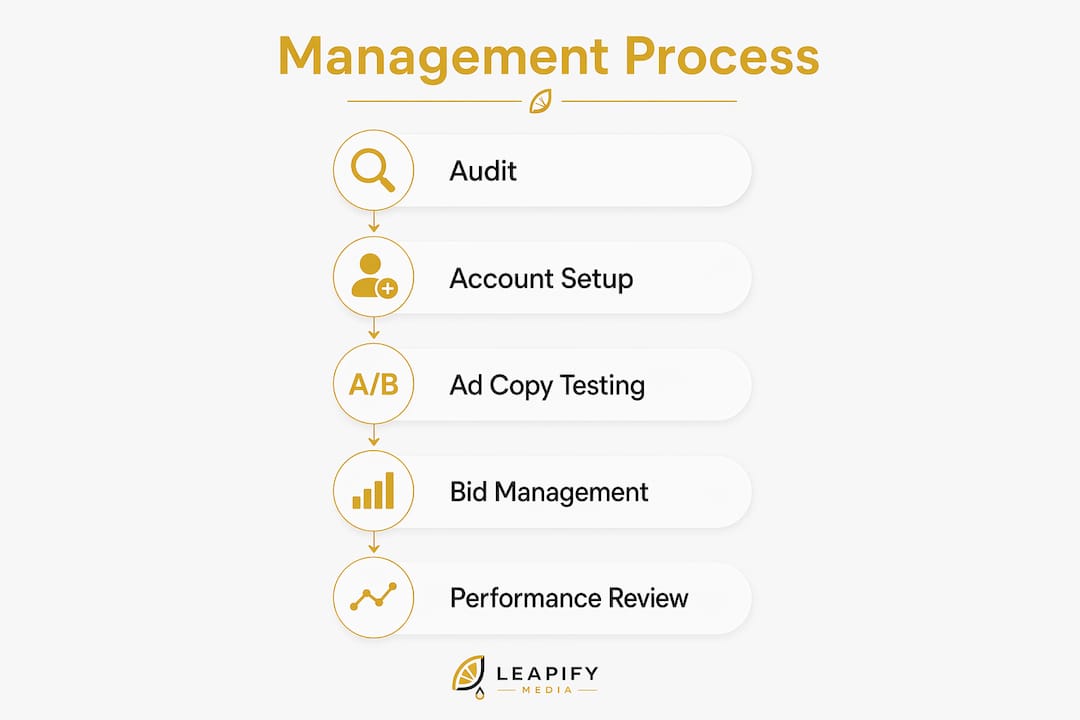
Management fees typically fall into two models: flat monthly retainers ranging from $1,500 to $5,000, or a percentage of ad spend at 10–20%. Smaller home service businesses often pay flat retainers in the $300–$2,000 range depending on account complexity. The percentage model scales with your budget, which can work in your favor when spend is low but becomes expensive as campaigns grow.
Ad budget minimums matter for a specific reason. AI-driven bidding strategies require a minimum monthly ad budget of $2,000–$5,000 to gather enough conversion data for the algorithm to function correctly. Below that threshold, Smart Bidding does not have enough signal volume to make reliable decisions. Home service businesses spending less than $2,000 per month are often better served by manual or enhanced CPC bidding until volume increases.
The tools used in professional management include Google Ads Editor for bulk changes, Google Analytics 4 for behavior tracking, call tracking platforms for phone lead attribution, and reporting dashboards that show real business outcomes rather than vanity metrics like impressions.
Account ownership is a critical protection. You should own your Google Ads account directly, with any agency receiving only manager access through a Google Manager Account (MCC). This preserves your full campaign history and data if you ever switch providers. Never let an agency create the account under their own login.
Pro Tip: Before signing with any AdWords management agency, confirm in writing that the account is created under your business email and that you hold admin access.
How to implement or choose a Google Ads management service
Selecting or launching professional management follows a clear sequence. Skipping steps early creates problems that compound over months.
-
Audit your existing account. Pull a search terms report and identify what you have been paying for. Look for irrelevant queries, duplicate keywords, and missing negative keywords. This single step often reveals 20–30% of spend going to unqualified traffic.
-
Define your conversion actions. Decide what counts as a real lead. For most home service businesses, that means phone calls longer than one minute and form submissions with a valid service address. Set these up in Google Ads with proper tracking before launching any campaign.
-
Build or restructure campaigns by service and geography. A roofing company should have separate campaigns for roof repair, roof replacement, and emergency leak service. Each campaign targets the right geographic radius and uses tightly themed ad groups.
-
Set up server-side tracking and offline conversion imports. Tracking calls longer than one minute and filtering junk traffic gives Google's AI accurate signals to bid toward real customers. This step separates campaigns that improve over time from those that plateau or decline.
-
Launch with manual or enhanced CPC bidding. Collect at least 30–50 conversions per month before switching to Target CPA or Maximize Conversions. Switching too early hands control to an algorithm with insufficient data.
-
Run the weekly optimization loop. Review search terms, add negatives, adjust bids on underperforming keywords, and test new ad copy. This loop is where most of the performance gains accumulate.
-
Evaluate performance monthly using cost per booked job. Clicks and impressions tell you nothing about business outcomes. Track cost per lead, lead-to-booking rate, and revenue per campaign to know where to scale and where to cut.
Pro Tip: Set a calendar reminder for your quarterly audit. Campaigns drift over time as search behavior changes, and a quarterly reset catches problems before they become expensive.
| Management phase | Key action | Success signal |
|---|---|---|
| Account audit | Identify wasted spend and gaps | Negative keyword list built |
| Conversion setup | Track calls and form fills | Clean data flowing into Google Ads |
| Campaign build | Restructure by service and area | Relevant search terms triggering ads |
| Ongoing optimization | Weekly loops and bid adjustments | Cost per lead declining month over month |
| Scale decision | Evaluate cost per booked job | Revenue per campaign justifies budget increase |
What are the most common Google Ads mistakes for home service businesses?
The biggest mistake is treating campaigns as a set-it-and-forget-it system. Campaigns left unattended for weeks accumulate spend on irrelevant searches, outdated bids, and underperforming ads with no one catching the drift.
Relying on impressions or clicks as the primary success metric is the second most common error. Using purely impression or click metrics instead of real customer calls or meaningful lead indicators leads directly to wasted spend. A campaign generating 500 clicks per week means nothing if none of those clicks become booked jobs.
AI bidding misfires are a growing problem as more businesses adopt Smart Bidding without the data foundation to support it. Companies often fail with Google Ads AI tools due to a lack of clean data. Reliable tracking must come before smart bidding, or the algorithm optimizes toward whatever signals it can find, which are often the wrong ones.
Junk traffic is a persistent drain on home service budgets. Competitor clicks, out-of-area searches, and irrelevant queries all consume budget without producing leads. A disciplined negative keyword strategy, combined with geographic bid adjustments, blocks most of this waste before it accumulates.
Operational discipline is what separates profitable Google Ads accounts from expensive ones. Daily spend checks, weekly search term reviews, and monthly budget reallocations are not optional tasks for high-performing campaigns. They are the mechanism by which wasted spend gets caught before it compounds into a significant loss.
Key Takeaways
Professional Google Ads management for home service businesses requires clean conversion data, a structured optimization cycle, and full account ownership to produce consistent, measurable results.
| Point | Details |
|---|---|
| Clean data before AI bidding | Set up server-side tracking and call tracking before enabling Smart Bidding strategies. |
| Own your account | Always hold admin access to your Google Ads account; grant agencies only MCC manager access. |
| Follow the optimization cycle | Run daily spend checks, weekly search term reviews, monthly reallocations, and quarterly audits. |
| Measure cost per booked job | Track revenue outcomes, not clicks or impressions, to make accurate budget decisions. |
| Budget minimums matter | Spend at least $2,000–$5,000 per month for AI bidding to gather enough conversion signal volume. |
Why disciplined management beats DIY every time
I have reviewed hundreds of Google Ads accounts run by home service business owners without professional help. The pattern is almost always the same. The account structure is loose, the conversion tracking is broken or missing, and the budget is split across too many campaigns with no clear winner. The business owner checks the dashboard occasionally, sees clicks going up, and assumes things are working. They are not.
The discipline gap is the real problem. Professional management is not primarily about knowing more settings or having access to better tools. It is about showing up every week, running the optimization loop, and making decisions based on real customer data rather than platform metrics designed to look impressive. Google's own interface surfaces impressions and clicks prominently because those numbers trend upward. Cost per booked job is the number that actually matters, and it requires you to build that measurement yourself.
I also see businesses hand full account control to agencies and then lose years of campaign history when the relationship ends. Account ownership is not a technicality. It is a business asset. The conversion data, audience lists, and historical performance in a mature Google Ads account have real value. Protecting that data by maintaining direct ownership is one of the highest-leverage decisions a home service business owner can make.
The combination of professional management and AI tools outperforms either approach alone. But the AI only works when the data feeding it is accurate. That is why I always say: fix your tracking before you touch your bidding strategy. Everything else follows from that.
— Everson Gorski
How Leapify Media manages Google Ads for home service companies
Home service businesses that want real results from paid search need more than ad management. They need a system built around booked jobs, not clicks.
Leapify Media builds growth infrastructure for home service companies that converts ad spend into revenue. The approach combines in-house AI tools with full account transparency, meaning you own your data and your account history from day one. Clients retain complete access to their campaigns, and every optimization decision ties back to cost per booked job, not vanity metrics. Leapify Media has reported a 20x return on ad spend for home service partners by focusing on the conversion signals that actually reflect customer intent. If your current campaigns are spending without producing booked jobs at a predictable cost, a free audit will show exactly where the budget is going and what needs to change.
FAQ
What is a Google Ads management service?
A Google Ads management service is a professional practice of building, monitoring, and continuously refining paid search campaigns to improve lead conversion and reduce wasted spend. It includes account auditing, conversion tracking, bid management, and ongoing optimization.
How long does it take to see results from professional management?
Professional management typically produces measurable improvements within 4–8 weeks, with conversion increases of 40–200% and cost-per-lead reductions of 30–50% achievable within 60 days of disciplined optimization.
How much does Google Ads management cost?
Monthly management fees range from $300 to $5,000 depending on account size and fee model. Agencies typically charge either a flat monthly retainer or 10–20% of ad spend, with minimum recommended ad budgets of $2,000–$5,000 per month for AI bidding to work effectively.
Should I own my Google Ads account or let the agency own it?
You should always own your Google Ads account directly. Grant agencies manager access through a Google MCC account so you retain full data history and campaign control if you ever change providers.
Why is conversion tracking so important for home service ads?
Without accurate conversion tracking, Google's AI bidding optimizes toward the wrong signals. Tracking real customer actions, such as phone calls longer than one minute, gives the algorithm the data it needs to find and bid on searches that produce actual booked jobs.