

Yes, user-generated content works for contractors, and it works fast. The quickest win is collecting one 15 to 30-second client video or before-and-after clip and running it as native ad creative within a week. Everything else, rights, timing, formats, measurement, is the system you build around that first asset.
TL;DR:
- Collect short, authentic client videos at project completion and ask for explicit permission with a simple release form before using them in ads.
- Use testimonial clips for paid social ads, before-and-after content for landing pages, and walkthroughs or reviews to build trust and engagement.
- Tag all UGC assets for measurement, run short tests, and replace underperforming videos quickly based on key KPIs like booked jobs and cost per lead.
- Build a systematic intake process for secure rights, timely collection, and measurement tracking, rather than relying on polished content or late submissions.
- Focus on operational systems to consistently generate and convert UGC into measurable, paid advertising results that directly increase booked jobs.
Table of Contents
- What Makes UGC For Contractors So Effective?
- Which UGC Formats Actually Drive Leads For Contractors?
- How Do You Collect UGC From Clients Without Killing Authenticity?
- What Rights And Permissions Do You Need Before Using UGC In Ads?
- How Do You Turn UGC Into High-Performing Ad Creative?
- How Do You Measure Whether UGC Is Actually Working?
- How Does Leapify Media Approach UGC For Contractor Clients?
- Why Most Contractor UGC Advice Misses The Point
- Ready To Turn Client Proof Into Booked Jobs?
- Sources
What Makes UGC For Contractors So Effective?
Home improvement is a high-trust, high-ticket purchase. A homeowner isn't buying a roof or a bathroom remodel on impulse. They're worried about getting scammed, overcharged, or stuck with shoddy work, and no amount of brand copy erases that fear the way a real client on camera can.
Social proof lowers perceived risk, and visual transformation, the literal before and after, closes the gap between "I hope this contractor is good" and "I can see this contractor is good." That's the psychology. The mechanics matter too: native-feel UGC ad creative shot on a phone often beats polished brand ads on click-through rate and cost per click, especially on Meta and YouTube, where audiences scroll past anything that looks like a commercial.
UGC does its heaviest lifting in two stages of the buyer journey. During consideration, it answers the silent question every homeowner has: "Will this actually look good in a house like mine?" During conversion, right before someone fills out a quote form, a client testimonial or a walkthrough video is often the nudge that turns a maybe into a booked call. This is contractor testimonials and reviews doing real commercial work, not just sitting on a landing page as decoration.
Which UGC Formats Actually Drive Leads For Contractors?
Not all client content pulls its weight. Some formats are built for paid feeds, others for organic trust building, and mixing them up wastes budget. Construction-specific formats like testimonials, before/after sequences, time-lapse footage, and full walkthroughs consistently reduce trust barriers for buyers weighing a big-ticket project.
Here's how to allocate the formats you collect:
- 15 to 30 second testimonial clips: best for paid feed ads on Meta and YouTube, where a hook in the first two seconds decides whether anyone keeps watching.
- Before-and-after photos and short videos: your strongest asset for landing pages and Google Business Profile posts, since they answer the "will it look good" question instantly.
- Time-lapse and full walkthroughs: lower urgency but great for engagement and building out a portfolio page that keeps visitors on site longer.
- Review screenshots and star ratings: pair these with local listings; they reinforce trust without needing any video production at all.
- Problem-solution clips: show the busted water heater or the sagging gutter, then cut to the fix. This format sells the transformation better than a finished shot alone.
How Do You Collect UGC From Clients Without Killing Authenticity?
Timing decides whether you get any footage at all. Contractors get the highest response rates when they ask at project completion or move-in week, when satisfaction is at its peak and the client is already excited to show off the result.
A simple four-step intake system works better than chasing clients after the fact:
- Ask at the moment of peak satisfaction. Final walkthrough, punch-list signoff, or the first week living in the finished space.
- Hand over an outcome-focused brief, not a script. Ask what the client wants to say about the result, not a rundown of the process. Scripted jargon kills credibility fast.
- Make submission nearly effortless. A QR code on a job-site sign, a text link, or an email upload form beats asking someone to remember later.
- Decide your incentive model up front. A modest discount or gift card works for video testimonials that take real effort; a simple thank-you note is enough for a five-star review or a quick photo.
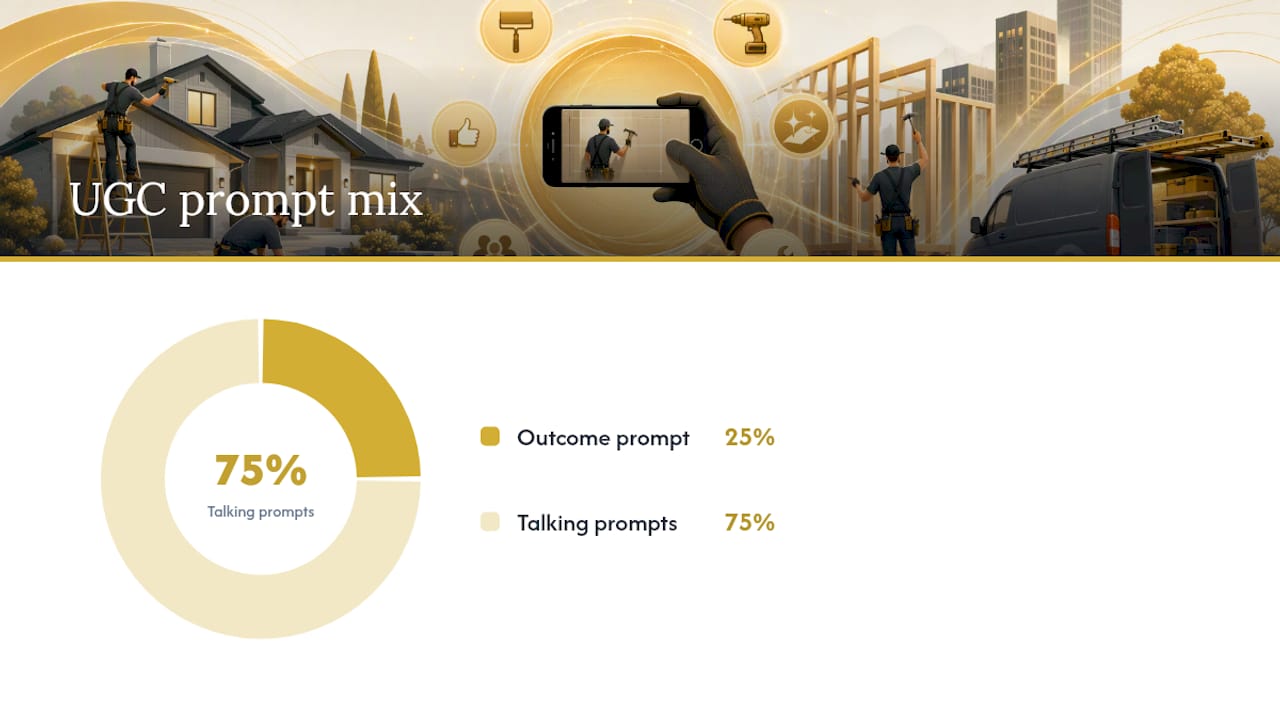
A workable shot list looks like this: one outcome prompt ("Tell us what changed since we finished"), three talking prompts (what worried you before hiring us, what surprised you during the project, would you recommend us and why), and a target length under 45 seconds. Keep it loose. The goal is a real homeowner talking, not a rehearsed ad.
Pro Tip: Skip the script entirely and just ask, "What would you tell a neighbor who's thinking about doing this project?" That single question almost always produces the most usable soundbite.
What Rights And Permissions Do You Need Before Using UGC In Ads?
A public post is not a license. You need explicit written consent before using someone's photo, video, or review in a paid ad, full stop. A tagged Instagram Story or a five-star Google review gives you exactly zero legal cover for running that content as a Meta ad or on a landing page.
The workflow doesn't need to be complicated:
- Ask publicly or in a follow-up message for permission to reuse the content.
- Send a one-page release the client can sign on a phone in under two minutes.
- Store the signed release with the asset, not in a separate folder you'll never find again.
- Escalate to a paid licensing agreement or legal counsel only for large campaigns or when a creator expects ongoing compensation.
A usable release should state exactly what you're allowed to do (paid ads, website, social), how long the rights last, whether any compensation changes hands, and how the client wants to be credited. Keep metadata with every asset: date collected, project type, release file, and expiration if the agreement isn't perpetual. Roughly most brands still lack a formal system for collecting and rights-clearing UGC, which is exactly why the contractors who build one see outsized returns when they convert that content into paid creative.
How Do You Turn UGC Into High-Performing Ad Creative?
Editing UGC for ads is a different discipline than editing a brand video. The goal isn't polish, it's believability, and over-produced client content tends to convert worse, not better.
Native creative for a 15 to 30 second clip follows a pretty consistent pattern: a two-second hook, then problem, then result, then a clear call to action, with captions on and branding kept minimal. Resist the urge to add a logo bumper or a music bed that makes it feel like a commercial. The slight imperfection, a shaky hand, a real kitchen in the background, is what makes viewers trust it.
Once you have a clip that performs, get more out of it:
- Crop the same footage for vertical (Stories, Reels) and horizontal (YouTube, website embeds) placements instead of shooting twice.
- Reuse the strongest 10 seconds on your homepage, in a follow-up email to leads, and on your Google Business Profile.
- Run a direct A/B test of UGC against your existing brand creative, watching click-through rate and cost per click on the same budget and audience.
- Fill gaps with paid UGC creators when organic submissions run dry. This works as a bridge tactic while your client-sourced pipeline matures, and per-clip costs typically run far below a full production shoot.
A brand's own contractor testimonial and walkthrough video can anchor this loop even before client submissions start flowing, giving you a template for tone and pacing that later UGC can match.
How Do You Measure Whether UGC Is Actually Working?
The KPIs that matter for contractor marketing are click-through rate, cost per lead, appointment rate, booked jobs, and cost per booked job, in that order of importance to the owner writing the check.
Tag every UGC-driven creative distinctly in your campaign naming convention and in your landing page URLs so you can isolate performance without guessing which asset drove which lead. Run each test for two to four weeks minimum, long enough to smooth out day-of-week noise, and track offline conversions through your CRM or call tracking rather than relying on platform-reported leads alone, which tend to overcount.
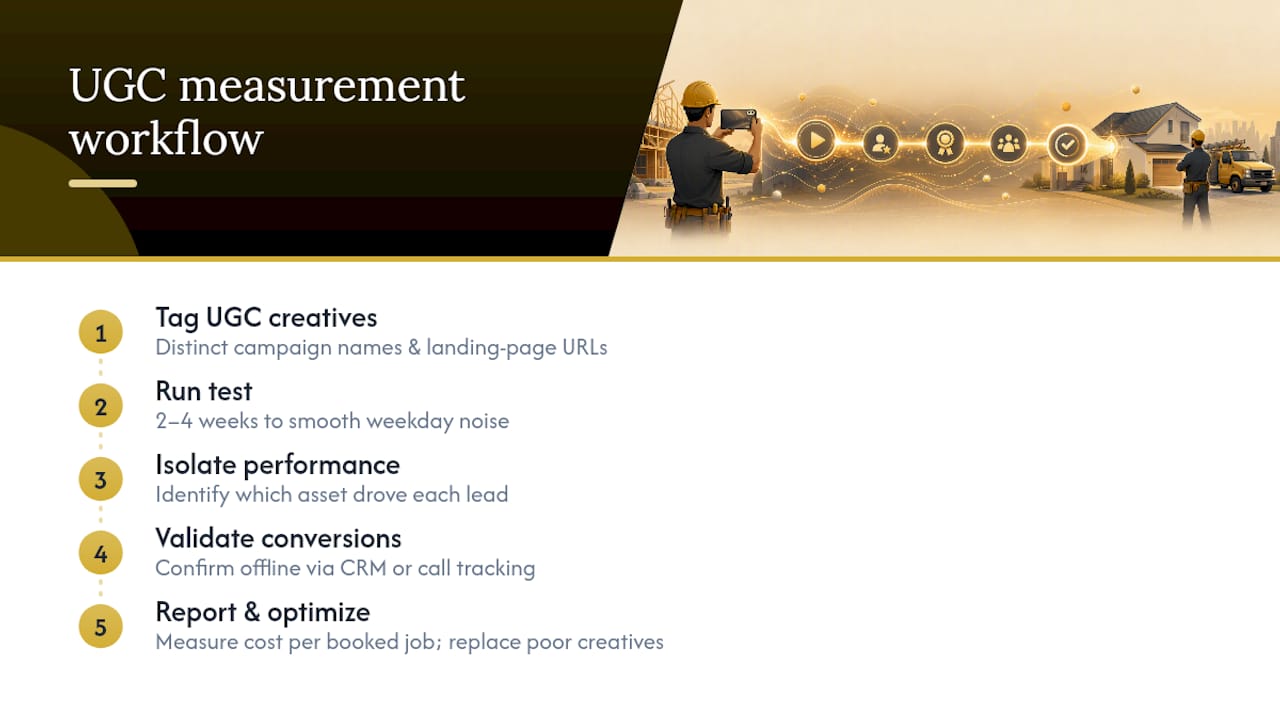
Cost per booked job is the number that actually matters to a contractor owner. A campaign with a great cost per lead but a poor appointment rate is not a win. If a UGC creative underperforms after a fair test window, don't tweak it endlessly, replace the hook or swap the client story and test again. Campaign structures built for testing ad variants apply just as well to UGC creative rotation as they do to any other paid channel.
How Does Leapify Media Approach UGC For Contractor Clients?
Leapify Media builds UGC directly into paid ad funnels and CRM automation, so a client testimonial doesn't just sit as a nice video, it gets tagged, tested, and tracked all the way to a booked job. That closed loop is part of what has driven a reported 20x return on ad spend for home service partners.
The recommended first test is simple: collect three client clips using the intake system above, run a short paid test against your current creative, and measure the lift in booked jobs, not just clicks. Small, measurable steps beat a big content overhaul every time.
Why Most Contractor UGC Advice Misses The Point
Most advice on this topic treats UGC as a content problem, get more videos, post more reviews, when it's really an operations problem. The contractors who win aren't the ones with the most client footage. They're the ones who built a repeatable system: ask at the right moment, secure rights immediately, tag every asset for measurement, and kill underperforming creative fast instead of nursing it for months out of sentimental attachment.
The conventional wisdom oversells production value and undersells timing and permission. A shaky 20 second clip shot at final walkthrough, with a signed release attached, will outperform a beautifully lit testimonial collected six months late with no paperwork. Every time.
If you take one thing from this, prioritize the intake system before the creative polish. Get the timing right, get the release signed, tag the asset, and only then worry about whether the lighting looks good. Contractors who reverse that order end up with a hard drive full of unusable footage and no way to prove what actually moved the needle on booked jobs.
— Everson Gorski
Ready To Turn Client Proof Into Booked Jobs?
Leapify Media exists for exactly the gap most contractors hit: they collect a few good testimonials, then have no system to turn them into tracked, tested ad creative that ties back to booked jobs. That's the difference between a folder of client videos and a paid campaign that reports cost per booked job every week.
Leapify's services cover the parts of this playbook that take the most operational effort: sourcing and organizing UGC, building and testing native ad creative, and wiring CRM automation so every lead from a UGC campaign gets tracked to a real appointment. For visual inspiration on formats worth collecting, the Buildberry blog is a solid reference point too. If you want a second set of eyes on how your review and referral pipeline could feed this system, an operations-first review system is worth a look before you start filming.
The next step is straightforward: get a quote from Leapify Media on running your first UGC test campaign, and find out what a properly tagged, measured version of this system could do for your booked-job numbers.
Sources
- UGC Marketing Strategy 2026: How User-Generated Content Is Replacing Paid Ads on Social Media
- User-Generated Content in 2026: Trends, Challenges & Wins
- Videoai