

Run three engines together, not one: segmented Search campaigns by service and ticket size, Local Services Ads where your market allows it, and Meta retargeting to close the sale over time. Start every campaign on Maximize Conversions until you hit roughly 30 conversions, then shift to Target CPA anchored to real job value. Above all, optimize toward booked and paid installs, not raw form fills.
TL;DR:
- Segment campaigns by service type and ticket size, avoiding lumping all leads into one to prevent skewed cost-per-lead metrics.
- Focus on targeting both keyword groups: those with high purchase intent and those that require persuasion, retargeting them over weeks.
- Use a combination of Maximize Conversions initially, then switch to Target CPA based on real job value once enough data accumulates.
- Prioritize booked and paid installations as conversions, and ensure proper call tracking and attribution are in place to measure true ROI.
- Develop landing pages with galleries, financing details, warranties, reviews, and load time optimization to effectively sell high-ticket turf jobs.
Table of Contents
- Why turf buyers behave differently than other home service leads
- Account architecture to protect your high-ticket pipeline
- Which keywords actually convert turf researchers into clients
- Bidding strategy and budget allocation by job value
- Landing pages and ad creative that sell the splurge
- How to measure what actually matters: booked jobs, not leads
- Coordinating Meta and Google for a long consideration cycle
- What proof should you expect from an agency before you hire one
- Author notes: quick launch checklist and common pitfalls
- How Leapify Media builds this for turf installers
- Sources
Why turf buyers behave differently than other home service leads
A homeowner searching "artificial turf installation near me" is not calling a plumber during a leak. They're weighing a discretionary purchase of substantial cost against a new patio, a pool fence, or just keeping the cash. Turf searches carry real intent, but the buyer usually collects three or four quotes and needs convincing before they sign, a pattern Encipher's turf marketing analysis confirms when it describes turf as high-intent yet discretionary.
That changes what your ads and pages have to do. A few consequences follow directly:
- Your landing page has to justify the splurge with a gallery, financing terms, and lifespan claims, not just a phone number.
- Retargeting stops being optional. Most buyers won't convert on visit one.
- Segmenting campaigns by ticket size keeps small patch repairs from skewing the cost-per-lead numbers on your larger backyard installs.
Account architecture to protect your high-ticket pipeline
Structure your account by service line first, then split by ticket size and service area underneath. A single "Turf Leads" campaign catching everything from putting-green touch-ups to full yard conversions will always undercount what your best jobs actually cost to acquire, a pattern echoed in guidance on campaign structure for local service businesses.
A workable build looks like this:
- Residential Full Install, Search, [City] — your flagship campaign, biggest budget, tightest keyword list.
- Residential Full Install, Search, [City 2] — cloned structure once city one proves out, never a shared budget.
- Putting Greens & Small Projects, Search, [Region] — separated so low-ticket demand doesn't cannibalize install budget.
- Commercial/Sports Turf, Search — separate again; this buyer researches differently and often has a longer sales cycle.
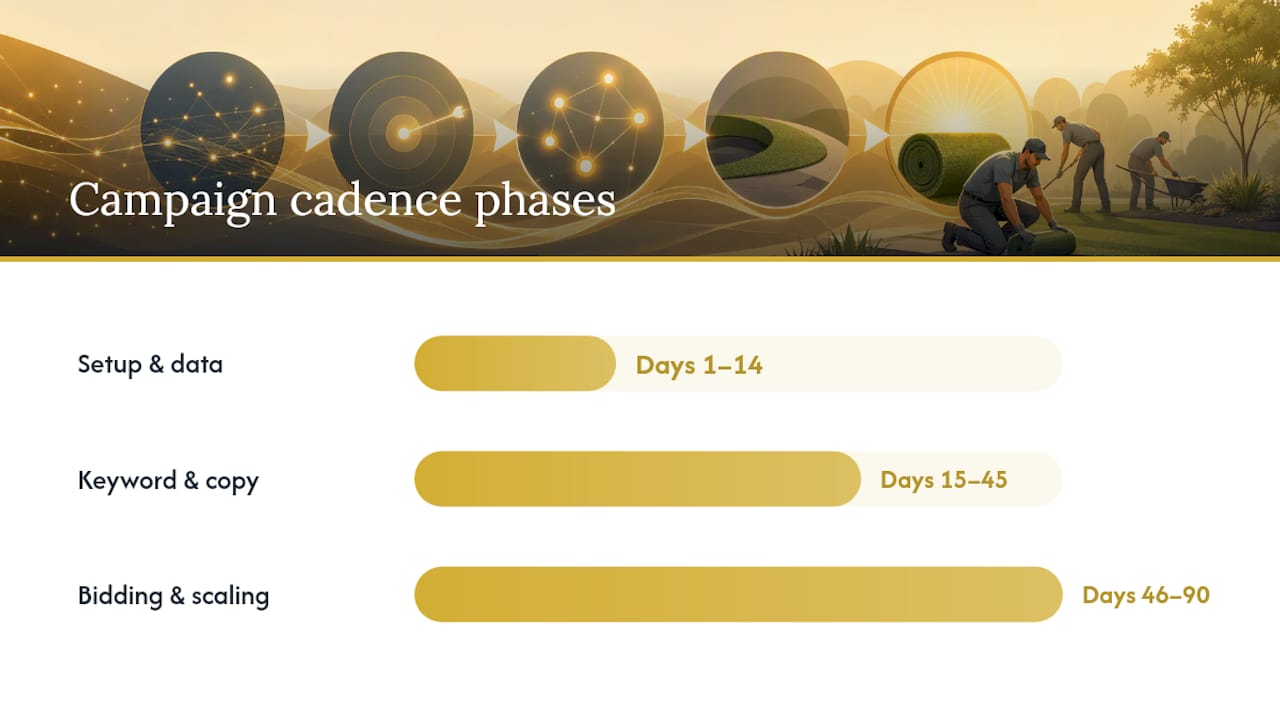
Run a 90-day cadence: Days 1 to 14 for setup and initial data collection, Days 15 to 45 for keyword and ad copy refinement, Days 46 to 90 for bid strategy graduation and budget scaling.
Pro Tip: Never let two service lines share one daily budget. Google will always spend where it finds the cheapest conversions first, and cheap patch-repair leads will quietly starve your install campaign of budget by mid-month.
Which keywords actually convert turf researchers into clients
Two keyword categories matter, and most turf advertisers only bid on one of them. The first is capture intent: "artificial turf installation [city]," "synthetic grass installer near me," "turf company [city]." The second is researcher intent: "artificial turf cost," "is artificial turf worth it," "synthetic grass vs sod." That second group looks soft, but turf-specific PPC guidance makes a strong case for targeting it anyway. These are exactly the buyers who need persuading, and retargeting closes them over the following weeks.
Start with phrase and exact match to control who sees your ads. Once you've logged enough conversion data, layer in broad match paired with smart bidding to find variations you haven't thought of.
Build a starter negative keyword list on day one:
- "DIY," "how to install," "tutorial," "instructions"
- "free," "cheap," "wholesale"
- "jobs," "hiring," "careers," "salary"
Review your Search Terms report every 48 to 72 hours during the first month. That's where wasted spend hides.
Bidding strategy and budget allocation by job value
Maximize Conversions works well early because it's built to learn fast with limited data, an approach home-service PPC playbooks recommend before you constrain the algorithm with a target. Once a campaign logs around 30 conversions, move to Target CPA and set it using real math, not a guess.
| Input | Example value |
|---|---|
| Average install job value | a typical high-value amount |
| Close rate on booked estimates | a typical proportion |
| Sustainable cost per lead | a common range |
| Target CPA (set slightly below sustainable CPL) | a recommended range |
Split budget across three channels rather than pouring everything into Search, including Local Services Ads where available in your market like J.R. Hardwood Floor Refinishing & Cleaning's PPC implementation. Search campaigns capture people ready to act now. Local Services Ads, where available in your market, add a second pool of pay-per-lead demand with built-in trust signals, since LSAs and Search Ads serve different buyer stages. Meta remarketing rounds it out by keeping your gallery in front of people who haven't decided yet.
Pro Tip: If your close rate is a guess, your Target CPA is a guess too. Pull real numbers from your CRM before you set a target, even if that means running Maximize Conversions a few extra weeks.
Landing pages and ad creative that sell the splurge
Your landing page has one job: make a high-cost lawn replacement feel obviously worth it. That means an above-the-fold before-and-after gallery, a visible phone number with click-to-call, and a form with no more than four fields.
Beyond the basics, a few elements consistently move the needle:
- Financing options stated plainly, since payment plans lower the psychological barrier on big-ticket jobs.
- Warranty length and product lifespan front and center, because "how long does this actually last" is the buyer's real objection.
- Recent review snippets or a star rating near the CTA button.
- Load time under three seconds on mobile, where most of your traffic will land.
Ad copy should mirror the landing page, not contradict it. Headlines like "See the 15 Year Turf That Never Needs Mowing" outperform generic service lines because they answer the objection before the click.
How to measure what actually matters: booked jobs, not leads
Set your primary conversion as a booked and paid install, not a form submission. Everything upstream (calls, chats, forms) should feed into that number through proper attribution, following the same logic home-service call-tracking guidance applies to service businesses generally.
Practical setup steps:
- Use Google's call forwarding numbers or a third-party service like CallRail to route and record calls.
- Filter for call quality: a minimum duration of 60 to 90 seconds weeds out wrong numbers and voicemail hang-ups.
- Push conversion value, not just conversion count, into Google Ads whenever your CRM can supply it.
Bid on the corrected number, not the flattering one.
Coordinating Meta and Google for a long consideration cycle
Turf buyers don't decide in one session. Meta shows the visual proof (thick, green, dog-friendly turf) that plants the idea; Google Search catches them once they start actively comparing installers.
A workable flow:
- Prospect on Meta with gallery-style video and carousel ads to build initial demand.
- Push website visitors into a retargeting list segmented by behavior: viewed the gallery, checked pricing, started a quote form.
- Recapture warm traffic through Google remarketing and Search campaigns once intent resurfaces weeks later.
Segment retargeting windows by behavior depth and cap frequency so the same three creatives don't burn out a warm prospect in a week. If you run Performance Max, keep asset groups tightly scoped by service and location. Loose asset groups tend to spend on irrelevant reach for a local service business, a caution worth taking seriously for local campaign structures.
What proof should you expect from an agency before you hire one
Leapify Media builds its infrastructure in-house, running on-premise servers rather than routing client data through third-party AI tools, which matters when call transcripts and CRM data carry customer information.
Before engaging any agency, run this self-audit:
- Ask exactly how leads get matched to booked revenue, not just how many leads they report.
- Confirm campaigns are segmented by service and ticket size, not lumped into one account-wide bucket.
- Check whether call tracking with quality filters is already in place.
- Verify the agency's own Google Partners listing and reviews before signing anything.
Author notes: quick launch checklist and common pitfalls
Three things to get right before anything else: call tracking wired to booked jobs, campaigns split by service and ticket size, and a landing page built around a gallery rather than a paragraph of text. The three mistakes I see most: one bloated campaign covering every service, ignoring researcher keywords because they look soft, and scaling budget before the tracking data is trustworthy. This week, test one thing: add "artificial turf cost" as a phrase-match keyword and watch what it does to your retargeting list size.
— Everson Gorski
How Leapify Media builds this for turf installers
Leapify Media is the alternative to guessing your way through Google Ads: instead of another agency reporting lead counts, it builds infrastructure that tracks every call and form through to a booked, paid job, then feeds that revenue data back into bidding automatically. For turf installers specifically, that means campaigns segmented by ticket size from day one, call tracking with quality filters already configured, and retargeting built to match a multiweek buying cycle.
An account audit takes a look at your current campaign structure, tracking setup, and keyword targeting, then shows you exactly where budget is leaking before you commit to anything larger. If a full engagement isn't the right fit yet, a pilot campaign lets you test the segmented structure and booked-job tracking on a smaller scale first. Visit Leapify Media's services page to request an audit, or start at the main site to see how the infrastructure fits your business.
Sources
- Meta + Google Ads for Artificial Turf
- Google Ads for Home Services: The Complete 2026 Playbook – Hubrig Crew Marketing
- Google Ads for Home Services: Plumbers, HVAC & More 2026
- Google Ads For Local Service Businesses In 2026: Campaign Structure, Bidding, And Lead Generation