

Server-side tracking routes browser events to a server you control before forwarding them to analytics and ad platforms like Google Analytics 4, Meta Conversions API, or Google Tag Manager's server container. If ad blockers are costing you conversions, or if a privacy audit has flagged your client-side tag stack, this is the architecture worth understanding.
Who benefits most: performance marketers running paid search or social campaigns, e-commerce operators with high-value checkout events, and any site where a meaningful share of visitors use ad blockers or privacy browsers. The tradeoff is real: server-side setups cost more to build and maintain than a standard tag manager deployment. And the legal caveat matters: moving data collection to your server does not replace the need for user consent or a lawful basis under GDPR or CCPA. It changes where you enforce those rules, not whether you need them.
Recovered conversions: Sites with ad-blocker-heavy audiences recover a substantial share of lost conversion signals by switching to server-side collection, since server endpoints bypass the browser-level blocking that strips client-side tags.
Key Takeaways
Server-side tracking recovers lost conversion signals and centralizes consent enforcement, but it requires real engineering investment and does not replace the legal obligation to collect data lawfully.
| Point | Details |
|---|---|
| Core definition | Events route to your server first, giving you control before data reaches any vendor. |
| Top use case | Performance marketers losing conversions to ad blockers or needing offline attribution. |
| Critical tradeoff | Higher accuracy and control come with real hosting, engineering, and maintenance costs. |
| Compliance reality | Server-side collection still requires a lawful basis under GDPR and CCPA — it enforces consent, it does not replace it. |
| Leapify Media | Builds compliant server-side pipelines for home-service businesses, connecting CRM booking data to ad platforms for cleaner ROAS signals. |
Table of Contents
- How does server-side tracking work?
- Server-side vs. client-side tracking: which one fits your situation?
- Common implementation approaches for server-side tracking
- Privacy and consent: how to implement server-side tracking responsibly
- What you gain and what to watch for
- Step-by-step implementation checklist and testing plan
- What Leapify Media has learned from server-side implementations
- Leapify Media can handle the implementation for you
- Sources
How does server-side tracking work?
The canonical architecture has four stages. Understanding each one tells you where things can go right — and where they go wrong.
Stage 1: Browser event capture. The user's browser fires a lightweight first-party request to an endpoint you own, typically on a custom subdomain like data.yoursite.com. This is not a third-party pixel; it's a call to your own infrastructure. The browser sends the event payload: page URL, event name, any parameters you've defined, and the client-side context your code explicitly captures.
Stage 2: Collector receives the event. Your server (a cloud function, a containerized app, or a GTM server container) receives the raw event. At this point the data has not touched Google, Meta, or any other vendor. You decide what happens next.
Stage 3: Server container processes, enriches, and enforces consent. This is where server-side tracking earns its value. The container can:
- Validate the payload (reject malformed or bot events)
- Enrich the event with server-side data (CRM status, order value from your database)
- Strip or hash PII fields (email → SHA-256, IP truncation)
- Check the user's consent state before deciding which destinations receive the event
Stage 4: Forward to platform APIs. The processed event goes to platform endpoints: GA4's Measurement Protocol, Meta's Conversions API, Google's Enhanced Conversions API, or any custom destination. Each platform receives only the fields you've chosen to send.
What a minimal server-to-server payload looks like
A GA4 Measurement Protocol POST gives you a concrete sense of the shape:
POST https://www.google-analytics.com/mp/collect
?measurement_id=G-XXXXXXXX&api_secret=YOUR_SECRET

{
  "client_id": "555.123456789",
  "events": [{
    "name": "purchase",
    "params": {
      "transaction_id": "T_12345",
      "value": 149.00,
      "currency": "USD",
      "session_id": "abc123"
    }
  }]
}
Meta's Conversions API follows the same pattern: a server-side POST to graph.facebook.com/v18.0/{pixel_id}/events with hashed identifiers and an event_id that matches the browser pixel's event for deduplication.
Pro Tip: The browser must explicitly capture UTM parameters, referrer, and session identifiers before the page unloads, then forward them in the event payload to your server. If you skip this step, your server-side events arrive with no attribution context — and your campaign data becomes useless. Tools like Twilio Segment document this pattern in detail.
Server-side vs. client-side tracking: which one fits your situation?
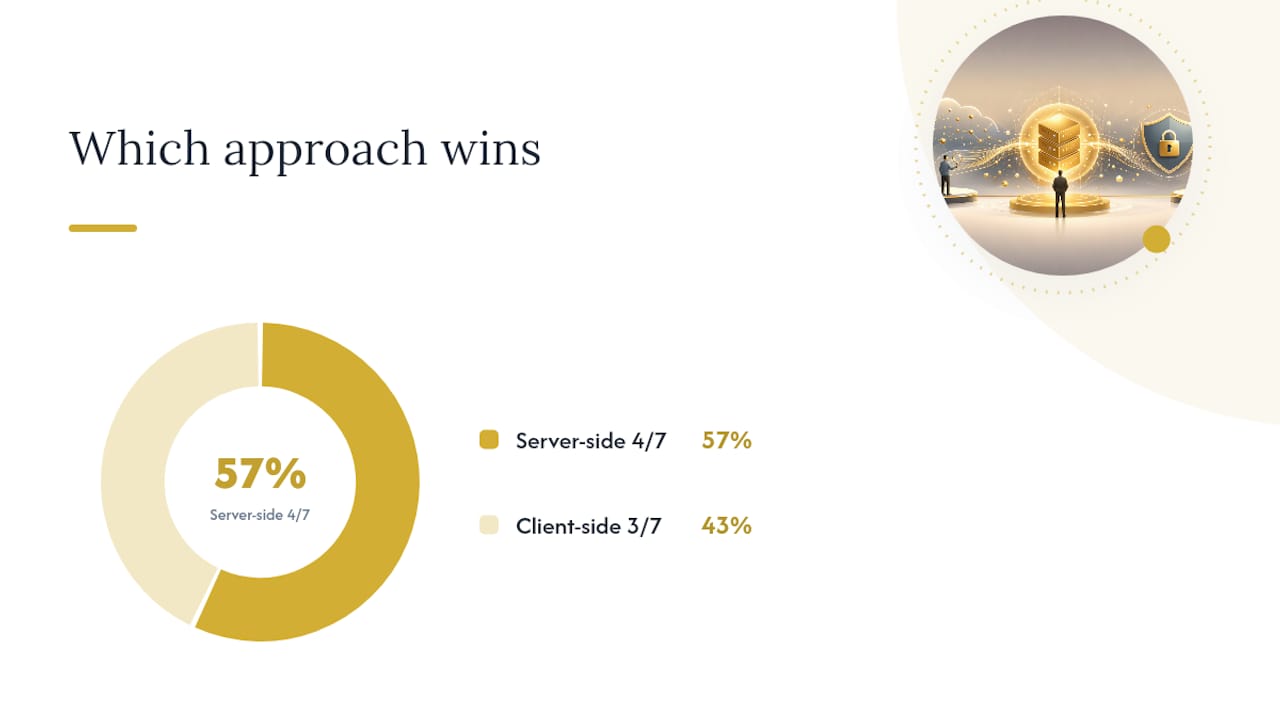
Many practitioners recommend a hybrid approach that uses client-side collection for basic signals and server-side for high-value conversions and PII handling. That recommendation makes sense once you see the tradeoffs side by side.
| Dimension | Client-side (browser tags) | Server-side collection |
|---|---|---|
| Data accuracy / blocker resilience | Vulnerable to ad blockers, ITP, and browser privacy modes | Bypasses browser-level blocking, higher signal completeness |
| Privacy & consent control | Consent enforced per tag; harder to audit centrally | Consent logic centralized in server; easier to audit and update |
| Ease of setup | Low: tag manager UI, no server needed | High: requires server infrastructure, custom subdomain, engineering time |
| Cost | Near-zero infrastructure cost | Hosting, maintenance, and engineering hours add ongoing cost |
| Enrichment & flexibility | Limited to browser context | Can inject CRM data, order status, LTV scores before forwarding |
| Real-time latency | Near-instant (runs in browser) | Adds milliseconds of server processing; rarely perceptible to users |
| Data ownership | Data leaves browser directly to vendor | You hold the raw event before any vendor sees it |
The practical read: a small-budget site with a simple funnel and a tech-averse team gets little return from a full server-side build. A performance marketer running $50K/month in paid social, where even a 10% conversion undercount distorts bidding algorithms, has a strong case for the investment. A site with a high proportion of privacy-browser users — common in B2B and tech audiences — sits firmly in the server-side column.
Common implementation approaches for server-side tracking
Four paths exist. They differ in engineering lift, cost, and how much control you get.
1. Server-side tag manager (sGTM)
Google Tag Manager's server container runs on a cloud instance you provision (Google Cloud Run is the standard host). Marketers deploy and update tags through the familiar GTM interface without full engineering cycles. The server container receives events from a GTM web container or a direct HTTP call, applies tag logic, and forwards to configured destinations. Setup time: one to three weeks for a competent team. Ongoing cost: cloud hosting fees plus maintenance.
2. Direct server-to-server APIs
Send events directly from your backend to platform APIs: GA4's Measurement Protocol, Google's Enhanced Conversions API, or Meta's Conversions API (CAPI). This approach requires no tag manager but demands engineering ownership. The payoff is precision: you control every field, every hash, every deduplication ID. For Enhanced Conversions and CAPI, identifiers (email, phone) must be hashed with SHA-256 before transmission. A shared event_id between the browser pixel and the server call is what prevents double-counting in platform reporting.
3. Analytics SDKs (Matomo, Snowplow, custom)
Matomo's server-side options include log import and server SDKs, which let security-sensitive sites collect data without modifying client code at all. Snowplow's event pipeline runs entirely on infrastructure you own, giving you a raw event stream you can model however your data team needs. Both tools suit organizations that want full data ownership and are willing to invest in the analytics engineering to use it.
4. Log ingestion
Web server logs (Apache, Nginx, CDN logs) contain every request. Parsing and importing them into an analytics platform is the most privacy-preserving option since no JavaScript runs on the client. The limitation: logs capture page requests, not rich interaction events. Useful as a supplemental data source, not a replacement for event-level tracking.
The deduplication problem is the most common implementation failure. When a browser pixel and a server-side call both fire for the same purchase event, platforms count two conversions unless you pass a matching
event_idin both calls. Build deduplication logic before you go live — not after you notice inflated conversion numbers in your dashboard.
| Approach | Engineering effort | Ongoing cost | Match quality |
|---|---|---|---|
| sGTM (server container) | Medium | Cloud hosting + maintenance | High |
| Direct API (Measurement Protocol / CAPI) | High | Engineering time | Highest |
| Analytics SDK (Matomo / Snowplow) | High | Self-hosted infra | High |
| Log ingestion | Medium | Storage + parsing | Low–Medium |
Privacy and consent: how to implement server-side tracking responsibly
Server-side tracking is a compliance tool when used correctly. It becomes a liability when teams assume moving data collection to a server removes their consent obligations. It does not.
The practical consent pattern works like this:
- Capture consent client-side using your CMP (OneTrust, Cookiebot, or similar)
- Pass the consent state as a parameter in every event payload sent to your server container
- Enforce consent logic in the server container: if consent for advertising cookies is absent, the container does not forward the event to Meta CAPI or Google Ads
- Log the consent state alongside the event for audit purposes
Data minimization in practice:
- Hash email and phone with SHA-256 before any transmission to a third-party API
- Truncate IP addresses to the last octet before storage (e.g.,
192.168.1.0instead of192.168.1.42) - Define retention periods for raw server logs and enforce them with automated deletion
- Document your data flows in a Record of Processing Activities (RoPA) — regulators ask for this
Google's Consent Mode v2 integrates with server-side pipelines: when a user declines advertising consent, Consent Mode signals tell the server container to send only non-personalized, aggregated pings rather than full event data. This preserves some modeling signal without transmitting personal data.
Under GDPR, server-side flows originating from backend systems (payment webhooks, CRM status updates) may not trigger ePrivacy cookie rules the same way browser-side collection does. But processing personal data still requires a lawful basis and documentation — a Legitimate Interest Assessment if you're relying on that basis, or explicit consent records if you're relying on consent. Server-side tracking is legal when implemented correctly; the implementation choices determine which legal basis applies.
One-sentence legal disclaimer: Server-side tracking does not remove the need for a lawful basis under GDPR or CCPA — it changes where you enforce that basis, not whether you need one. Confirm your specific compliance posture with qualified legal counsel.
What you gain and what to watch for
Benefits
- Recovered conversions: Server endpoints bypass ad blockers and browser privacy restrictions that strip client-side pixels, recovering events that would otherwise disappear
- Improved ad optimization: Cleaner, more complete conversion signals feed bidding algorithms with better data, which tends to improve ROAS over time
- Page performance: Fewer client-side scripts mean faster load times; reducing the tag burden on the browser is a measurable performance win
- First-party cookies: Server-set cookies live longer than browser-set third-party cookies and are not subject to ITP restrictions in Safari
- Centralized consent enforcement: One place to update consent logic instead of auditing dozens of individual tags
- Data enrichment: Inject CRM data, booking status, or lifetime value scores into events before forwarding — something a browser tag can never do on its own. For home-service businesses, this means a booked job from a plumbing service call can be attributed back to the exact ad click that drove it
Limitations
- Engineering cost is real: a proper sGTM build takes weeks, not hours
- Debugging is harder than client-side; you need server logs, replay tools, and someone who can read them
- Hosting and maintenance add ongoing cost that a tag manager deployment does not
- Latency risk exists if your server container is slow or misconfigured — though in practice the added milliseconds are rarely user-perceptible
- Misuse risk: teams that implement server-side tracking to bypass consent requirements rather than enforce them face growing detection risk as privacy auditing tools improve
Server-side tracking is not a compliance shortcut. Privacy auditing tools and security researchers are increasingly capable of detecting and evaluating server-side endpoints. Treating your server container as a way to collect data without consent is not just legally risky — it is technically detectable and enforcement capabilities are improving year over year.
Step-by-step implementation checklist and testing plan
Phase 1: Discovery (days 1–5)
- Audit your current tag stack: list every client-side tag, what it fires, and what data it sends
- Identify your highest-value conversion events (purchases, form submissions, phone calls)
- Map which events involve PII (email, phone, address) and which platforms receive them
- Confirm your consent management platform (CMP) can pass consent state as an event parameter
- Decide on your implementation path: sGTM, direct API, or SDK
Phase 2: Minimum viable build (weeks 1–3)
- Start with Enhanced Conversions for Google Ads and Meta CAPI for your top conversion event — these deliver the fastest ROI and lowest infrastructure complexity
- Provision your server container on a custom subdomain (
data.yoursite.com) using Google Cloud Run or an equivalent - Configure event deduplication: assign a shared
event_idto every conversion event, passed in both the browser pixel and the server call - Implement SHA-256 hashing for all email and phone fields before transmission
- Connect Consent Mode v2 signals to your server container's forwarding logic
Phase 3: Testing and validation
- End-to-end test: Fire a test conversion event and verify it appears correctly in GA4 DebugView, Meta Events Manager, and your server logs simultaneously
- Deduplication check: Confirm that a single purchase event produces exactly one conversion in platform reporting, not two
- Hashing verification: Inspect outbound API calls to confirm PII fields are hashed, not plain text
- Consent enforcement test: Simulate a consent-declined user and verify the server container does not forward the event to advertising platforms
- Replay log review: Use your server container's preview/debug mode to replay recent events and spot any missing fields or malformed payloads
Phase 4: Rollout and monitoring
- Launch with your critical conversion events only; expand to micro-conversions and enrichment events after two weeks of stable data
- Monitor match quality scores in Google Ads and Meta Events Manager weekly for the first month
- Set alerts for event volume drops (a sign something broke in the pipeline)
- Review server logs monthly for unexpected data fields or consent enforcement gaps
Timeline and cost guidance: A small site implementing Enhanced Conversions and basic CAPI can be live in one to two weeks with one engineer. A full sGTM build with enrichment and multi-platform forwarding typically takes four to eight weeks and ongoing cloud hosting costs. Enterprise setups with custom SDKs and data warehouse integration run longer and require dedicated analytics engineering resources.
What Leapify Media has learned from server-side implementations
The home-service industry has a specific tracking problem that server-side architecture solves better than anything else: the conversion happens offline. A homeowner clicks a Google Ad, calls the number, and books an HVAC repair. The browser session ends. The client-side pixel never fires a "booked job" event because the booking happens in a CRM or a dispatcher's phone call, not a thank-you page.

Server-side tracking closes that loop. When a CRM automation workflow marks a lead as "booked and paid," that status update can trigger a server-side conversion event sent directly to Google Ads and Meta via their APIs — no browser required. The ad platform receives a real revenue signal, not a proxy like a form submission. Bidding algorithms respond to that signal by finding more users who convert to actual jobs, not just leads.
For home-service clients running performance-based campaigns, the practical impact is a cleaner feedback loop between ad spend and booked revenue. One anonymized example: after connecting CRM booking status to Meta CAPI for a mid-size roofing operator, the platform's conversion count dropped (because it was previously double-counting form fills and calls), but cost-per-booked-job fell as the algorithm optimized toward the higher-quality signal.
When to DIY vs. when to bring in a specialist: If your team has a developer comfortable with API calls and a marketer who understands event schemas, Enhanced Conversions and basic CAPI are achievable in-house. A full sGTM build with enrichment, consent enforcement, and multi-platform forwarding is where most marketing teams benefit from outside help — not because it's impossible, but because the debugging and maintenance burden compounds quickly without experience.
Leapify Media can handle the implementation for you
Most home-service marketing teams are good at running campaigns. They are not staffed to build and maintain server infrastructure, debug event pipelines, or keep up with API versioning changes from Google and Meta. That gap is exactly where Leapify Media operates.
Leapify Media builds the full tracking infrastructure for home-service businesses: server-side event pipelines, CRM-to-ad-platform conversion bridges, consent-compliant data flows, and the ongoing monitoring that keeps it accurate. The setup runs on on-premise and secure cloud infrastructure, so client data stays under your control — not pooled on a shared vendor platform. Every implementation starts with a compliance-first audit of your existing tag stack before a single server-side event goes live.
If you're ready to stop guessing at your real cost-per-booked-job, see what Leapify Media builds for home-service operators — or visit Leapifymedia to start the conversation.
Sources
The vendor documentation below is where implementation details live. Each source covers a specific layer of the stack.
- Google Tag Manager server-side tagging (support)
- Matomo: What is server-side tracking? (2025)
- Snowplow: Server-side vs client-side tracking (2025)
- Privacy/ethical analysis of server-side tracking (PoPETS 2024)