
Most roofing contractors pay somewhere between $75 and $250 per lead in 2026, depending almost entirely on channel and market. Non-branded Google Ads leads average around $124, Local Services Ads run $75 to $150, and paid search overall can climb past $228 in competitive metros. The number that actually matters isn't cost per lead. It's cost per signed job, and that depends on what happens after the phone rings.
TL;DR:
- Private equity investment and storm-driven demand surges are increasing roofing lead costs, with non-branded Google Ads averaging around $124 per lead in 2026.
- Branded search campaigns typically cost about $44 per lead, offering lower-cost opportunities and stronger return on ad spend, especially for brands with good recognition.
- Speed-to-lead response within five minutes and automated reactivation campaigns significantly improve conversion rates and reduce overall customer acquisition costs.
- Lead quality varies between exclusive and shared leads, with exclusives costing more but often yielding higher close rates; verify lead source quality before purchasing.
- Tracking actual conversion metrics from lead to signed job, including contact, estimate, and close rates, is essential to determine true cost per signed job and maintain profitability.
Table of Contents
- What Is a Normal Roofing Cost Per Lead Right Now?
- How Do Google Ads Costs Compare By Campaign Type?
- Are Local Services Ads Or Lead Marketplaces Cheaper?
- What Do Published Roofing Lead Prices Actually Look Like?
- How Do You Turn Cost Per Lead Into Cost Per Signed Job?
- What Actually Lowers Your Effective Cost Per Job?
- Where Do These Roofing CPL Benchmarks Come From?
- A Practitioner's Take On Where To Focus In 2026
- Turn Your Roofing Ad Spend Into Booked Jobs, Not Just Leads
- Sources
- FAQ
What Is a Normal Roofing Cost Per Lead Right Now?
Roofing cost per lead has climbed steadily since 2024, and 2026 is showing the sharpest jump yet. Industry data from Cloudflow Technology found a material Q2 2026 increase in cost per qualified roofing lead across nearly every paid channel, driven by tighter aggregator inventory and heavier competition for the same searches.
Three forces are pushing the number up this year. Private-equity-backed regional roofing companies have been pouring money into metro ad accounts, and Boxwood Partners notes this consolidated spending is raising the CPC and CPL floor for everyone bidding in the same zip codes. Storm cycles compress demand into short windows, spiking bids exactly when homeowners are searching hardest. And aggregator platforms are seeing thinner lead inventory relative to demand, which pushes marketplace pricing higher even for shared leads.
Here's the blended range contractors are reporting across channels:
- Local Services Ads: $75 to $150 per lead, according to Web Tonic's Q1 2026 benchmarks.
- General paid search (broader sample): LocaliQ's 2025 data put roofing and gutters at a median cost per conversion near $228, well above most home-service categories.
Quick benchmark reality check: when you see a single "average CPL" number floating around online, ask whether it's a median or a mean, and how many contractors and dollars are behind it. SearchLight's $124 figure comes from a real, if modest, sample. A number with no disclosed sample size deserves more skepticism than one with a stated dataset behind it.
How Do Google Ads Costs Compare By Campaign Type?
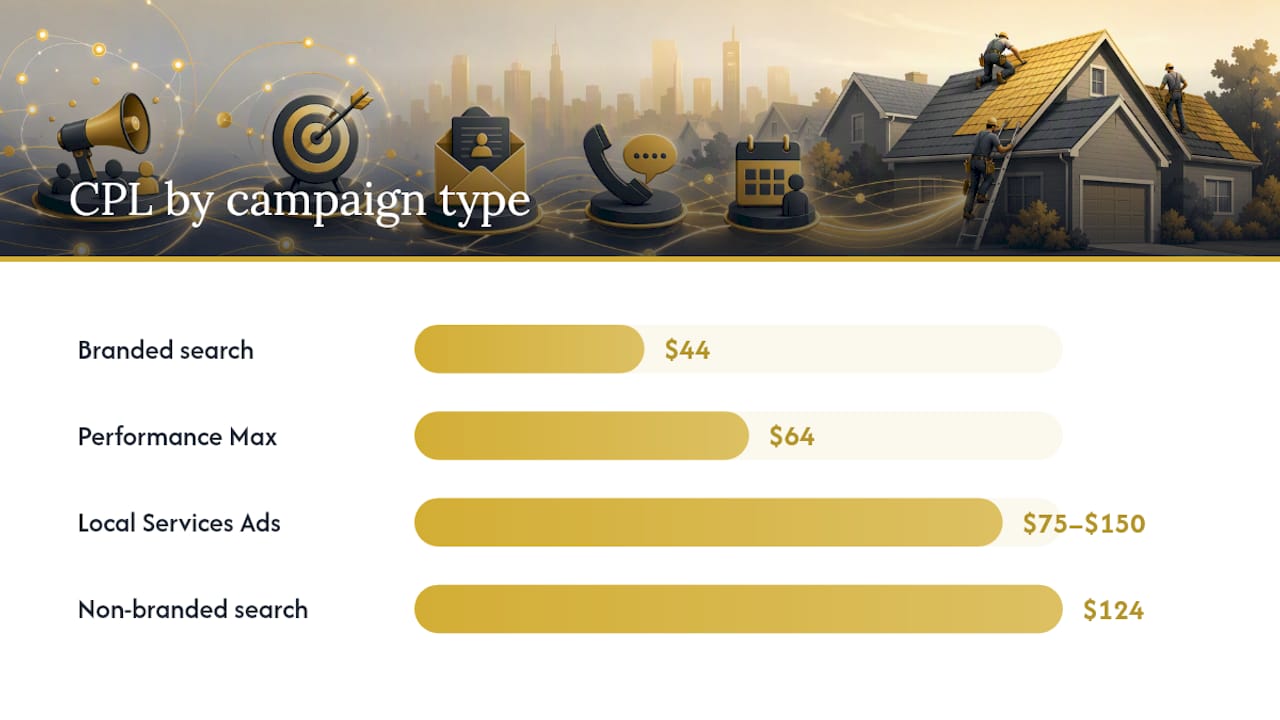
Not all Google Ads traffic costs the same, and treating "Google Ads CPL" as one number is where a lot of budgets go wrong. Branded search, where someone types your company name, costs a fraction of non-branded search where you're competing against every roofer in the metro for generic terms like "roof replacement near me."
Web Tonic's Q1 2026 benchmarks break the channel down clearly:
| Campaign type | Average CPL (Q1 2026) | Typical use case |
|---|---|---|
| Branded search | $44 | Retargeting people who already know your name |
| Performance Max | $64 | Automated, cross-network reach with less control |
| Non-branded search | $124 | Competing for new-customer intent keywords |
| Local Services Ads | $75–$150 | Pay-per-lead, Google-verified positioning |
The spread here tells you something important: branded search delivers leads at roughly a third the cost of non-branded search, and Web Tonic's data suggests contractors with strong brand recall see disproportionately better ROAS once branded campaigns enter the mix. That's not a reason to abandon non-branded search, since it's usually your primary source of new customers, but it is a reason to run a branded campaign alongside it instead of assuming Google will handle brand traffic for free through organic results.
Performance Max sits in an odd middle spot. At $64 average CPL, it looks like a bargain next to non-branded search, but the trade-off is control. PMax hands bidding and placement decisions to Google's algorithm, which can work well once it has enough conversion data but tends to underperform in the first few weeks of a new account. Budget for a learning period before judging results.
Pro Tip: Run branded and non-branded search as separate campaigns, never combined. Blending them into one campaign hides the fact that your branded traffic is doing most of the conversion heavy lifting at a fraction of the cost, which makes your blended CPL look worse than either channel actually performs. Contractors who want a full campaign structure built around this split should look at a dedicated Google Ads playbook for roofers.
Are Local Services Ads Or Lead Marketplaces Cheaper?
LSA and lead marketplaces solve different problems, and the price difference reflects it. Google's Local Services Ads program verifies contractors through a Google Guaranteed badge, and Google's own documentation confirms these listings appear above every other ad type, including standard paid search. That top placement, plus the trust badge, is why LSA leads run $75 to $150 and often convert better than an equivalent search ad click.
Lead marketplaces work on a different model entirely. Here's what separates them:
- Shared leads get sold to three or more contractors simultaneously, which drives the per-lead price down but also means you're racing competitors to the phone the moment the lead lands.
- Exclusive leads cost more but go to you alone, removing the speed-to-close race that kills conversion on shared leads.
- LSA leads are pay-per-lead like marketplaces but come with Google's verification layer, which tends to raise trust and contact rates.
- Aggregator platforms have faced real scrutiny over lead-quality claims. The FTC's 2023 enforcement action against HomeAdvisor centered on deceptive marketing of lead quality, a reminder to verify any supplier's disclosure claims before committing budget.
An exclusive lead is worth the premium when your close rate on shared leads is genuinely suffering from competition, not just theoretically lower. If you're losing jobs to contractors who called back faster, paying more for exclusivity solves a real problem. If your close rate is fine, the extra cost is just margin you're giving away.
What Do Published Roofing Lead Prices Actually Look Like?
Published pricing on lead-provider sites varies more by targeting geography and lead freshness than by anything else. County-level targeting typically costs less than statewide campaigns, since narrower geography means less competition for the same inventory.
According to Aged Lead Store's 2026 pricing guide, the spread looks roughly like this:
- Exclusive replacement leads: typically start in the $50 to $150+ range, depending on region and roof type.
- Live transfer leads: priced noticeably higher than standard leads because a human has already pre-qualified the homeowner on the phone.
- Aged leads: sold in batches at $0.25 to $1.50 per record, with price scaling based on how recent the lead is and how many filters (job type, timeline, credit) you apply.
Before you buy from any published price list, confirm four things: whether the lead is exclusive or shared, how old it is at the time of delivery, what qualification criteria were applied before it was sold to you, and whether the provider discloses its data sourcing. A cheap aged lead with no qualification behind it can cost more in wasted callback time than a pricier live transfer that's already primed to talk.
How Do You Turn Cost Per Lead Into Cost Per Signed Job?
Cost per lead tells you almost nothing on its own. What you actually need to know is cost per signed roof, and that requires tracking four conversion steps between the lead and the signature.
- Contact rate — the percentage of leads you actually reach by phone or text.
- Estimate booking rate — the percentage of contacted leads who agree to an in-home or virtual estimate.
- Close rate — the percentage of estimates that convert into a signed contract.
- Average ticket and margin — your typical job value and the profit margin on that job, since CAC only matters relative to what you keep.
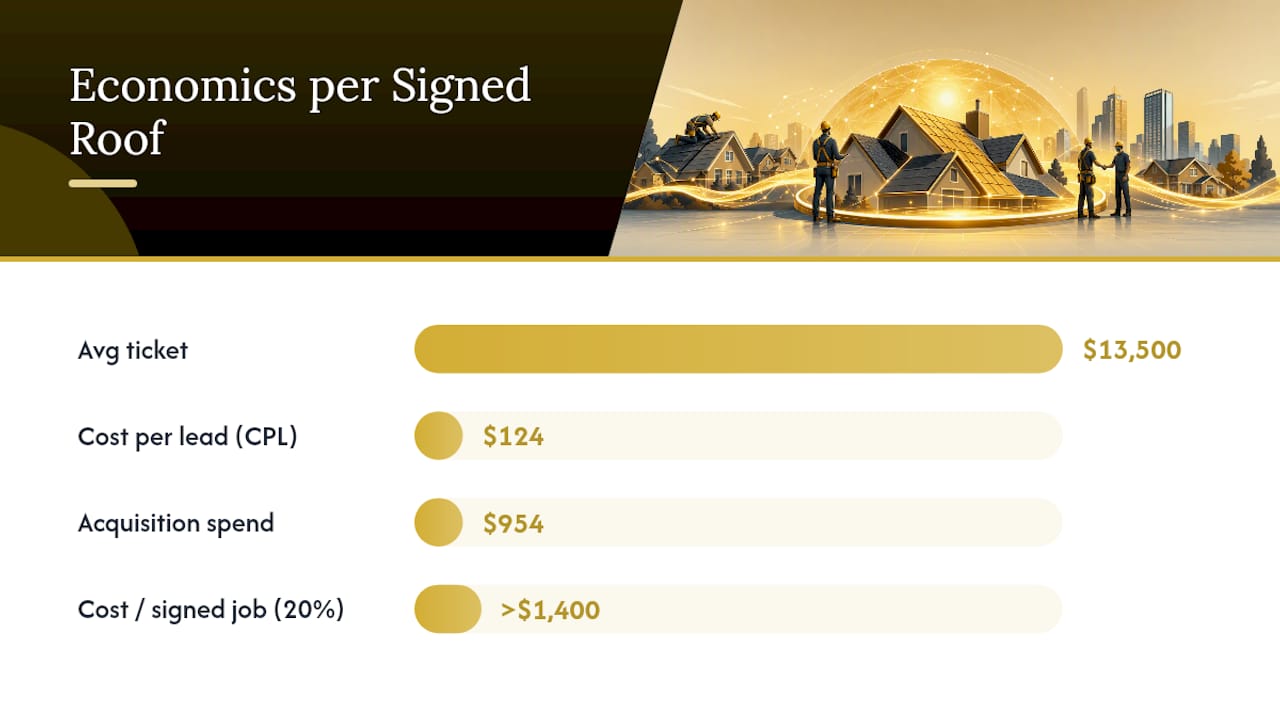
Here's a conservative worked example using a $124 non-branded search CPL:
At an average roof replacement ticket of $12,000 to $15,000 with a healthy margin, a $954 acquisition cost is comfortable. If your close rate drops to 20% instead of 30%, that same spend only produces 8 to 9 jobs, and cost per signed job jumps past $1,400. Run this math with your own actual conversion rates, not industry averages, before setting a maximum CPL you're willing to pay in any given campaign.
What Actually Lowers Your Effective Cost Per Job?
The fastest way to reduce your real acquisition cost isn't negotiating a lower CPL. It's fixing what happens in the minutes after a lead comes in. Speed-to-lead response time changes conversion rates enough that Cloudflow's Q2 2026 research flags it as a bigger lever than chasing cheaper leads altogether.
A sub-five-minute first response, backed by an automated one-minute SMS acknowledgment, materially increases the odds a lead turns into a booked estimate. Reactivation campaigns targeting old estimates and aged leads you already own are another low-cost source many top-performing shops lean on hard during storm season, since you're not paying a fresh CPL at all to work that list.
- Route new leads through automated SMS the instant they arrive, before a human even sees the notification.
- Build a booking workflow that lets homeowners schedule an estimate without waiting for a callback.
- Time review requests for right after job completion, when satisfaction is highest and response rates peak.
- Run a monthly reactivation campaign against every estimate that didn't close in the last 12 months.
Pro Tip: A well-maintained CRM with automated reactivation cadences doesn't just fill gaps in your pipeline. It also improves the review velocity that feeds your LSA ranking and Google Business Profile, which lowers your effective CPL on those channels over time. For a deeper dive into building this pipeline, see this roof repair lead growth plan.
Where Do These Roofing CPL Benchmarks Come From?
The figures in this article come from a mix of paid-channel benchmark datasets and published lead-provider pricing, not a single source.
- Cloudflow Technology tracked the Q2 2026 upward trend and operational countermeasures.
- Non-branded means generic-intent keywords; branded means searches for your company name; exclusive leads go to one contractor, shared leads go to several.
- National averages hide serious local variance. Test any benchmark against your own market before setting budgets.
A Practitioner's Take On Where To Focus In 2026
The data this year points to one clear priority: fix speed-to-lead and CRM reactivation before you touch ad spend. Most contractors chasing a lower CPL are solving the wrong problem, since a five-minute response time and a working reactivation cadence often move cost per signed job more than any bidding change ever will.
That said, once your booking rate and close rate are genuinely dialed in and the math from your own cost-per-job model still shows room, that's the signal to scale ad spend, not before. Pouring more budget into non-branded search while your contact rate sits below 60% just buys you more expensive missed opportunities.
— Everson Gorski
Turn Your Roofing Ad Spend Into Booked Jobs, Not Just Leads
Leapify Media exists for exactly the gap this article just walked through: the space between a cheap lead and a signed job. Where most agencies hand you a CPL number and call it a win, Leapify Media builds the infrastructure that actually converts that lead, using in-house AI dispatch and intent scoring instead of a third-party black box, so your lead data stays yours.
That infrastructure maps directly onto the levers covered above. Google Ads Management and Meta Ads Management get your channel mix and branded/non-branded split right from the start. On-Premise AI Dispatch routes and scores leads the moment they arrive, tackling the speed-to-lead problem that Cloudflow's research flagged as the biggest lever on effective CAC. CRM Integration builds the reactivation cadence that turns old estimates back into booked jobs without paying for a fresh lead.
If you're managing your own paid channels and want a second set of eyes on where your acquisition cost is actually leaking, check the Foundation, Growth, and Scale packages or browse the full service breakdown to see which piece fits your current setup.
Sources
- Roofing Google Ads Statistics & CPL Benchmarks (2026) | Web Tonic
- Roofing lead costs hit a new high in Q2 2026 | Cloudflow Technology
- FTC approves final order against HomeAdvisor — FTC
FAQ
How Much Do Roofers Pay Per Lead?
Most roofing contractors pay between $44 and $228 per lead depending on channel, with non-branded Google Ads averaging around $124 and branded search running as low as $44. Local Services Ads typically fall in a $75 to $150 range, while broader paid-search samples can push past $228 in competitive metros.
What Is the 25% Rule in Roofing?
It's a rough budgeting anchor, not a strict regulation, so contractors should model their own cost per signed job rather than applying the rule blindly.
What Is a Reasonable Cost Per Lead For Roofing?
A reasonable CPL depends on your close rate and average ticket, not a flat number. A contractor closing 30% of booked estimates at a $12,000 to $15,000 average ticket can often absorb a $124 non-branded search CPL comfortably, while a lower close rate demands a cheaper lead source like branded search or LSA to stay profitable.
Is $30,000 Too Much For a Roof?
Whether a high roofing price is reasonable depends entirely on factors like roof size, material, and regional labor costs, as large or complex replacements in high-cost markets carry higher price points. This homeowner pricing context is separate from lead-generation costs, and contractors should factor acquisition cost tolerance into their marketing math accordingly.
Does Leapify Media Offer Roofing Lead Generation Services?
Yes, Leapify Media offers Lead Generation as one of its core services alongside Google Ads Management, CRM Setup & Automation, and On-Premise AI Dispatch. Current pricing for these services is listed on the Leapify Media pricing page.