

For small home-service businesses, the best marketing platform is AI-first, revenue-focused infrastructure that connects ad spend directly to booked jobs. Not clicks. Not impressions. Booked jobs. Leapify Media is built specifically for this outcome, and it's the recommendation here.
Three reasons this matters right now:
- AI discovery behavior is reshaping how homeowners find contractors, rewarding businesses that have consistent entity signals (NAP, geotagged media, schema) over those with bigger ad budgets.
- Automated 14-day follow-up sequences convert more existing leads than raising ad spend, a strategy highlighted in the Designer Trade Program - Interior Designers | One Day Doors & Closets, yet most contractors skip them entirely.
- A properly optimized Google Business Profile can generate 30–50% of inbound leads for a contractor, and most owners treat it as an afterthought.
Table of Contents
- Why AI-first marketing changes outcomes for home-service businesses
- What the best marketing platform must include for home services
- How Leapify Media maps to this checklist
- What questions should you ask a marketing vendor?
- What does implementation actually cost and how long does it take?
- What do real outcomes look like for home-service clients?
- Key Takeaways
- What most agencies get wrong about home-service marketing
- Leapify Media builds the infrastructure that turns ad spend into booked jobs
- Authoritative sources and further reading
Why AI-first marketing changes outcomes for home-service businesses
According to a 2026 Scorpion industry report, 67% of home-service businesses cannot directly connect their marketing spend to revenue, and 78% use two or more marketing vendors. That fragmentation is the core problem. When your Google Ads, CRM, and call tracking don't talk to each other, you're optimizing for clicks, not jobs.
Generative Engine Optimization (GEO) adds a new layer. AI assistants like ChatGPT and Google's AI Overviews now recommend local contractors based on entity signals: consistent name/address/phone data, geotagged photos, structured schema markup (LocalBusiness, Service, Review), and problem-solving reviews. Businesses that ignore these signals are invisible to a growing share of homeowners who never scroll past the AI answer.
The follow-up gap is just as costly. Most contractors call a lead once, maybe twice, then move on. Automated sequences that touch a lead at days 0, 1, 3, 7, and 14 with varied message types routinely outperform ad budget increases for revenue impact. The leads are already there. The money is in the follow-through.
What the best marketing platform must include for home services
The right home-service marketing stack isn't about having the most tools. It's about having the right ones connected in the right order.
Table-stakes features (without these, nothing else works):
- AI CRM automation: Triggers follow-up sequences based on lead status, job stage, and time elapsed. Without it, follow-up depends on someone remembering to call.
- Call tracking and attribution: Assigns unique numbers to each channel. Without it, 60–80% of phone leads carry no attribution, making ad decisions guesswork.
- Google Business Profile automation: Weekly photo posts, review response workflows, and service-area updates. GBP is often the single highest-ROI asset a contractor owns, typically generating 30–50% of inbound leads.
- Ads management tied to booked jobs: Google Ads and Meta Ads optimized toward job completions, not clicks. The algorithm needs conversion events that matter.
- Review management: Automated post-job review requests materially increase volume and directly influence GEO discovery signals.
Advantage features (separate good platforms from great ones):
- Intent scoring and lead dispatch: Emergency HVAC calls get routed immediately; non-urgent maintenance requests go into a scheduling flow. This preserves dispatch resources and lifts conversion on high-value jobs.
- Geotagged media support: Photos embedded with location metadata strengthen local SEO and GEO entity signals simultaneously.
- Field-service integrations: Connections to platforms like Housecall Pro or similar scheduling tools so marketing events trigger from operational ones.
- Data ownership and on-premise AI: Your lead data and model training stay yours, not a vendor's.
How Leapify Media maps to this checklist
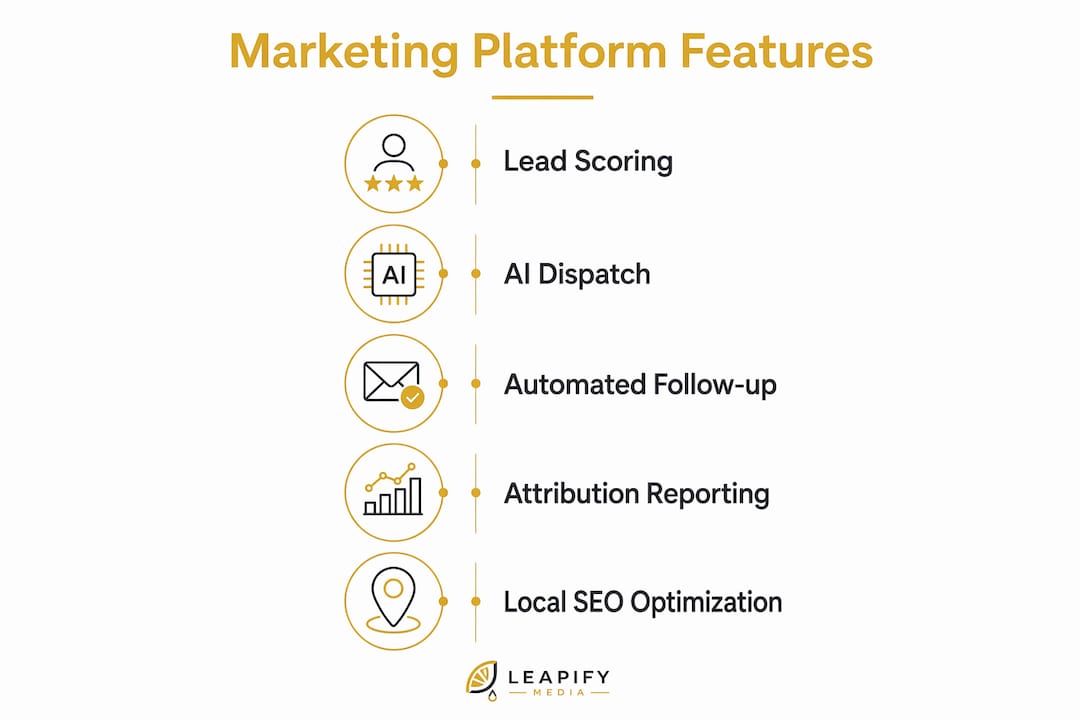
Leapify Media covers every table-stakes feature and most advantage features, with one meaningful differentiator: on-premise AI servers. Client data never passes through a shared cloud environment, which matters when you're storing customer contact history, job records, and revenue data.

| Feature | What it does | Example outcome for a contractor |
|---|---|---|
| On-premise AI lead dispatch | Scores and routes leads by urgency and intent | Emergency calls reach a tech in minutes; routine leads enter automated scheduling |
| Attribution layer (ads + call tracking + CRM) | Links every dollar of ad spend to a booked job | Identifies which campaigns produce revenue, not just clicks |
| GBP and geotagged media workflows | Automates profile updates and photo publishing | Consistent entity signals improve AI discovery and local rankings |
| 14-day CRM follow-up sequences | Multi-touch automated outreach after first contact | Converts leads that would otherwise go cold after one call |
| Google Ads and Meta Ads management | Managed campaigns optimized toward booked-job events | Ad spend feeds the algorithm real conversion signals |
| Review generation automation | Post-job SMS/email review requests | Higher review volume strengthens GEO trust signals |
Leapify Media clients have reported up to 20x return on ad spend. That figure reflects the compounding effect of attribution-linked optimization: when the ad platform knows which campaigns produce booked jobs, it allocates budget toward those campaigns automatically.
Pro Tip: Ask any vendor to show you a sample attribution report that traces a specific lead from ad click to booked job to revenue. If they can't produce one, the attribution layer doesn't exist.
What questions should you ask a marketing vendor?
Start with these before you sign anything:
- Can you show me a report linking a specific ad campaign to a booked job and its revenue?
- How does your system handle call tracking, and which channels does it cover?
- What is your lead response SLA, and how does intent scoring work?
- Who owns the data if I leave? Can I export my CRM records and attribution history?
- What are all the fees: setup, tools, call tracking, and minimum ad spend?
Red flags to watch for: vague ROI claims with no measurement methodology, opaque pricing that reveals tool fees only after signing, no documented intent-scoring logic, and no data-export option. Any vendor that can't explain how they connect ad spend to booked jobs is optimizing for clicks, not your revenue.
Set a 60–90 day proof-of-performance window with two objective KPIs: cost per booked job and booked jobs per lead. Any vendor worth hiring will agree to this upfront. For more on evaluating agencies, the best marketing for contractors comparison covers common pitfalls in detail.
What does implementation actually cost and how long does it take?
For a single-location contractor, expect a 60–90 day on-ramp before the system runs at full efficiency. Here's a realistic phase breakdown:
- Weeks 1–2: Discovery and tracking setup. Call tracking numbers assigned, Google Tag Manager configured, CRM connected to ad platforms.
- Weeks 3–4: GBP and local SEO optimization. Profile audit, schema markup, geotagged photo workflow launched.
- Weeks 5–6: CRM automation and lead flows. Follow-up sequences built and tested, intent-scoring rules configured.
- Weeks 7–10: Ad ramp and optimization. Campaigns launched with booked-job conversion events; budget scaled as data accumulates.
- Weeks 11+: Iterative GEO and content work. Review generation running, content updated for GEO entity signals.
Pricing typically follows a monthly retainer for ongoing management, a one-time setup fee for AI dispatch and CRM integration, and project-based fees for on-site content production. Performance-based components are common for larger accounts. For a detailed breakdown, Leapify's pricing page lists current packages.
Pro Tip: Ask specifically about the minimum ad spend threshold for attribution to work. Most attribution layers need at least $2,000/month in ad spend to generate enough conversion events for the algorithm to optimize meaningfully.
An attribution layer becomes cost-effective once monthly ad spend clears roughly $2,000. Below that, focus on GBP optimization and follow-up automation first.
What do real outcomes look like for home-service clients?
The most consistent pattern across home-service clients: the biggest gains come from fixing follow-up, not from raising ad budgets. A roofing contractor running $3,000/month in Google Ads with no follow-up automation is leaving a significant share of leads on the table. Adding a structured 14-day sequence to an existing lead volume often produces more booked jobs than doubling the ad budget.
A second pattern: GBP optimization produces fast, measurable results. Contractors who implement weekly geotagged photo posts, structured review requests, and schema markup typically see local ranking improvements within 30–60 days, before any ad spend changes.
On data security: Leapify Media's on-premise AI architecture means client lead data, model training, and attribution history stay on dedicated servers. For contractors in industries where customer data is sensitive (security systems, elder care services, high-value property work), this is a material assurance, not a marketing point. For more on AI-driven lead generation and what measurable outcomes look like, the linked case study overview covers the methodology.
Key Takeaways
AI-first marketing infrastructure that closes the attribution loop between ad spend and booked jobs is the most effective approach for small home-service businesses in 2026.
| Point | Details |
|---|---|
| Fix attribution first | Connect call tracking, CRM, and ads before scaling budget — 67% of businesses currently cannot directly connect their marketing spend to revenue. |
| GBP is your highest-ROI asset | An optimized Google Business Profile can generate 30–50% of inbound leads for a contractor. |
| Follow-up beats ad spend | Automated 14-day follow-up sequences convert more existing leads than raising ad budgets. |
| Vet vendors with a fake lead test | Submit a test inquiry during the sales process and measure response time and follow-up quality. |
| Leapify Media | Covers the full checklist with on-premise AI, attribution-linked ads management, and reported 20x ROAS for home-service clients. |
What most agencies get wrong about home-service marketing
The conventional wisdom says spend more on ads. Run more campaigns. Get more clicks. That advice works for e-commerce, where a click can become a purchase in 90 seconds. Home services don't work that way. A homeowner with a burst pipe calls three contractors. The one who answers fastest and follows up most consistently wins the job, regardless of who had the better ad.
The real leverage in this industry is operational: how fast you respond, how persistently you follow up, and whether your marketing system knows which campaigns produce jobs versus which ones produce tire-kickers. Most agencies can't answer that last question because they never built the attribution layer to find out.
The businesses that will pull ahead over the next two years aren't the ones with the biggest Google Ads budgets. They're the ones that treat local SEO for contractors and CRM automation as infrastructure, not optional add-ons. GEO is accelerating this shift. When an AI assistant recommends a plumber, it's not picking the one with the most clicks. It's picking the one with the most consistent, trustworthy entity signals across every platform.
Build the infrastructure first. The ad spend works harder when the foundation is solid.
Leapify Media builds the infrastructure that turns ad spend into booked jobs
Most home-service businesses are paying for leads they never convert. Leapify Media fixes the infrastructure underneath: on-premise AI lead dispatch, attribution linking every ad dollar to a booked job, automated follow-up sequences, GBP and geotagged media workflows, and full CRM integration. The result is a system where your ad spend feeds an algorithm that knows what a booked job looks like, not just a click.
The reported 20x return on ad spend from Leapify clients reflects what happens when attribution, follow-up, and local SEO work together instead of in silos. If you're running ads without that infrastructure, you're paying for data you'll never see.
Request a demo at leapifymedia.com or review current packages on the pricing page. Ask for a sample attribution report and a live walkthrough of the lead dispatch system. That's the fastest way to see whether the infrastructure fits your operation.
Authoritative sources and further reading
For owners who want to validate claims or go deeper on implementation:
- Home Services Report Finds AI Search Gap — Street Fight / Scorpion 2026 report. Start here if you want to understand the attribution gap and why fragmented stacks underperform.
- How AI Will Decide Which Home Service Companies Get The Next Customer — Forbes Business Council. Best primer on GEO, entity signals, and what AI assistants use to rank local contractors.
- The Biggest Digital Marketing Mistakes Home Service Contractors Make — Forbes Agency Council. Read this if you want to audit your current follow-up and lead-handling process.
- The Home Service Marketing Stack: What Tools You Actually Need — Rivet Ops. Practical stack guide covering the six core tools and recommended implementation order.
- Local SEO for Contractors: The 2026 Ranking Blueprint — Leapify Media. Detailed GBP and local SEO tactics for contractors ready to implement.
- AI for Plumbers: Win More Jobs With Smarter Tech — Leapify Media. Covers CRM automation and AI-driven follow-up in a trade-specific context; useful for any single-trade contractor.