

The best advertising approach for small businesses is not a single platform. It is a connected system: Google Ads and Meta Ads driving immediate demand, organic SEO compounding over time, and AI-powered lead conversion turning those clicks into actual booked jobs. Chasing clicks without tracking what those clicks become is where most small business ad budgets quietly disappear. The metric that actually matters is cost per booked job, not cost per click.
Here is what a high-performing small business advertising system looks like:
- Google Ads and Local Services Ads for capturing high-intent, ready-to-hire searches
- Meta Ads for demand generation, retargeting, and brand awareness at the top of the funnel
- Google Business Profile and local SEO as owned, compounding assets that do not require ongoing spend
- AI-powered lead dispatch and intent scoring to prioritize and convert leads before they go cold
- CRM integration and call tracking to close the loop between ad spend and revenue
Tinuiti frames this well: effective home services marketing works like an operating system, connecting demand, conversion, and reputation rather than running disconnected tactics.
Table of Contents
- Which advertising platforms work best for small businesses?
- How do you measure whether your ads are actually working?
- Common mistakes that drain small business ad budgets
- Why AI-powered integrated marketing outperforms traditional ad management
- How to select and test the right advertising platform for your business
- Leapify Media turns your ad spend into booked jobs
- Key Takeaways
Which advertising platforms work best for small businesses?
Not every platform fits every business. The right choice depends on your sector, your budget, and whether you need leads today or customers next quarter.

Google Search Ads are the strongest option when someone is already searching for what you sell. For home services, HVAC, plumbing, and roofing, the intent is immediate. The tradeoff is cost: keyword-driven bidding gets expensive in competitive markets, and costs rise with seasonality. Tight geo-targeting and negative keyword lists are non-negotiable.
Google Local Services Ads (LSAs) sit above the map pack and charge only for valid leads after background checks. For licensed emergency trades, this is often the highest-ROI paid channel available.
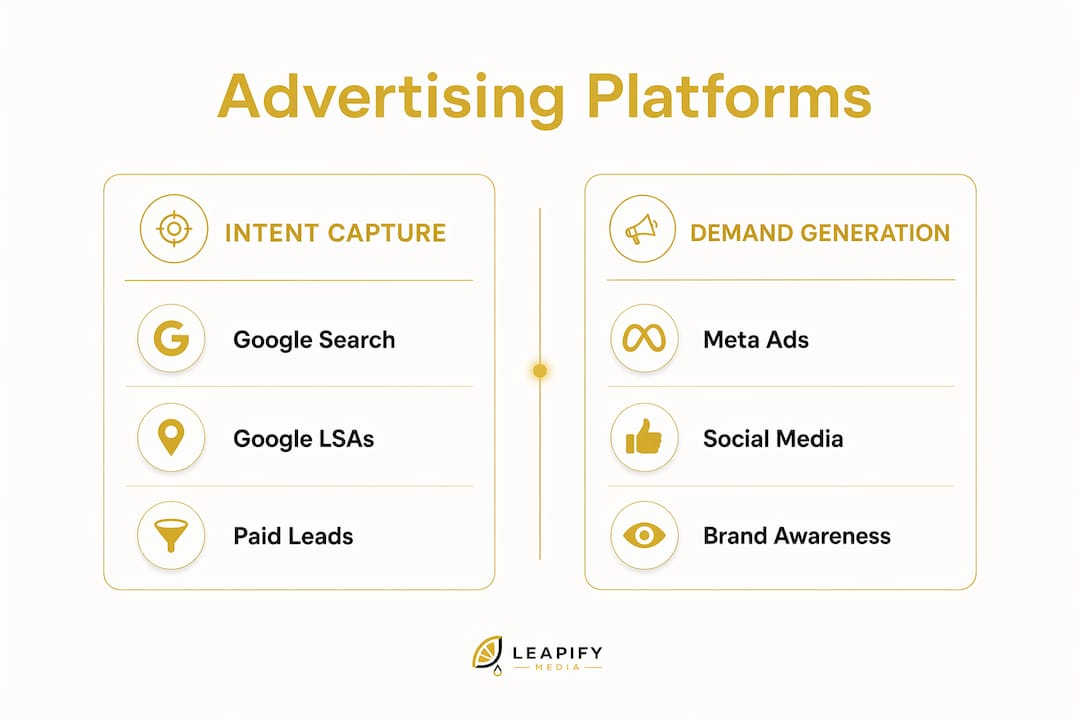
Meta Ads (Facebook and Instagram) work differently. They are demand generation tools, not intent capture. Someone scrolling Instagram was not searching for a roofer. Meta's strength is retargeting people who visited your site and building awareness with lookalike audiences. Expect longer nurture cycles before a lead converts.
Google Business Profile and local SEO are the most underused assets in small business advertising. They cost nothing per click. Organic SEO combined with AEO and GEO techniques compounds over 3–6 months and builds owned traffic that no algorithm change can take away overnight.
Industry-specific guidance:
- Home services (HVAC, plumbing, electrical): LSAs first, then Google Search Ads, then Meta retargeting
- Retail and e-commerce: Google Shopping and Meta Ads together, with strong product feed management
- Professional services (legal, financial, medical): Google Search Ads for high-intent queries, LinkedIn for B2B, and a content-heavy SEO strategy for long-term authority
How do you measure whether your ads are actually working?
Most small business owners track clicks and leads. That is the wrong finish line. A lead that never answers the phone, never books, and never pays is worth zero. The metric that reveals true ROI is cost per booked job.
Tinuiti calls this "lead math": building usable metrics by service line, season, and location so you can see exactly what it costs to hit a revenue target. Without that math, you are guessing.
Here is a practical evaluation framework:
- Install call tracking (a dedicated number per campaign) so you know which platform generated each call
- Connect your CRM to log which calls became booked appointments
- Calculate cost per booked job by dividing total ad spend by jobs booked, not leads received
- Feed that data back into your campaigns to shift budget toward the channels producing the lowest cost per booked job
- Review conversion rates at every stage: click to call, call to booked, booked to completed job
The math gets clarifying fast. If Google Ads generates leads at $50 each and only a quarter actually book jobs, your real cost per booked job is four times the lead cost. If Meta generates leads at a lower cost and a higher booking rate, Meta wins on efficiency. You cannot see that without closing the loop.
Common mistakes that drain small business ad budgets
The most expensive mistake is spending more on traffic when the real problem is conversion. Doubling your conversion rate from 0.5% to 1% halves the ad spend required to hit the same number of booked jobs. That math is uncomfortable because it means the problem is often the website, not the ads.
Common pitfalls to avoid:
- Tracking vanity metrics (impressions, clicks) instead of booked jobs and revenue
- Sending paid traffic to a generic homepage instead of a dedicated landing page matched to the ad's promise
- Ignoring Google Business Profile while spending heavily on paid ads
- No call tracking, so you cannot attribute revenue to a specific campaign
- Disconnected tactics where paid ads, SEO, and follow-up operate in separate silos with no shared data
Pro Tip: Before increasing your ad budget, audit your website's conversion basics. Heuristic CRO improvements like shortening contact forms, moving your phone number to the top of every page, and improving mobile load speed can produce significantly more inquiries from the same traffic. A well-designed home service website builds these conversion patterns in from the start.
Why AI-powered integrated marketing outperforms traditional ad management
Running Google Ads and Meta Ads in isolation is table stakes. The businesses pulling ahead are the ones treating paid media, organic search, and lead conversion as one connected system, with AI doing the optimization work that no human can do manually at scale.
Leapify Media's approach is built around this principle. Rather than relying on third-party AI dashboards, Leapify uses on-premise servers and proprietary AI for lead dispatch and intent scoring. That means client data stays private, attribution is accurate, and the system learns from actual booked jobs rather than proxy metrics. Clients report over 20x return on ad spend through this model.
Core benefits of an integrated AI-powered marketing infrastructure:
- True closed-loop attribution: every dollar of ad spend traced to a booked job, not just a click
- On-premise data control: no third-party platform holding your customer data or your competitive intelligence
- AI intent scoring: leads ranked by likelihood to book so your team calls the right ones first
- Compounding organic assets: SEO and content that reduce your cost per lead over time as paid costs rise
- CRM automation: follow-up sequences that prevent leads from going cold between contact attempts
The difference between this and a traditional agency setup is measurement depth. Most agencies report on clicks and leads. This model reports on margin.
How to select and test the right advertising platform for your business
Start with your business model, not the platform. The right sequence:
- Define your cost per booked job target. Work backward from your average job value and profit margin. If a job nets $400, you can afford to spend meaningfully to acquire it.
- Audit your current conversion rate. Check Google Analytics for your top landing pages. A site converting below 1% on paid traffic needs CRO work before more ad spend.
- Start with one high-intent channel. For most home service businesses, that is Google Local Services Ads or Google Search Ads. Run it for 60–90 days with proper call tracking before adding channels.
- Add a second channel only when the first is profitable. Meta Ads make sense as a retargeting layer once you have a converting funnel, not as a starting point.
- Build your organic foundation in parallel. Google Business Profile optimization and local SEO cost time, not money, and begin compounding while paid campaigns run.
- Review cost per booked job monthly, not weekly. Short windows produce noise. Monthly data reveals real trends.
- Integrate your CRM and ad platforms. Feed booked job data back into Google Ads and Meta as offline conversion signals. Both platforms optimize better when they know what a real customer looks like, not just what a form fill looks like. A conversion-optimized web presence makes this integration far cleaner.
The businesses that waste the most ad spend are the ones that skip step two, launch on three platforms simultaneously, and measure success by lead volume. Pick one channel, prove the math, then scale.
Leapify Media turns your ad spend into booked jobs
Most small business advertising advice stops at "run Google Ads and Meta Ads." Leapify Media starts where that advice ends: converting those ads into revenue you can actually measure.
Leapify Media builds the full marketing infrastructure for home service companies, including Google Ads and Meta Ads management, local SEO, on-premise AI lead dispatch, CRM automation, and custom content production. The difference is data ownership and measurement depth. Your leads, your customer data, your attribution, all on your terms. No third-party AI holding your competitive intelligence. Clients have reported over 20x return on ad spend using this model.
If you are spending on ads and not seeing that spend translate into a predictable number of booked jobs, the system needs fixing, not just the budget. See how Leapify Media works and find out what a properly integrated marketing infrastructure looks like for your business.
Key Takeaways
The best advertising platform for small businesses is not a single channel but an integrated system connecting paid ads, organic SEO, and AI-powered lead conversion measured by cost per booked job.
| Point | Details |
|---|---|
| Measure cost per booked job | Track ad spend against actual booked revenue, not clicks or raw lead volume. |
| Start with high-intent channels | Google Local Services Ads and Google Search Ads deliver the most immediate, measurable results for service businesses. |
| Fix conversion before scaling spend | Heuristic CRO improvements can produce significantly more inquiries from the same traffic without increasing ad budgets. |
| Build organic assets in parallel | Local SEO and Google Business Profile compound over 3–6 months and reduce long-term cost per lead. |
| Leapify Media | Provides AI-powered marketing infrastructure for home service businesses, with clients reporting substantial improvements in booked jobs and over 20x return on ad spend. |