

Google Ads works for artificial turf businesses, but only when the account is built for a high-ticket, long-consideration purchase rather than a cheap-click race. Success requires three things: campaigns segmented by ticket size, landing pages that match each offer exactly, and CRM or call tracking wired in before launch. Give the setup roughly 90 days to gather enough conversion data to optimize properly.
TL;DR:
- Segment campaigns by service type, ticket size, and geographic area to prevent low-value clicks from draining budget and prioritize high-ticket installs.
- Use specific, intent-focused keywords and build tailored landing pages to improve relevance, message match, and conversion for each ad group.
- Implement detailed tracking, call attribution, and CRM automation before launching ads to accurately measure and improve lead quality and job conversion.
- Allocate higher budgets to installation campaigns early on, with a focus on data collection for at least 90 days before scaling or refining strategies.
- Combine local service ads with search campaigns, leveraging AI-driven lead scoring and remarketing for a long, high-value sales cycle typical of luxury turf purchases.
Table of Contents
- Structuring Artificial Turf Google Ads Campaigns
- What Keywords Should You Target for Artificial Turf Ads?
- Landing Pages and Ad Creative That Convert Turf Clicks
- How Much Should You Budget, and Where Do LSAs Fit?
- Tracking, Call Attribution, and CRM Setup
- Managing the Long, Luxury-Style Turf Buying Journey
- Where an AI-First Approach to Ads Fits In
- What I'd Fix First If I Were Running Your Account
- How Leapify Media Builds the Full Turf Ad Funnel
- Sources
Structuring Artificial Turf Google Ads Campaigns
The single biggest mistake in artificial grass advertising is dumping installation and maintenance keywords into one campaign. Google's algorithm chases whatever converts fastest, and a $150 cleaning job converts faster than a $22,000 backyard install. Left unchecked, the platform starves your highest-value work of budget. Segmenting by service type and ticket size is consistently the highest-leverage fix when a turf account underperforms.
Build the account around this split:
- Installation campaigns: new turf projects, backyard putting greens, pet turf, commercial installs. Bid aggressively; these fund the business.
- Maintenance campaigns: infill top-ups, repairs, cleaning, seam fixes. Cap spend so it doesn't cannibalize install budget.
- Ad groups of 10 to 15 tightly related keywords each — split "artificial turf installation," "synthetic lawn install," and "pet turf backyard" into their own groups rather than one bloated bucket.
- Geographic splits by service area, especially if you cover multiple counties with different price sensitivity or labor costs.
Start every campaign on phrase and exact match only. Broad match without a mature negative keyword list burns budget fast in this category, since "turf" gets confused with sports fields, artificial flowers, and DIY carpet projects.
Pro Tip: Build your negative keyword list before you launch, not after you've paid for a week of junk clicks. Pull from sports-turf, DIY, and job-search terms first.
What Keywords Should You Target for Artificial Turf Ads?
Effective artificial turf keyword strategies start with service plus intent, not generic terms like "artificial grass." Generic head terms are expensive and attract browsers, not buyers.
Use these templates as seed keywords:
- Installation: "artificial turf installation [city]," "synthetic grass install cost," "backyard artificial turf company"
- Replacement: "replace artificial turf backyard," "turf replacement near me"
- Repair: "artificial turf seam repair," "fix artificial grass patch"
- Maintenance: "artificial turf cleaning service," "synthetic lawn infill top up"
- High-LTV/comparison: "artificial turf vs sod cost," "best artificial turf for dogs," "putting green installation backyard"
Launch on phrase and exact match. Once you've logged roughly 30 conversions per campaign, you have enough data to test broad match with strict negatives layered on top.
Your starter negative list needs four categories:
- Job-search terms ("turf installer jobs," "landscaping careers")
- DIY terms ("how to install artificial turf yourself," "diy synthetic grass")
- Price-shopping fishing terms without buying intent ("free artificial turf samples")
- Unrelated turf ("football turf," "artificial turf field for sale")
Landing Pages and Ad Creative That Convert Turf Clicks
Every campaign or offer needs its own dedicated landing page. Sending a "backyard putting green" ad to your generic homepage kills conversion rate and Quality Score in one move. Message match between the ad headline and the landing page headline lowers your cost per click because Google rewards relevance.
A landing page built for a turf install needs:
- A headline that echoes the ad copy word for word
- A clickable phone number above the fold
- A short form, three fields maximum: name, phone, ZIP code
- A before/after photo gallery of actual installs, not stock imagery
- Starting price bands or financing language, since "cheap synthetic grass" and "premium pet turf system" attract completely different buyers
For ad creative, write responsive search ad headlines around the price-plus-proof formula: "$8 to $12/sq ft Installed" paired with "500+ Backyards Transformed." Aspirational visuals and financing details do more work than pure value messaging for a luxury home-service purchase like turf. On Display and Performance Max, lean on video walkthroughs and before/after carousels over static banners.
Pro Tip: Run one A/B test at a time. Test the headline first, then the form length, then the hero image. Stacking three changes at once tells you nothing about which one actually moved the needle.
How Much Should You Budget, and Where Do LSAs Fit?
Most turf advertisers need a realistic runway of 90 days before the account has enough signal to optimize well. Start with Maximize Conversions or manual CPC while data accumulates, and only shift to Target CPA once you're logging a steady conversion volume, generally in the neighborhood of 30 conversions per campaign.
- Budget installation campaigns higher than maintenance from day one; installs carry the revenue.
- Expect cost-per-acquisition to run higher than typical home-service categories because turf jobs are bigger tickets with longer research cycles.
- Treat your first 30 to 60 days as data collection, not a performance verdict.
- Run Local Services Ads alongside search once you clear Google's eligibility and review thresholds.
LSAs place above standard search results and charge per lead rather than per click, which makes them a useful complement to search rather than a replacement for it. Running both gives you more shelf space on the results page during peak search months.
Tracking, Call Attribution, and CRM Setup
Set up your measurement stack before you spend a dollar on clicks, not after. You need Google Ads conversion actions, GA4 event tracking, and offline conversion import so booked and paid jobs, not just form fills, flow back into the platform.
- Install dynamic number insertion so every call gets attributed to the exact keyword and ad that generated it.
- Call tracking and CRM automation configured before launch measurably lifts lead-to-booked-job conversion rates compared to accounts that bolt these on later.
- Automate instant text or email confirmations the moment a lead comes in, followed by a booking link and a short nurture sequence.
- Score leads by project size and urgency so your team calls the $25,000 backyard inquiry before the $200 patch repair.
Calculate true cost per acquisition against booked and paid installs, never against form fills. A campaign generating cheap leads that never convert to signed contracts is a worse investment than one generating fewer, pricier leads that close.
Pro Tip: Reaching a new lead within minutes of form submission, rather than hours, is one of the most reliable ways to raise close rates on high-ticket installs.
Managing the Long, Luxury-Style Turf Buying Journey
Turf behaves like a luxury purchase, not an emergency repair. Buyers research for weeks, compare photos, and think hard about financing before calling anyone. Treating turf searches as high-intent but low-urgency changes how you build the funnel.
- Build remarketing lists from landing page visitors and serve them project galleries, video testimonials, and financing offers over the following weeks.
- Pace budget toward spring and early summer, when search volume for outdoor projects peaks, without shutting off winter demand entirely.
- Give your intake team a script that nurtures a lead over multiple touches instead of writing them off after one unanswered call.
- Offer a low-commitment next step, like a free design consultation, for leads who aren't ready to book yet.
Where an AI-First Approach to Ads Fits In
A booked turf install depends on every link in the chain holding: the ad, the landing page, the CRM, and the follow-up that turns a click into a signed contract. Some vendors build that chain for home service businesses, running Google Ads and Meta Ads management alongside on-premise AI lead scoring, CRM automation, and landing pages built for message match rather than generic templates.
Any vendor claiming outsized returns, including a figure like 20x return on ad spend, should be able to show you the conversion math behind it: how many leads, at what cost, converted into how many booked and paid jobs. Ask for that breakdown before you ask for the pitch.
Before hiring any agency for artificial turf ad campaigns, ask them:
- Who owns your conversion and customer data, and where is it stored?
- Do they use proprietary systems or resell third-party AI tools?
- Can they walk you through a real, referenceable case study, not just a summary metric?
- Are they listed in Google's Partners directory with a verifiable agency profile?
What I'd Fix First If I Were Running Your Account
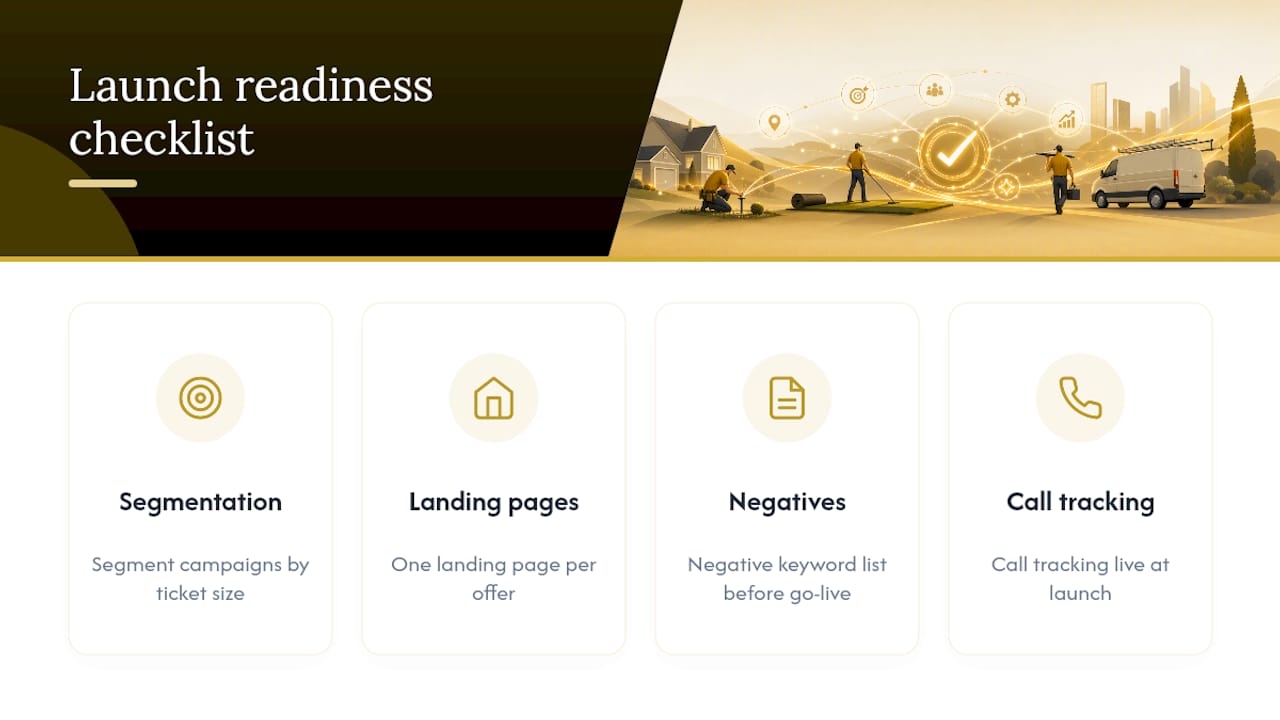
Launch checklist: segmented campaigns by ticket size, one landing page per offer, a negative keyword list built before go-live, call tracking live, and a CRM sequence ready to fire on lead one. Skip any of these and you're paying for data you can't act on.
The three mistakes I see most: broad match turned on with no negatives, ad traffic dumped on a homepage instead of a matched landing page, and leads sitting unanswered for hours. Any one of these alone can sink an otherwise well-built account.
Ninety days, three phases: launch tight and measure, optimize based on real conversion data, then scale budget into what's actually booking jobs.
— Everson Gorski
How Leapify Media Builds the Full Turf Ad Funnel
There are solutions that provide a single infrastructure to handle Google Ads and Meta Ads management, AI-driven lead scoring, CRM automation, landing page builds, and call and conversion tracking, all connected so a click can be traced to a booked job.
This fits artificial turf businesses doing significant annual revenue that are tired of paying for clicks with no visibility into which ones actually turned into signed contracts. The services page breaks down exactly what's included in ads management, lead scoring, and CRM setup. If you're ready to see what an audit of your current account would surface, start with Leapify Media and bring your last 90 days of ad spend and conversion data to the conversation.
Sources
- Why Landscaping Companies Are Wasting Money on Google Ads (And What to Do About It)
- Google Ads for Artificial Turf: High Intent, but It's Still a Luxury Buy
- Google Ads for Home Services: The Complete 2026 Playbook
- Google Ads for Remodeling Contractors: Lead Generation Guide