

For most 1–25-tech residential HVAC, plumbing, or electrical shops, FieldEdge is the smarter near-term choice. For growth-oriented operations running 25+ techs across multiple locations, ServiceTitan earns its premium. The decision almost always comes down to three things: how many trucks you run, how dependent your bookkeeper is on QuickBooks, and how much you spend on paid marketing each month.
Quick audience split:
- Small to mid teams (1–25 techs) running QuickBooks: FieldEdge delivers faster implementation, lower total cost of ownership, and a native two-way QuickBooks sync that bookkeepers actually prefer. Reported all-in monthly costs for a 10-truck shop run $400–$700 per month for FieldEdge and $1,200–$1,800 per month for ServiceTitan.
- Growth-oriented, multi-location operations (25+ techs): ServiceTitan's AI dispatch, closed-loop marketing attribution, and advanced business intelligence justify the higher spend once your operation has the internal processes to use those features.
Pro Tip: Most contractors follow a natural growth path: stabilize operations on a QuickBooks-centric FSM at roughly 8–12 trucks, then evaluate migrating to an enterprise platform once dispatch complexity and marketing attribution needs outgrow what simpler tools can handle. Don't pay for enterprise complexity before you need it.
Table of Contents
- ServiceTitan vs FieldEdge: Side-by-side feature comparison
- What does each platform actually cost you?
- Which business size and model is each platform built for?
- What does onboarding and support actually look like?
- How do integrations and ecosystem depth compare?
- Where does each platform win and where does it fall short?
- What do users actually say about both platforms?
- What does the research say about ROI and implementation risk?
- How to choose: a decision checklist and demo questions
- Key Takeaways
- The FSM choice that most articles miss
- More booked jobs from whichever FSM you choose
- Useful sources for deeper due diligence
ServiceTitan vs FieldEdge: Side-by-side feature comparison
| Dimension | FieldEdge | ServiceTitan |
|---|---|---|
| Best for | 1–25 techs, QuickBooks-dependent residential trades | 25+ techs, multi-location, marketing-driven operations |
| Core features | Scheduling, dispatch, invoicing, mobile app, flat-rate pricing | All of FieldEdge's core plus AI dispatch, pricebook Pro, financing, Marketing Pro |
| QuickBooks integration | Native real-time two-way sync (Desktop & Online) | Broader ecosystem; accounting sync requires separate configuration |
| Other integrations | Solid third-party app support; lighter marketplace | Extensive marketplace, Intacct, marketing attribution, financing partners |
| Ease of use / setup | Simpler UI; faster ramp for field techs | Feature-rich; steeper learning curve; requires dedicated admin |
| Support & training | Standard onboarding; faster time-to-live | Dedicated implementation team; structured onboarding program |
| Pricing / TCO | ~few hundred dollars per month/month per tech; lower all-in cost | ~mid-to-high hundreds per month/month per tech; add-ons can double year-one cost |
| Reporting & marketing attribution | Standard operational reports | Deep BI, closed-loop marketing attribution, cost-per-job-closed |
| Implementation time | ~30–45 days | ~60–90 days (longer with full pricebook config) |
Key differentiators by dimension:
- QuickBooks fidelity: FieldEdge's native real-time sync is the tightest in the category. ServiceTitan connects to QuickBooks but requires more configuration and reconciliation steps.
- Marketing attribution: ServiceTitan's closed-loop attribution lets you measure cost-per-job-closed. FieldEdge has no equivalent.
- Pricebook and ticket size: ServiceTitan users report 15–25% average ticket increases from pricebook tools that FieldEdge doesn't match.
- Implementation speed: FieldEdge gets teams live in weeks. ServiceTitan's full rollout typically runs two to three months minimum.
What does each platform actually cost you?
Sticker price is only part of the story. FieldEdge runs roughly low hundreds per month per technician; ServiceTitan runs mid-to-high hundreds per month per tech. For a 10-tech operation, that gap is several thousand dollars per year before you add anything else.
The real gap widens once you account for:
- Implementation fees: ServiceTitan's structured onboarding carries a separate cost. FieldEdge's faster path typically means lower setup fees.
- Add-on modules: ServiceTitan's Marketing Pro and Pricebook Pro are separate line items. These add-ons can effectively double year-one investment compared with a base subscription.
- Admin overhead: ServiceTitan requires a dedicated internal admin, at minimum part-time, to manage pricebook updates, reporting, and integrations. That's a real labor cost.
- Financing integrations: If your sales model relies on consumer financing, ServiceTitan's financing partners are built in. FieldEdge's options are lighter.
The all-in monthly cost for a 10-truck shop: FieldEdge runs $400–$700 per month; ServiceTitan runs $1,200–$1,800 per month. That 2–3x gap is the number to put in front of your accountant before you sign anything.
For shops spending $2,000–$10,000+ per month on paid marketing, ServiceTitan's attribution tools can recoup that cost difference by identifying which campaigns actually close jobs. Below that spend threshold, the attribution upside rarely justifies the premium.
Which business size and model is each platform built for?
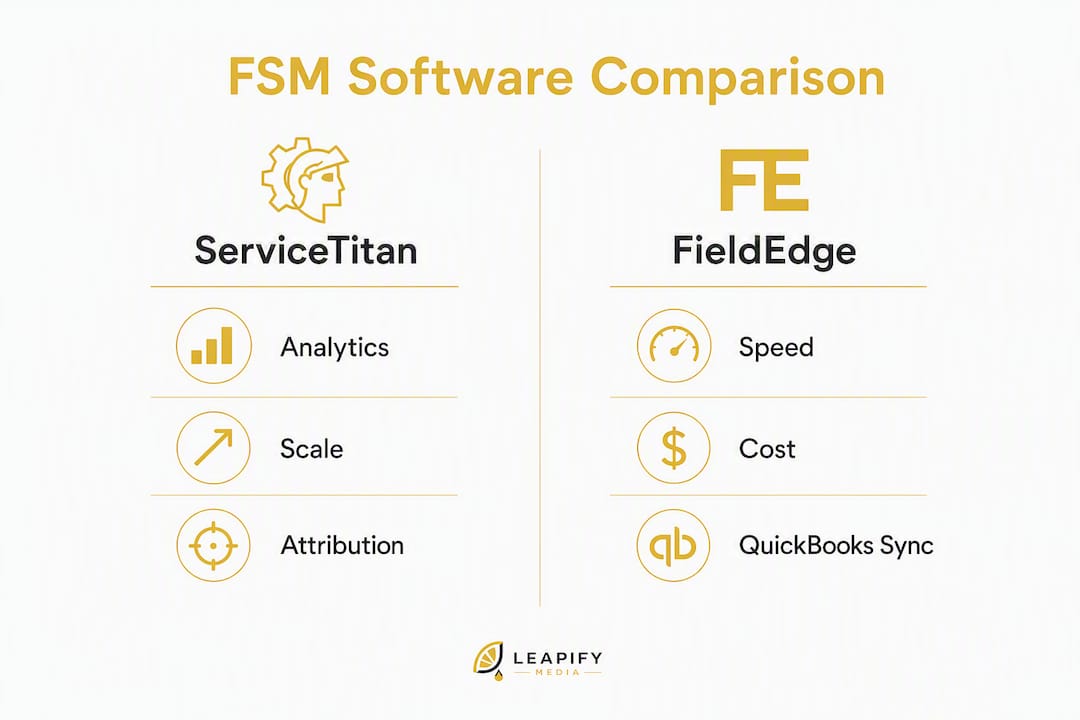
The choice is rarely about features in isolation. It's about whether your organization has the operational complexity to extract value from advanced tools.
FieldEdge is the right fit if you:
- Run 1–25 techs on residential HVAC, plumbing, or electrical work
- Use QuickBooks Desktop or Online and want your bookkeeper to stay in that workflow
- Need to be live and productive within 30–45 days
- Want predictable monthly costs without surprise add-on fees
- Don't yet have a dedicated marketing or analytics function
ServiceTitan makes sense when you:
- Operate 25+ techs or are actively scaling toward that threshold
- Run multiple locations and need consolidated reporting across them
- Spend materially on Google Ads, LSAs, or other paid channels and need closed-loop attribution
- Sell financing and want that workflow embedded in the job flow
- Have or plan to hire a dedicated FSM admin or operations manager
The common mid-market threshold where ServiceTitan typically earns its premium sits around 20–25 techs. Below that, most shops pay for capabilities they won't use for another two or three years.
One fringe case worth flagging: if you're a smaller shop but run aggressive paid advertising, ServiceTitan's attribution alone can justify the jump earlier than tech count suggests.

What does onboarding and support actually look like?
Implementation timelines differ more than most vendors admit upfront. FieldEdge typically goes live in 30–45 days; ServiceTitan's full rollout runs 60–90 days, and that assumes you've already cleaned up your pricebook data before kickoff.
What drives longer timelines on ServiceTitan:
- Pricebook configuration is the single biggest variable. Rushing it causes persistent reporting gaps and under-used sales features for months afterward.
- Data migration from a legacy system adds time regardless of platform.
- Training field techs on a feature-rich mobile app takes longer than training on a simpler one.
Both platforms require internal commitment. Plan for:
- A dedicated internal champion who owns the rollout and trains the team
- Parallel operation during the first two to four weeks (old system + new system simultaneously)
- A realistic productivity dip of four to eight weeks as techs adjust
Practitioners consistently identify poor change management as the primary failure mode in FSM transitions, not missing features. The platform rarely fails. The rollout plan does.
Pro Tip: Before you sign, ask the vendor for a written implementation milestone schedule with defined deliverables and go-live criteria. Vague "onboarding support" language in a contract is a red flag. Get specifics: who owns each phase, what happens if milestones slip, and what your recourse is.

How do integrations and ecosystem depth compare?
QuickBooks is where the two platforms diverge most sharply. FieldEdge's native two-way sync with both QuickBooks Desktop and Online is real-time and bidirectional. Invoices, payments, and customer records flow without manual reconciliation. Bookkeepers who've used both platforms consistently prefer FieldEdge's accounting workflow.
ServiceTitan connects to QuickBooks but treats it as one integration among many rather than a core architectural dependency. For shops that need Sage Intacct or more sophisticated multi-entity accounting, ServiceTitan's broader ecosystem is the better fit.
Beyond accounting, the platforms diverge on:
- Marketing attribution: ServiceTitan's Marketing Pro tracks calls, campaigns, and job outcomes in a closed loop. FieldEdge has no comparable attribution layer. If you're managing Google Ads or Local Service Ads and want to know which campaign closed which job, ServiceTitan is the only option between these two.
- Financing: ServiceTitan integrates consumer financing directly into the estimate and approval workflow. FieldEdge's financing options are more limited.
- API and marketplace: ServiceTitan's marketplace is broader, which matters if you plan to add niche tools for fleet management, HR, or advanced scheduling. FieldEdge's third-party app support is solid but lighter. For AI-driven scheduling and maintenance workflows, the AI maintenance scheduling space is evolving quickly on both sides.
- Third-party marketing stacks: Neither platform replaces a purpose-built external marketing infrastructure. Shops running serious paid campaigns typically layer an external marketing automation stack on top of whichever FSM they choose.
Where does each platform win and where does it fall short?
FieldEdge strengths
- Fastest path from contract to live operation in the category
- Tightest QuickBooks sync available; fewer reconciliation headaches
- Lower and more predictable total cost of ownership
- Simpler mobile app that field techs adopt faster
- No surprise add-on fees for core functionality
FieldEdge limits
- Reporting depth is operational, not analytical; no marketing attribution
- Pricebook tools don't drive the ticket-size increases ServiceTitan's do
- Limited multi-location consolidation for growing operations
- Lighter marketplace for adding niche third-party tools
ServiceTitan strengths
- AI-assisted dispatch that optimizes technician routing and job assignment
- Closed-loop marketing attribution down to cost-per-job-closed
- Advanced BI and custom reporting across locations
- Financing integration embedded in the sales workflow
- Pricebook tools that drive measurable ticket-size increases
ServiceTitan tradeoffs
- 2–3x higher all-in monthly cost for a comparable tech count
- 60–90-day implementation minimum; longer with full pricebook config
- Requires a dedicated internal admin to maintain and optimize
- Feature depth creates a steeper learning curve for field techs
What do users actually say about both platforms?
User sentiment on both platforms is generally positive, with predictable fault lines.
FieldEdge users consistently praise:
- The QuickBooks sync working as advertised with minimal reconciliation
- Fast onboarding and a support team that responds quickly
- A mobile app that field techs find intuitive without training
Common FieldEdge complaints:
- Reporting feels limited once a business grows past 15–20 techs
- Some users want deeper customization in scheduling views
- Marketing tools are basic compared to what growth-stage shops need
ServiceTitan users consistently praise:
- The depth of reporting and marketing attribution once fully configured
- Pricebook tools that visibly move average ticket values
- The breadth of integrations for complex, multi-location operations
Common ServiceTitan complaints:
- Implementation takes longer and costs more than initial sales conversations suggest
- Support quality varies; some users report slow response times post-onboarding
- The mobile app has more features than most field techs need, which creates friction
Rating snapshot: Both platforms carry strong aggregate ratings on software marketplaces, with ServiceTitan and FieldEdge each scoring in the 4.3–4.5 range on G2 and SoftwareAdvice. The gap in satisfaction scores is narrow; the gap in complaints is about complexity versus capability.
What does the research say about ROI and implementation risk?
The productivity dip is real and consistently underestimated. ServiceTitan customers commonly experience 3–6 months before teams reach full proficiency. Skipping pricebook configuration during that window compounds the problem: teams end up with an expensive platform they're using at 40% of its capability.
The revenue upside, when ServiceTitan is implemented properly, is meaningful. Analyst and practitioner sources report revenue uplifts in the 20–40% range for growth-oriented shops that fully use ServiceTitan's marketing and pricebook tools. That's not a guarantee, and it assumes disciplined adoption, but it's the number that justifies the premium for the right operation.
FieldEdge's ROI story is simpler: faster time-to-value, lower ongoing cost, and fewer adoption risks. The ceiling is lower, but so is the floor.
The single biggest implementation risk on either platform is change management, not technology. Budget for a mandatory adjustment period and assign a dedicated internal champion before you sign the contract.
Pro Tip: Build a 30/60/90-day adoption plan before your go-live date. Define what "proficient" looks like for dispatchers, field techs, and office staff at each milestone. Tie vendor support commitments to those milestones in writing.
How to choose: a decision checklist and demo questions
Work through this before you schedule vendor demos.
Decision checklist:
- Tech count today and projected in 18 months (under 25 or over?)
- QuickBooks dependency (is your bookkeeper unwilling to leave it?)
- Monthly paid marketing spend (under $2K or over $5K?)
- Financing as a sales tool (yes or no?)
- Multi-location reporting needs (current or planned?)
- Internal capacity for a dedicated FSM admin (available or not?)
- Implementation timeline tolerance (30–45 days or 60–90 days?)
- Contract flexibility requirements (month-to-month vs. annual commitment?)
Ten questions to ask on every demo:
- Who owns our data if we cancel, and how do we export it?
- Show me a live QuickBooks sync with a payment posting in real time.
- Walk me through pricebook setup: who builds it, how long does it take, and what does it cost?
- How does marketing attribution work end-to-end, from ad click to closed job?
- What happens to the mobile app when a tech loses cell service mid-job?
- What are the implementation milestones, and what's the vendor's accountability if we miss go-live?
- What does "success" look like at 90 days, and how do you measure it?
- What add-ons are not included in the base price we're discussing?
- What's the contract term, and what are the cancellation terms?
- Can we speak with two current customers at our tech count in our trade?
| Scoring dimension | FieldEdge | ServiceTitan | Your priority (1–5) |
|---|---|---|---|
| QuickBooks integration depth | Native two-way, real-time | Configurable; broader ecosystem | |
| Implementation speed | 30–45 days | 60–90 days | |
| Monthly cost per tech | $400–$700 per month for a 10-truck shop | $1,200–$1,800 per month for a 10-truck shop | |
| Marketing attribution | None | Closed-loop, cost-per-job | |
| Reporting depth | Operational | Advanced BI, multi-location | |
| Pricebook / ticket-size tools | Standard | Advanced (separate add-on) | |
| Mobile app simplicity | Simpler, faster adoption | Feature-rich, steeper curve | |
| Multi-location support | Limited | Strong |
Pro Tip: Run both demos with identical scenarios: the same job type, the same customer record, the same invoice. Vendors perform best on their own demo scripts. Your scenario reveals the gaps.
Key Takeaways
FieldEdge wins on speed and cost for smaller shops; ServiceTitan wins on analytics and scale for operations that have the processes to use it.
| Point | Details |
|---|---|
| Size threshold matters | ServiceTitan typically earns its premium at around 20 techs or more; below that, FieldEdge delivers faster ROI. |
| TCO gap is 2–3x | All-in monthly costs run $400–$700 (FieldEdge) vs. $1,200–$1,800 (ServiceTitan) for a 10-truck shop. |
| QuickBooks dependency | FieldEdge's native real-time two-way sync is the strongest in the category for QuickBooks-reliant teams. |
| Change management is the real risk | Budget several months for full proficiency on ServiceTitan; assign a dedicated internal champion before go-live. |
| Leapify Media fills the marketing gap | Whichever FSM you choose, Leapify Media's AI-powered lead routing and attribution wiring closes the gap between your FSM and your marketing spend. |
The FSM choice that most articles miss
Most comparisons treat this as a software decision. It's actually an operations decision with a software component.
The contractors who get the most out of ServiceTitan aren't the ones with the biggest budgets. They're the ones who treated the implementation like a business process overhaul, not a software install. They cleaned their pricebook before go-live. They assigned an internal champion with real authority. They ran parallel systems for four weeks and didn't rush the cutover.
The contractors who regret ServiceTitan are usually the ones who bought the platform at 15 trucks because a sales rep convinced them they were "ready to scale." They paid enterprise prices for features they couldn't use yet, burned out their office staff on a complex rollout, and ended up with a $1,500/month system running at 30% capacity.
FieldEdge's ceiling is real. If you're running 30 trucks across three locations and spending $15,000/month on paid marketing, you will outgrow it. But most shops reading this comparison aren't there yet, and paying for the platform you'll need in three years before you have the team to run it is a predictable way to waste money and frustrate your staff.
The honest answer: pick the platform that fits where you are today, build the operational discipline to use it fully, and revisit the migration question when your dispatch complexity and marketing attribution needs actually demand it.
More booked jobs from whichever FSM you choose
Both ServiceTitan and FieldEdge manage your jobs. Neither one fills your pipeline. That's the gap Leapify Media was built to close.
Leapify Media runs Google Ads and Local Service Ads for HVAC and plumbing businesses, wires attribution data back into your FSM so you know which campaigns close jobs, and deploys on-premise AI lead dispatch that routes inbound leads before a competitor answers. For mid-size home service companies, a typical engagement starts with a marketing audit, moves into CRM and lead conversion automation, and scales into full campaign management with job-level ROI reporting. Client outcomes include a reported 20x return on ad spend.
If you're evaluating FSM platforms and want to know how your marketing stack should connect to whichever one you choose, talk to Leapify Media and get a clear picture of what your current spend is actually producing.
Useful sources for deeper due diligence
- FieldEdge vs. ServiceTitan — FSMAdvisor: Clean side-by-side on fit by business size and QuickBooks dependency.