

Run both, but give each one a lane: Search protects the high-intent queries you already know convert, and Performance Max hunts for the demand you haven't found yet. The two aren't competitors for the same budget line, they're different tools for different parts of the funnel. The immediate fix if you're not doing this already: lock your brand terms into an exact-match Search campaign today, then add those same terms as exclusions inside Performance Max so it stops bidding against you.
TL;DR:
- PMax is effective for discovering new demand across multiple channels, but requires at least 30 conversions per month for reliable optimization.
- Proper setup involves locking brand terms into Search campaigns and excluding them from PMax to prevent budget cannibalization and maintain control.
- A variety of high-quality creative assets and accurate downstream conversion signals are essential for PMax to optimize toward valuable leads rather than low-quality form fills.
- Both campaigns need ongoing audits for keyword overlap, blended ROAS, and proper measurement to ensure budget is not wasting spend on redundant or competing traffic.
- A hybrid approach prioritizes strict control of brand terms, sufficient conversion data, and strategic budget splits based on industry and campaign goals.
Table of Contents
- Performance Max vs Search: How the Two Systems Actually Differ
- When Should You Choose Search Over Performance Max?
- When Does Performance Max Outperform Search?
- Building a Hybrid Search and Performance Max Strategy
- Setting Up Measurement and Bidding the Right Way
- PMax Lead Generation: Assets, Signals, and Form Hygiene
- How Long Does Performance Max Take to Optimize?
- What an Agency Actually Prioritizes First
- Get a Hybrid Search and Performance Max Setup That Actually Protects Your Budget
- Sources
- FAQ
Performance Max vs Search: How the Two Systems Actually Differ
Search and Performance Max solve different problems because they're built on different logic. Search matches a typed query to a keyword you chose. PMax feeds a machine learning model a pile of assets and a conversion goal, then lets it decide where to show up.
That difference in structure creates four practical gaps advertisers keep running into:
- Inventory coverage. Search lives on the search results page. PMax pulls from a pooled inventory spanning Search, Display, YouTube, Discover, Gmail, and Maps, which is why it tends to report more volume even when performance per lead is weaker.
- Control and transparency. Search gives you query-level visibility and manual keyword control. PMax gives you input-driven control through audience signals and asset groups, but you're trusting the model's judgment on where those assets get shown.
- Optimization logic. Search runs a fairly deterministic path: a specific query triggers a specific ad triggers a conversion. PMax runs cross-surface modeling, blending signals across channels in ways that are harder to trace back to a single cause.
- Reporting limits. Search term reports in PMax have improved but still lag behind the granularity Search campaigns have always offered, which matters the moment something breaks and you need to know why.
That last point is the one advertisers underestimate. When a Search campaign's conversion rate drops, you can usually find the query, the ad, and the landing page in ten minutes. When PMax underperforms, you're often troubleshooting blind for days.
When Should You Choose Search Over Performance Max?
Search still wins the argument in specific, recognizable situations. If any of these describe your account, don't let PMax take over that budget.
- Brand defense and exact-intent terms. If someone types your company name or a near-exact match for what you sell, that click belongs to a keyword you control, not a model guessing at intent.
- Low-volume or tight-budget accounts. Smaller accounts without enough conversion data struggle to give PMax's algorithm anything to learn from, and Search's predictability protects a limited budget better.
- Regulated or complex B2B sales. When compliance teams need to know exactly which query triggered which ad, Search's transparency isn't optional, it's a requirement.
- Query-transparency needs generally. Any account where "what search term triggered this cost" is a question someone in the business actually asks needs Search's reporting depth.
For bidding, keep your highest-priority terms on exact match so you're not paying for loosely related traffic, and layer Smart Bidding on top once you have enough conversion volume to justify automation without losing sight of which queries are driving results.
Pro Tip: Before you touch PMax budgets, audit your Search campaigns for branded exact-match coverage. Accounts that skip this step almost always end up paying PMax to "discover" traffic they already owned.
When Does Performance Max Outperform Search?
PMax earns its budget when the goal is finding demand you can't target with keywords alone, not when you're trying to protect demand you've already identified. Think top-of-funnel discovery, cross-channel reach, and situations where a buyer's path doesn't start with a Google search at all.
Before turning PMax loose on real budget, check three things:
- Conversion volume. A rough industry rule of thumb is 30 or more conversions a month before the model has enough signal to optimize reliably.
- Creative inventory. PMax needs a real spread of images, headlines, and video, not three stock photos and a logo. Google's own guidance ties strong performance directly to asset variety and quality.
- Clean conversion signals. If your "conversions" include spam form fills and accidental clicks, PMax will happily optimize toward more of exactly that.
Once those boxes are checked, pick a bidding goal that matches the actual business objective. Maximize Conversions makes sense when you need volume and have flexible cost tolerance. Maximize Conversion Value or target ROAS fits better when some leads or sales are worth meaningfully more than others, since it points the model at value instead of raw count.
One caveat worth repeating: don't run a PMax-only account if you genuinely need query-level visibility. You'll get scale, but you'll lose the ability to see exactly what's driving it, and that trade-off isn't right for every business.
Building a Hybrid Search and Performance Max Strategy
Running both campaign types without a plan is how budget quietly leaks from one to the other. The fix is a small set of rules, applied consistently.
- Give Search first claim on core queries. Exact-match Search campaigns for your highest-value terms should always take priority, structurally and in bid strategy, over anything PMax is doing.
- Fence off brand terms. Use account-level negative keywords and PMax's campaign-level exclusions, a control that expanded through recent platform updates, to keep PMax from bidding on the branded searches your Search campaign already owns.
- Set a budget split by vertical. Lead-generation accounts typically lean 60 to 70% Search for control, ecommerce accounts often flip that ratio toward PMax for catalog-driven reach, and local-service businesses usually sit in the middle depending on how competitive local search terms are.
- Watch for the warning signs of cannibalization. Track blended account ROAS, not just each campaign's individual number, alongside brand impression share and any overlap showing up in search term reports.
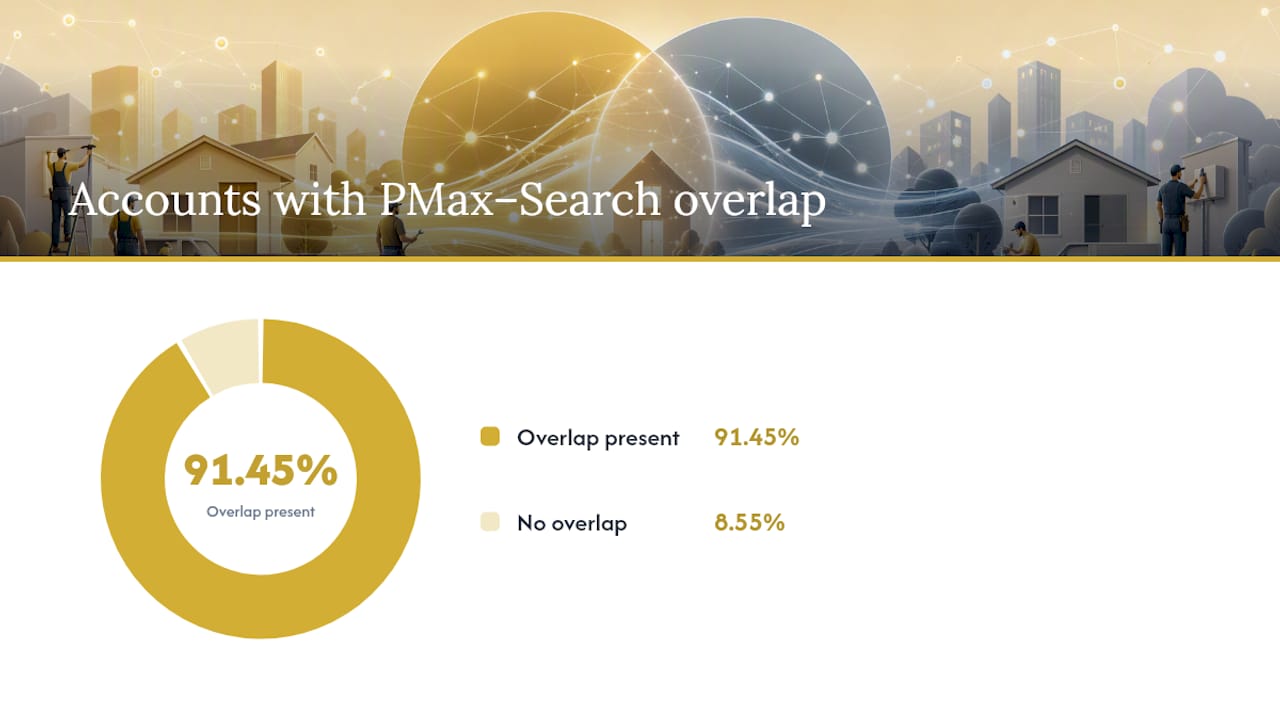
That overlap problem is bigger than most advertisers realize. Third-party audits found that 91.45% of accounts had some form of keyword overlap between PMax and Search in 2026, and unmanaged overlap can leak 10 to 25% of budget as PMax quietly captures branded queries that Search was already converting for less.
To actually measure whether PMax is adding incremental value or just cannibalizing Search, compare brand impression share and conversion counts before and after PMax launches, and consider a short holdout test, pausing PMax or its brand-exposed asset groups for a defined window to see what Search picks up on its own. Practitioner analyses have flagged cases where PMax reported strong standalone ROAS while blended account efficiency stayed flat, which tells you the campaign was winning credit for conversions Search would have gotten anyway.
Setting Up Measurement and Bidding the Right Way
PMax is only as good as the conversion data you feed it, and this is where most underperforming accounts actually go wrong. Google's own guidance is direct about this: conversion signals and asset quality steer the algorithm, so garbage signals produce garbage optimization.
- Integrate your CRM and import offline conversions so PMax learns from booked jobs and closed deals, not just form submissions.
- Pass lead scores or deeper-funnel events back into Google Ads whenever the sales cycle extends past the initial contact.
- Choose Maximize Conversions when volume is the goal and cost flexibility exists; choose target CPA once you have a stable cost benchmark; choose Maximize Conversion Value or target ROAS when leads carry different dollar values.
- If conversion counts are low, start on Maximize Conversions to build a data baseline, then introduce tCPA once the campaign has enough history to bid intelligently.
- Check asset performance reports, search term insights, and bid strategy reports on a regular cadence rather than only when something looks wrong.
Feeding the model conversion value instead of raw conversion count is the single change Google's own lead-generation guidance points to most often for pushing PMax toward higher-value outcomes rather than sheer volume.
PMax Lead Generation: Assets, Signals, and Form Hygiene
Lead-gen accounts have a specific failure mode with PMax: the model optimizes toward whatever conversion is easiest to get, and "easiest" often means a low-value form fill from someone who was never going to buy. Fixing that requires attention in four places.
- Asset variety. Supply a genuine range of images, headlines, descriptions, and video, and aim for an "Excellent" ad strength rating rather than settling for "Good."
- Downstream signals. Send value per lead, win rate, or SQL (sales-qualified lead) flags back into Google Ads so the model learns to chase quality, not just quantity.
- Negative keyword hygiene. Apply negatives at both the campaign and account level proactively, don't wait until wasted spend shows up in a report.
- Form validation. Layer in reCAPTCHA v3, disqualifying questions, and server-side validation, then deduplicate against your CRM so repeat submissions don't inflate conversion counts.
Changing what counts as a conversion in the first place often matters more than any bid adjustment. If PMax is optimizing toward a simple form fill, it will find more form fills, regardless of whether those leads ever turn into revenue. Redefining the conversion goal around a downstream action, a booked appointment or a qualified lead rather than a raw submission, tends to move lead quality further than tweaking targets ever does.
Pro Tip: Run a monthly audit comparing form submissions against your CRM's "qualified" tag. If the gap is wide, your conversion signal is training PMax to find you more junk leads, not more customers.
How Long Does Performance Max Take to Optimize?
PMax needs a learning period before its numbers mean anything, and pulling the plug too early is one of the most common mistakes advertisers make.
- Expect two to four weeks of unstable performance after any major change, whether that's a new campaign, a new bidding strategy, or a big budget shift.
- If you're consistently below the 30-conversion-per-month threshold, focus on fixing volume (broader assets, wider targeting, offline conversion imports) before judging performance.
- Intervene when a metric is clearly broken, like conversion tracking failing or ad strength stuck at "Poor." Let the model keep learning when performance is simply noisy and normal for its age.
- Report on a blended view across Search and PMax together, not just platform-reported ROAS, since platform numbers can look great while overlap quietly inflates them.
What an Agency Actually Prioritizes First
Here's where most accounts should start this week, in order: lock brand terms into exact-match Search and exclude them from PMax, import offline conversions so the algorithm learns from real bookings, and hand PMax a real asset library instead of three leftover banner images.
Conversion value, not raw lead count, is often treated as the north star for home-service clients, because a cheap form fill that never becomes a booked job is worse than no lead at all. For smaller teams, a conservative test looks like this: run Search alone for two weeks to establish a baseline, then introduce PMax with brand exclusions in place from day one.
— Everson Gorski
Get a Hybrid Search and Performance Max Setup That Actually Protects Your Budget
Most home-service businesses running Search and PMax on their own end up with the exact overlap problem this article just walked through: PMax quietly eating brand clicks Search already had for less, and nobody noticing until quarterly numbers look flat. Some companies build growth infrastructure specifically for home-service companies, combining managed Google Ads setup with AI-based lead scoring so the conversion signal feeding campaigns reflects booked jobs, not just form fills.
Clients working with such services typically see cleaner measurement, better lead quality, and a meaningful lift in blended return on ad spend once brand and discovery budgets stop competing against each other, as explained in How to Source HVAC Talent Locally: A Contractor's Guide. If your Search and PMax campaigns have never been audited together, that's the first thing worth fixing. Visit Leapify Media's services page to see how a hybrid setup gets built, or head to the main site to start a conversation about your account.
Sources
- Performance Max best practices for lead generation (Google Support)
- How to reduce low-quality leads from Performance Max campaigns (Search Engine Land)
FAQ
Is Performance Max Better Than Search?
Neither is universally better. PMax scales discovery across channels while Search offers precise query control, and most accounts perform best running both with clear guardrails between them.
Is Performance Max Worth It?
It's worth it once an account has clean conversion tracking, roughly 30 or more monthly conversions, and a real library of creative assets. Below that threshold, the model rarely has enough signal to optimize well.
When Should I Use Performance Max?
Use it for cross-channel discovery, catalog-driven ecommerce, or reaching buyers who haven't started typing keyword searches yet, always with brand-term exclusions in place so it doesn't cannibalize Search.
Are Google Shopping Ads Better Than Performance Max?
Standalone Shopping campaigns are being phased into PMax structures, but where choice still exists, standalone Shopping gives more granular product-level control, while PMax adds broader reach at the cost of that same visibility.