
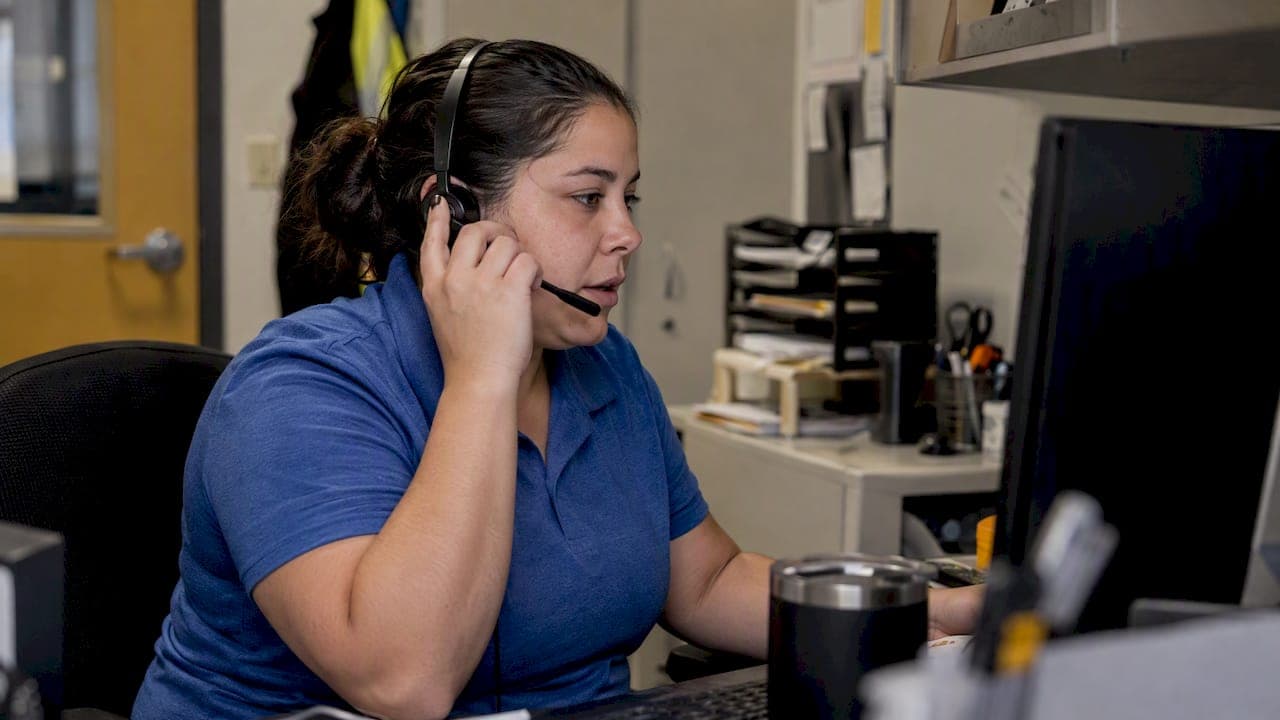
This page gives you a modular dispatcher script you can copy into your phone system or CRM today, along with scenario branches for active leaks, sewer backups, no-hot-water calls, and gas odor reports. It includes shutoff checks and safety triage language drawn from OSHA guidance, plus short notes on rolling it out and measuring results.
TL;DR:
- Capture the caller’s name, verified phone number, service address, problem, urgency, shutoff status, and access details before booking; attach photos to the job record.
- Treat any gas or sewer gas odor as an escalation: tell callers to leave the area, avoid switches and appliances, and never enter confined spaces.
- For active leaks, ask callers to shut off the main water supply; dispatch severe cases urgently and flag each job for priority handling.
- Before booking, state the arrival window and diagnostic fee, explain that it applies toward repairs, and disclose any extra after hours emergency charge.
- Run role play across two shifts, review live calls during the first week, and hold weekly quality sessions lasting 15 minutes for the first month.
Table of Contents
- Full Dispatcher Script You Can Copy and Paste
- How to Roll This Out Fast: Training, Role-Play and QA
- Opening and Data Capture: Exact Phrasing and Required Fields
- Triage Questions That Reveal Urgency and Safety Hazards
- Closing the Booking: Arrival Windows, Fees and Payment
- Scenario Branches: Leak, Sewer Backup, No Hot Water, Gas
- After-Hours Intake, On-Call Fees and Escalation
- Call Intake Checklist: Required vs. Helpful Fields
- Turn the Script Into CRM Fields and Phone Templates
- How Disciplined Scripts and AI Dispatch Improve Conversion
- Why Consistency Beats Improvisation on Every Call
- Leapify Media: Turning Scripts Into Automated Dispatch
- FAQ
- Sources
Full Dispatcher Script You Can Copy and Paste
A good dispatcher script is not a rigid transcript. It is a set of modular blocks you snap together depending on how the call unfolds. Below is a line-by-line structure built around the calls plumbing offices field most often.
Opening and confirmation:
- "Thanks for calling [Company Name], this is [Dispatcher Name], how can I help you today?"
- "Before we get started, can I grab your full name and the best callback number?"
- "And what's the service address where you're having the issue?"
Once you have the basics, move into structured intake. This is where most scripts fall apart because dispatchers ask questions out of order or skip ones that matter.
- Confirm the problem in the caller's own words, then restate it back to verify understanding.
- Ask how long the issue has been happening and whether it's getting worse.
- Ask if water, gas, or electricity needs to be shut off right now.
- Request a photo or short video of the issue if the caller has a smartphone handy.
- Confirm who will be home for the appointment and whether that person can authorize the repair and payment.
Embed a triage checkpoint here before you move toward booking. Ask directly: "Is there any active water on the floor, or any smell of gas?" This single question catches most emergencies before you waste time on scheduling logistics for a problem that needs an immediate dispatch instead.
Booking close:
- "Based on what you've described, I can get a technician out between [window], and they'll call 20 to 30 minutes before arrival."
- "There's a diagnostic fee that gets applied toward the repair if you move forward with the work."
- "Can I confirm that address and get you on the schedule?"
Short variant for price shoppers: when a caller leads with "how much do you charge," skip straight to value framing: "Pricing depends on what we find once we're on site, but our diagnostic fee is [$X] and that's applied to the repair. I can get you a technician as soon as [window]. Want me to book that?" This avoids an open-ended pricing debate while still answering the question.
Short variant for repeat customers: pull their account first. "I see you're in our system from [last service date], is this the same issue or something new?" Skipping redundant intake questions signals you remember them, which shortens the call and builds trust faster than a generic script read top to bottom.
How to Roll This Out Fast: Training, Role-Play and QA
Dropping a new script on your team without practice guarantees it gets ignored on the first busy day. A short, structured rollout works better than a memo.
- Run two shifts of role-play before the script goes live: one with easy calls, one with a mix of emergencies and price shoppers.
- Record a handful of live calls in week one and review them as a group, flagging any skipped triage questions.
- Set a recurring 15-minute QA session every week for the first month, then monthly after that.
Track call-to-book rate, average handle time, and no-show rate as your early indicators. A rising call-to-book rate with a stable or shorter handle time usually means the script is working, not just adding steps.
Let dispatchers deviate from the script when safety or access questions demand it. A caller reporting a gas smell or confined-space hazard needs immediate escalation language, not a scripted booking flow.
Pro Tip: Keep a printed or pinned version of the triage questions next to every workstation. Under pressure, dispatchers default to what's visible, not what's memorized.

Opening and Data Capture: Exact Phrasing and Required Fields
Every call needs the same four pieces of information before you move to triage: name, phone number, service address, and a plain description of the problem. Skipping any of these creates callbacks and wasted technician trips.
- Verify the phone number by reading it back, since misheard digits are a common cause of missed callback attempts.
- Ask for the service address early, even if it matches the caller ID or account on file, since calls often come from a different number than the one listed.
- Request photos with specific framing: "Can you send a photo of the leak and the area around it? That helps us bring the right parts."
- Identify the decision-maker directly: "Will you be the one approving the repair and handling payment, or is there someone else we should coordinate with?"
Store photos directly in the job record inside your CRM rather than a separate messaging app, so the technician sees them before arrival instead of digging through text threads.
Triage Questions That Reveal Urgency and Safety Hazards
Triage is the part of the call that protects both the customer and your crew. A handful of direct questions, asked in the same order every time, catches almost every emergency before it becomes a liability.
- "Is there water actively running or pooling right now, and is it reaching any electrical outlets or appliances?"
- "Do you smell gas, or notice a smell like rotten eggs anywhere in the house?"
- "Do you know where your main water shutoff is, and has anyone tried to turn it off?"
- "Is the area around the problem accessible, or is anything blocking it, like furniture or a locked door?"
Gas and sewer gas questions deserve their own safety branch. OSHA's confined space guidance lists atmospheric hazards and the need for monitoring and ventilation before anyone enters a sewer system or similarly enclosed space, which is why dispatcher scripts should default to "do not enter" and immediate professional dispatch whenever a caller reports gas odor or a confined space concern rather than attempting to troubleshoot it over the phone.
Shutoff and access questions matter just as much for routine calls. A caller who doesn't know their shutoff location, or who has a locked gate a technician can't get through, turns a 45-minute job into a wasted trip. Asking these two questions up front cuts down on truck rolls that produce no completed work.
Closing the Booking: Arrival Windows, Fees and Payment
Once triage is done and the call isn't an emergency, move directly into booking language that sets clear expectations and avoids surprises later.
- State the arrival window plainly: "We'll have a technician there between [X] and [Y], and they'll call ahead before showing up."
- Introduce fees before asking for the booking: "There's a [$X] diagnostic fee, which applies toward the cost of the repair if you move forward."
- For after-hours or emergency calls, state the premium clearly: "Since this is after our regular hours, there's an emergency service fee of [$X] in addition to the diagnostic."
- Cover payment options early: "We accept cards, checks, and can also keep a card on file if you'd prefer not to deal with payment at the door."
Confidence in your own pricing language matters more than the number itself. A dispatcher who states the fee plainly and moves on gets far fewer objections than one who hedges or apologizes for it.
Scenario Branches: Leak, Sewer Backup, No Hot Water, Gas
These four call types cover most of what a plumbing office handles day to day. Keep each branch short enough to read from memory after a week of practice.
- Active leak or burst pipe: "Can you locate your main shutoff and turn it clockwise to stop the water?" If they can't find it or the leak is severe, prioritize same-day or emergency dispatch and flag the job as urgent in your system immediately.
- Sewer or drain backup: "Please avoid running any water or flushing toilets until a technician arrives, and if you can, take a photo of the affected area without getting close to standing water." Containment and photos matter more here than troubleshooting over the phone.
- No hot water: "Is this an electric or gas water heater, and do you notice any error lights or smells near the unit?" Basic diagnostic questions here route the job to the right technician skill set instead of a generalist.
- Gas odor or sewer gas smell: "For your safety, please leave the area and don't operate any switches or appliances. We're going to get someone out to you right away." Treat any gas report as an immediate escalation rather than a scheduled appointment, consistent with the "do not enter" principle in confined space and gas safety guidance.
Pro Tip: Flag gas and sewer-gas calls as priority-one in your CRM the moment the caller mentions a smell, even before you finish the rest of the intake questions.
Sewer gas deserves a bit more detail because it's often misunderstood by callers. According to the Wisconsin Department of Health Services, sewer gas can enter a home through dry floor drain traps, blocked roof vents, or cracks in the foundation, and flushing drains with water or clearing debris from roof vents can reduce some of that entry. A dispatcher doesn't need to diagnose the source over the phone, but knowing this helps explain to a worried caller why the smell is happening while the technician is on the way.
After-Hours Intake, On-Call Fees and Escalation
After-hours calls need their own short script so callers know exactly what to expect before they agree to a dispatch.
- "You've reached our after-hours line. Since it's outside normal business hours, there's an emergency service fee, and a technician typically arrives within a short timeframe."
- Ask the same core triage questions (active water, gas odor, access) before deciding whether the issue truly needs a same-night dispatch or can wait until morning.
- Transfer language for anything beyond dispatcher authority: "I'm going to connect you with our on-call manager who can confirm the best next step."
- Callback language when a technician isn't immediately available: "I don't have anyone available in the next hour, but I can have someone call you back within [X] minutes to confirm timing."
Stating the fee and response time upfront reduces hang-ups and avoids disputes once the technician arrives.
Call Intake Checklist: Required vs. Helpful Fields
Use this as a quick audit tool during QA reviews to see whether a call captured everything a technician needs before arrival.
- Mandatory: caller name, phone number, service address, problem description, urgency level, shutoff status, access instructions.
- Helpful: photos of the issue, gate or lock codes, pet warnings, membership or warranty status.
| Field type | Examples | Why it matters |
|---|---|---|
| Mandatory | Name, phone, address, problem, urgency, shutoff, access | Technician cannot safely or efficiently start the job without these |
| Helpful | Photos, gate codes, pet info, warranty status | Reduces delays and surprises once the technician is on site |
Score call completeness by checking off each mandatory field during a QA review. A call missing more than one mandatory field is worth a follow-up conversation with the dispatcher.
Turn the Script Into CRM Fields and Phone Templates
Once the script is working on paper, map it directly into your CRM and phone system so the structure holds even when call volume spikes.
- Mark name, phone, address, problem description, and urgency as required fields that can't be saved blank.
- Create an attachment field specifically for photos so they're attached to the job record, not buried in a text thread.
- Build an automation that flags any call marked "emergency" and sends an SMS confirmation to the customer with the arrival window.
- Add a technician instructions field that pulls directly from the shutoff and access answers, so the tech sees it before leaving for the job.
- Before full rollout, run ten test calls through the new fields and confirm each one generates a complete, readable job note without manual cleanup.
Our AI dispatch guidance for plumbers covers how automated lead scoring can extend this same structure to route jobs by technician skill set and urgency.
How Disciplined Scripts and AI Dispatch Improve Conversion
Consistent intake and triage language does more than reduce chaos. It directly affects how many calls turn into booked, paid jobs and how much of your marketing spend actually converts.
- Calls that capture shutoff location, access details, and photos tend to produce fewer technician drive-bys and more first-visit fixes.
- A brief A/B test, comparing your current script against one with more explicit booking close language, can show a measurable difference in call-to-book rate within a few weeks.
- Faster handle times don't always mean better performance: a dispatcher who takes slightly longer to secure a complete, accurate booking often outperforms one who rushes the call.
- Our HVAC call scripts guide outlines similar A/B testing approaches that translate directly to plumbing dispatch.
Why Consistency Beats Improvisation on Every Call
The biggest gap we see between high-performing dispatch teams and struggling ones isn't talent, it's consistency. A dispatcher who asks the same triage questions in the same order every time catches more emergencies and books more jobs than one relying on instinct, even a skilled one. Empathy still matters: acknowledging frustration before moving into questions keeps callers cooperative. But the script should always pull the call back toward a decision, not just a conversation. Review a handful of calls each week, flag any skipped steps, and treat the script as a living document that improves with evidence instead of gut feeling.
— Everson Gorski
Leapify Media: Turning Scripts Into Automated Dispatch
A great script only pays off if it's built into your systems, not just handed out on paper. We engineer On-Premise AI Dispatch that scores incoming leads by urgency and routes them automatically, paired with CRM integration that turns the fields in this script into structured, searchable job records instead of scattered notes.
A discovery call walks through your current intake process, where calls are getting lost, and which pieces of this script map cleanly into your CRM. Plans start at our Foundation tier, and On-Premise AI Dispatch runs $1,000 per month with a one-time $7,500 setup fee. Check our pricing page to see what fits your call volume.
FAQ
What does a dispatcher do for a plumbing company?
A plumbing dispatcher answers incoming calls, captures job details, triages urgency, and schedules technicians based on availability and skill set. They also handle fee explanations, after-hours escalation, and often enter job notes directly into a CRM for the technician to review before arrival.
What is the 135 rule in plumbing?
This isn't a recognized standard term in plumbing dispatch or safety guidance, and definitions vary depending on where it's referenced. If you've seen it used in a specific context, it's worth checking that source directly rather than treating it as an industry-wide rule.
What are some good scripts for customer service?
Effective customer service scripts open with a clear greeting, confirm the caller's information, ask structured questions in the same order every time, and close with a specific next step rather than an open-ended question. The templates in this guide follow that structure for plumbing intake, triage, and booking calls.
What is the most common plumbing service call?
Common call types include clogged drains, leaking pipes, water heater issues, and running or malfunctioning toilets, though call volume varies by season and region. Dispatcher scripts typically build dedicated branches for the highest-volume categories, like leaks and no-hot-water calls, since those require the most triage detail.
Sources
- Confined Spaces in Construction: Sewer Systems | OSHA
- Air: Sewer gas | Wisconsin Department of Health Services