

Use a hybrid defense: server-side filtering that intercepts bad clicks before they reach Google or Meta, paired with managed monitoring that catches what automated rules miss. Global digital ad fraud losses have grown into a multi-billion-dollar problem by Statista's estimates, and Imperva's Bad Bot Report puts automated bot traffic above 53% of the entire web in 2025. For most marketing teams running real budget through PPC, a managed partner that combines first-party server-side validation with ad management, like Leapify Media, gives the fastest path to cleaner conversion data. Everyone else falls into three buckets: enterprise platforms built for massive spend, mid-market SaaS tools for lean teams, and self-serve blockers for advertisers who want a lighter, cheaper layer.
- Best overall for hands-on teams: managed protection bundled with ad management (Leapify Media)
- Best for large, multi-market budgets: enterprise-grade platforms with dedicated account teams
- Best for lean teams on a budget: self-serve blocking software with automated IP exclusion
By the numbers: Bot traffic crossed more than half of global web activity in 2025, and paid-click bot rates on some platforms run from a moderate share up to nearly one-third depending on channel and campaign type, according to SignalBridge's analysis.
Key Takeaways
Server-side filtering combined with managed monitoring stops more invalid traffic before it corrupts your bidding data than any single point solution does alone.
| Point | Details |
|---|---|
| Server-side beats client-side | Filtering before platform ingestion protects bidding algorithms; pixel-only tools react after damage is done. |
| No tool guarantees 100% | Agentic AI and residential proxies mean some invalid traffic always slips through detection. |
| Demand raw logs | Exportable, timestamped evidence is what actually wins platform disputes and refund claims. |
| Test with real volume | Run trials for at least 30 days on your normal traffic mix, not a curated sample. |
| Leapify Media bundles protection with ads | Integrates server-side validation and CRM lead cleanup directly into ad management for home service businesses. |
Table of Contents
- What Is PPC Click Fraud and Why It's Worse in 2026?
- How Does Click Fraud Protection Actually Work?
- What Features Should You Require From a Click Fraud Detection Tool?
- Which Click Fraud Protection Tools Should You Compare?
- How Much Does Click Fraud Protection Cost?
- Can You Fully Prevent Click Fraud?
- How Do You Choose the Right Click Fraud Solution?
- How Leapify Media Protects Your PPC Budget While Managing Your Campaigns
- Frequently Asked Questions
- Sources
What Is PPC Click Fraud and Why It's Worse in 2026?
Click fraud is any click on a paid ad that doesn't come from a genuine, interested prospect. That covers a wide range: bots scraping pages, click farms paid to exhaust a competitor's budget, accidental taps on mobile ads, and increasingly, autonomous AI agents browsing the web on a user's behalf and triggering ad interactions without any human intent behind them.
The scale is no longer a rounding error. Imperva's 2026 Bad Bot Report found automated traffic surpassed more than half of all web activity in 2025, with agentic AI and API-targeting becoming the dominant new vector. Bot-driven clicks on paid channels vary by platform, landing between moderate and higher shares depending on where the ad runs, according to SignalBridge's traffic analysis. Search tends to run cleaner than display or social placements.
The damage goes beyond wasted dollars. Invalid clicks corrupt the bidding signals that automated systems like Smart Bidding and Advantage+ rely on, so the algorithm starts optimizing toward fake conversions instead of real buyers. That contamination compounds: it poisons lookalike audiences built from bad conversion data, inflates click-through and conversion metrics that mask true performance, and dumps junk leads into a CRM that a sales team then has to manually sort through.
How Does Click Fraud Protection Actually Work?
Three approaches dominate the market: server-side first-party filtering, platform-level invalid-click filtering, and third-party pixel or monitoring tools. Each intervenes at a different point, and where it intervenes determines how much damage it actually prevents.
Server-side filtering sits between the click and the ad platform's own tracking. It evaluates signals like IP reputation, device fingerprint, and timing before a click or conversion event ever gets reported to Google Ads or Meta. That timing matters enormously: validated data forwarded server-side improves algorithmic bidding immediately, because the platform never sees the fraudulent event in the first place. Platform-level filtering, by contrast, works after the fact, flagging suspicious clicks that Google or Meta itself deems invalid and issuing partial credits.
- Server-side filtering: blocks bad events pre-platform, protects bidding algorithms in real time
- Platform-level filtering: native to Google Ads and Meta, catches obvious bot patterns after the click lands
- Third-party pixel monitoring: client-side scripts that flag suspicious IPs, useful but easier for sophisticated bots to evade
Post-click refund mechanisms exist, but they're conservative by design. Ad platforms have limited incentive to aggressively credit invalid clicks they profited from, which is why independent, real-time protection remains the stronger play for advertisers with meaningful spend on the line.
What Features Should You Require From a Click Fraud Detection Tool?
Demand real-time, server-side blocking first. Anything that only reports fraud after your budget is already spent is a dashboard, not protection. Beyond that baseline, cross-channel coverage across Search, Display, Meta, Performance Max, and mobile matters, along with clean integration into server-side conversion pipelines like Conversions API and Enhanced Conversions.
Detection signals to ask vendors about:
- IP reputation and datacenter/proxy detection
- Device fingerprinting across sessions
- Click timing and behavioral pattern analysis
- API-level protections against agentic bot traffic
- Anomaly scoring tied to specific campaign IDs
- Cross-campaign correlation to catch coordinated attacks
Integration and operational checklist:
- Tag manager compatibility for fast deployment
- Native server-side ingestion, not just a browser pixel
- Data residency and privacy controls that match your compliance needs
- A managed-service option if your team lacks in-house technical bandwidth
Vendor transparency, especially raw exportable logs, separates serious tools from marketing dashboards dressed up as protection.
Pro Tip: When trialing a vendor, insist on at least 30 days of live traffic and a minimum spend threshold that matches your normal monthly budget. A one-week trial on a fraction of your real traffic tells you almost nothing about how the tool performs against your actual bot patterns.
Which Click Fraud Protection Tools Should You Compare?
The right fit depends on your traffic volume, technical resources, and how hands-on you want to be. Enterprise platforms suit multi-market budgets with dedicated ops teams. Mid-market SaaS tools fit growing advertisers who want more control without a full managed relationship. Self-serve blockers work for lean teams that mainly need automated IP exclusion. A managed partner fits teams that want the protection layer and the ad management working together, not two separate vendors pointing fingers at each other.
Tools worth knowing across these categories include TrafficGuard, CHEQ, ClickCease, ClickGUARD, fraud0, ClickPatrol, and Lunio, each occupying a slightly different spot on the enterprise-to-self-serve spectrum. Leapify Media operates differently: it bundles server-side click and lead validation directly into the ad management it already runs for home service businesses, so protection isn't a bolt-on, it's built into the same infrastructure buying the clicks.

| Vendor category | Detection method | Real-time blocking | Transparency & reporting | Pricing model | Managed vs self-serve |
|---|---|---|---|---|---|
| Enterprise platform | Hybrid onsite + platform-level | Yes, with dedicated tuning | Raw logs available, often behind account management | Custom contracts, volume-based | Managed with account team |
| Mid-market SaaS | Onsite first-party | Yes, automated rules | Dashboard reporting, exportable logs | Monthly subscription + traffic tier | Self-serve with support tickets |
| Self-serve blocker | Client-side pixel + IP exclusion | Partial, rule-based | Basic reporting, limited raw export | Flat monthly fee, traffic caps | Fully self-serve |
| Leapify Media (managed) | Server-side first-party validation integrated with ad ops | Yes, pre-platform | Full raw log access, tied to CRM data | Retainer bundled with ad management | Fully managed |
Reading this table comes down to two columns: real-time blocking and transparency. Real-time blocking means the fraudulent event never reaches your ad account's reporting, so it can't corrupt your bidding data. Platform-level or after-the-fact detection can still get you a partial refund, but the damage to your algorithm's training data has already happened by the time that credit posts. Raw log access matters just as much: when you dispute a batch of suspicious clicks with an ad platform, exportable, timestamped evidence is what actually gets a resolution instead of a form-letter rejection.
Enterprise platforms tend to win on scale and dedicated support, but the pricing usually reflects that, and onboarding can stretch into weeks of custom configuration. Self-serve tools win on speed and cost but leave you managing false positives and log analysis yourself. The managed model closes that gap by putting the protection layer inside the same team already optimizing your campaigns.
How Much Does Click Fraud Protection Cost?
Pricing generally falls into three shapes: a subscription tied to a traffic cap (per thousand clicks or impressions), a percentage of recovered ad spend, or a managed-service retainer that folds protection into broader campaign management. Each has a catch. Traffic-cap subscriptions penalize you the moment a campaign scales past the tier you signed up for. Percentage-of-recovery models sound appealing until you realize "recovered spend" is defined entirely by the vendor's own detection thresholds.
Red flags in contracts to watch for:
- Hidden traffic caps that trigger steep overage fees mid-month
- Refund or dispute windows shorter than your billing cycle
- Vague or undisclosed detection thresholds ("proprietary algorithm" with no specifics)
- Sample-size guarantees that only apply to enterprise-tier contracts
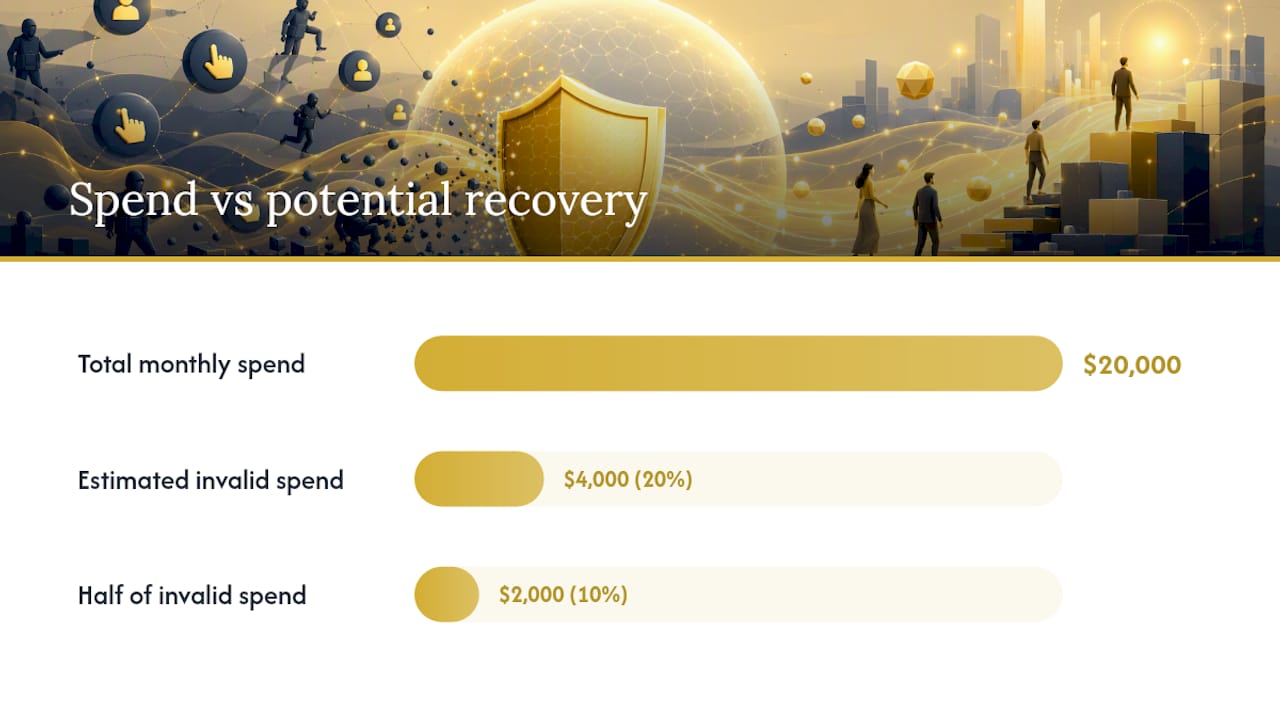
Here's a rough example. If your account spends $20,000 a month and bot click rates on your platform mix run around 20%, industry analyses suggest that removing even half of that invalid traffic can meaningfully lower your cost per acquisition, since your remaining budget concentrates on real prospects instead of noise. That shift alone often justifies a protection budget equal to a small fraction of total ad spend.
Can You Fully Prevent Click Fraud?
No tool eliminates click fraud entirely, and any vendor promising 100% prevention is overselling. Sophisticated bots rotate through residential proxies, mimic human click timing, and increasingly run through agentic AI that's genuinely difficult to distinguish from a real, if unusual, user session.
Practical limits worth planning around:
- Cold-start lag: new campaigns have thin data, so detection models take time to calibrate against your specific traffic patterns.
- Detection delay for novel patterns: fraud tactics evolve faster than static rule sets, creating a window where new bot behavior slips through.
- False positives: overly aggressive blocking can filter out real customers, so validate flagged traffic before assuming it's all fraud.
- Platform refund ceilings: Google and Meta credits rarely cover the full scope of what independent monitoring detects.
Deliberate, coordinated click fraud is illegal in many jurisdictions under fraud and computer-crime statutes, which gives advertisers a real basis for takedown requests and platform disputes when they can produce documented, timestamped evidence of an attack.
Ad platforms will keep issuing conservative invalid-click credits, but their financial incentive to catch everything is limited. That's exactly why independent validation still matters for any advertiser spending real money.
How Do You Choose the Right Click Fraud Solution?
Run a structured trial before signing anything long-term, and validate the vendor's claims against your own data rather than their case studies. Here's the process:
- Set a trial period of at least 30 days across your normal traffic mix, not a curated sample.
- Request raw logs weekly, not just a summary dashboard, so you can audit what's actually being flagged.
- Check integration depth: confirm server-side ingestion works with your existing tag manager and conversion API setup.
- Compare pre- and post-filtering CPA to see if the tool measurably changes your cost per lead.
Questions to ask every vendor, and red flags if the answer disappoints:
- Can you export raw click and IP logs? (No raw logs is a dealbreaker.)
- Do you support server-side filtering, or only a client-side pixel?
- What's your dispute and refund process if we contest a flagged batch?
- Can you back up your "detection rate" claim with third-party audited data?
How This Comparison Was Compiled
This comparison draws on aggregated industry fraud-cost data, bot-traffic reports, and practitioner benchmarks on server-side filtering performance, cross-checked against how managed protection performs when bundled with active ad management. Independent surveys find that only a small share of marketing teams currently use a dedicated IVT prevention platform, despite measurable budget losses. That adoption gap is exactly where a managed approach earns its keep.
Home service clients working with Leapify Media's integrated protection and ad management have reported dramatically improved return on ad spend once conversion signals were cleaned at the server level rather than left to platform-side filtering alone.
When Should You Choose Managed Protection Over Self-Serve Tools?
If your team has strong technical resources and a smaller budget, a self-serve blocker can genuinely be enough. But most marketing teams don't have a developer on standby to resolve false positives or maintain server-side infrastructure, and that operational gap is where self-serve tools quietly underperform. Once you're managing meaningful spend across multiple channels, a managed partner gets you to clean data faster and handles the infrastructure you'd otherwise have to build yourself.
How Leapify Media Protects Your PPC Budget While Managing Your Campaigns
Leapify Media builds click and lead validation directly into the ad management it runs for home service businesses, so protection isn't a separate subscription fighting your campaigns from the outside.
That means server-side event validation, CRM-level lead deduplication, and on-premise data controls happen inside the same system already bidding on your Google Ads and Meta Ads campaigns, instead of bolted on as an afterthought. Clients typically see cleaner conversion signals feeding their bidding algorithms, faster recovery of wasted spend, and CRM automation that isn't clogged with junk leads from bots or click farms. One home service partnership working with Leapify's integrated system reported a 20x return on ad spend once conversion data was validated before it reached the ad platforms.
If your team is tired of chasing false leads through a CRM automation setup that was never built to filter them out, visit Leapify Media's services page to see how managed protection gets folded into your existing campaign management, and request a walkthrough of what implementation looks like for your budget.
Frequently Asked Questions
What is the best click fraud protection for PPC campaigns? The best approach for most advertisers combines server-side filtering with managed monitoring, since it blocks invalid clicks before they reach Google Ads or Meta and protects your bidding algorithms from corrupted data.
How do I stop click fraud on Google Ads specifically? Layer Google's native invalid-click filtering with a server-side validation tool, and tighten campaign-level exclusions like IP blocking and placement exclusions for known low-quality sources.
Can click fraud protection tools guarantee zero fraud? No. Sophisticated bots, residential proxies, and agentic AI make full prevention impossible; the realistic goal is meaningfully reducing invalid traffic and catching new patterns quickly.
How much do PPC click fraud detection tools typically cost? Pricing usually falls into subscription-plus-traffic-cap models, percentage-of-recovered-spend models, or managed retainers bundled with broader ad management services.
Is click fraud illegal? Deliberate, coordinated click fraud violates fraud and computer-crime statutes in many jurisdictions, which supports formal disputes when advertisers can document the attack with raw logs.