
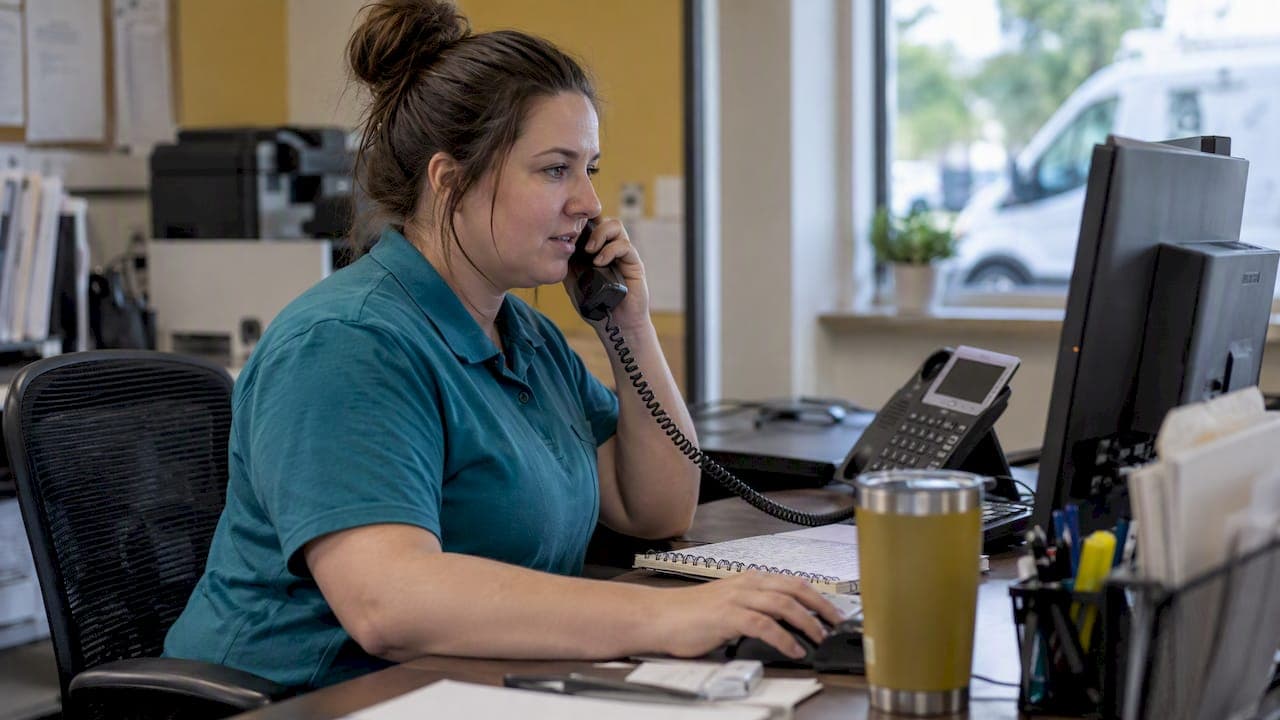
For most home service companies, calls are the higher-intent lead and forms are the higher-volume, lower-certainty lead. But the real gap is rarely the channel. It is what happens in the first few minutes after each one arrives. A form that gets a text and a call back in two minutes can outperform a call that rolls to voicemail. So stop asking which channel wins and start asking which one you are handling worse.
This guide is for owners and marketing managers of HVAC, plumbing, roofing, electrical, landscaping and similar companies who pay for leads and want to know where the booked jobs are leaking.
TL;DR
- Calls usually signal urgency: the caller wants an answer now. Forms capture people who are comparing, busy, or contacting you after hours.
- Published conversion figures for calls and forms vary widely and mostly come from vendors. Measure your own booked-job rate per channel instead of borrowing a benchmark.
- Speed decides form leads. A missed call decides call leads. Fix response time and missed-call handling before you change your ad mix.
- A form fill followed by a call from the same person is one high-intent buyer, not a duplicate to delete.
- Track both channels back to the ad click and the booked job, or you will cut the wrong campaign.
Table of Contents
- What counts as a lead, and why the definition matters
- How calls and forms behave differently
- What the published conversion numbers really tell you
- Speed is the variable that moves both
- Treat a call and a form as one buyer
- Tracking both channels so you do not cut the wrong campaign
- Perspective: why we stopped ranking channels
- Calls or forms: what to emphasize by trade
- Make the form earn its place
- A 30-day plan to find your answer
- How we can help
- FAQ
- Sources
What counts as a lead, and why the definition matters
Before comparing channels, agree on what you are counting. The Federal Trade Commission's own lead generation overview defines a lead as a person who has expressed interest in a company's product or service through a data form submission, an inbound call, or a click-to-call action. So the government treats the form and the call as the same kind of thing: a raised hand.
Your dashboard probably does not. Calls get counted when they connect, forms get counted when they submit, and the two rarely land in the same report. That is how a company ends up saying "forms are cheap" while ignoring that half of them never answer the phone.
A practical definition for a home service business:
- Lead: any inbound call, form, text or chat from a real person in your service area asking about work.
- Qualified lead: a lead for a job you do, in a place you serve, at a size you take.
- Booked job: a qualified lead with a time on the calendar.
- Paid job: the only one that pays the bills.
Compare channels at the last two steps, not the first.
How calls and forms behave differently
The difference is in the situation behind the contact.
Calls: urgent, expensive to miss
Someone whose furnace quit at 6 p.m. in January does not want to describe the problem in a text box. They want a human. Call leads tend to be:
- Higher intent. Picking up the phone takes more effort than typing a name.
- Faster to close. The conversation can end in a booked time on the first contact.
- Unforgiving. A missed call is often a lost job, because the caller dials the next company on the map listing.
Google makes this visible. Call history in Google Business Profile keeps calls from Google Search and Maps in one place so you can respond to missed calls. If you have never opened it, do it today. The number of missed calls from people who found you organically is usually uncomfortable.
Forms: convenient, but easy to forget
Forms win in situations where calling is awkward or inconvenient:
- After hours, when nobody answers but the person is researching.
- At the office, in a meeting, or with kids in the room.
- For planned projects such as a roof replacement quote, a turf install or a landscape redesign, where the buyer wants to describe the job and attach photos.
- For people who assume calling means waiting on hold.
The weakness is that a form is a request, not a conversation. The person is also probably filling out two or three other forms. Whoever responds first and sounds like a person tends to get the booking. Research on lead response time, such as this speed-to-lead benchmark guide, defines it as the time from inquiry to the first genuine human reply, and that is the number to watch, not an auto-confirmation email.
Side by side
| Factor | Phone call | Web form |
|---|---|---|
| Typical intent | Immediate need, ready to talk | Mixed: urgent, planning or comparing |
| Volume per ad dollar | Usually lower | Usually higher |
| Main failure | Missed call, voicemail, hold time | Slow or no follow-up, junk entries |
| Best fit | Emergency repair, same-day service | Quotes, estimates, after-hours inquiries |
| What you need | Call answering, tracking, call recording | Instant text-back, fast callback, spam filtering |
| Easiest to measure | Harder without call tracking | Easy, but often overcounted |
What the published conversion numbers really tell you
Search this topic and you will find confident claims: call leads converting at several times the rate of form leads, or a stated percentage of home service customers who prefer to call. They are directionally plausible, since calls do tend to close better. But most come from call tracking, pay-per-call or lead vendors who sell the channel they are measuring, and their definitions of "converted" differ. One counts a sale on the call, another counts any later booking.
We would not set budgets on a number from someone else's dataset. Your own mix of services, markets and seasons produces a different answer. A drain cleaning company with 80% emergency demand will see calls dominate. A landscaper selling spring design projects will see forms carry far more of the revenue.
The only benchmark that matters is yours:
- Count leads by channel over the last 90 days.
- Count how many became booked jobs.
- Count how many became paid jobs, and the revenue.
- Divide ad spend by each result.
If you cannot do step 2 or 3, you have found your real problem, and it is tracking, not channel choice.
Speed is the variable that moves both
The line you most often see is that responding within five minutes dramatically improves your odds. Treat the exact multiples with caution, since they vary by source and industry, but the principle is not controversial: the sooner a human replies, the more likely the buyer is still in the market and still has your tab open.
For calls, speed means someone picks up, or the call is routed so it does not die. For forms, a workable cadence looks like this:
- Within a minute: automatic text that names your company and confirms you got the request.
- Within five minutes: a live call from a person who has read the form.
- Later that day: a second attempt and a short voicemail or text if there was no answer.
- Next day: one more try, then move the lead to a slower follow-up sequence.
One more point owners miss: after-hours forms. Many arrive in the evening, and a form from 11 p.m. that is answered at 8:05 a.m. beats the competitor who answers at noon. Set a rule that the first morning task is calling last night's forms before the day's schedule fills up.
Treat a call and a form as one buyer
The most useful idea in this whole debate comes from outside home services. Forrester's analysis of leaving single-signal lead models behind argues that every interaction, digital or in person, creates a signal, and that companies do better when they combine signals instead of scoring each in isolation.
Here is what that looks like at a plumbing company:
- A homeowner reads your water heater page, fills out the form, and gets a text.
- An hour later they call because they want to talk about the price.
- Your CRM logs two leads. Your report shows one form and one call. Your office manager marks the second as a duplicate.
That was one buyer, with two signals, and a very high likelihood of booking. Discarding the second contact throws away exactly the information that should move them to the top of the queue. The same Forrester piece argues that sharing combined signals between marketing and sales is associated with large conversion gains. It is B2B research, not a home service study, so use it as a design principle rather than a promised result.
In practice:
- Match calls and forms by phone number, and flag the repeat as "high intent" instead of "duplicate."
- Show the dispatcher the full history before they call back: pages viewed, form text, previous calls.
- Credit the booked job to every touch in your reporting, not just the last.
Tracking both channels so you do not cut the wrong campaign
Here is the typical failure. A company runs Google Ads, sees form conversions in the platform, and sees little else. It cannot see which calls came from which keyword. Forms look cheap, calls look invisible, so budget shifts toward the campaigns producing forms. Booked jobs fall, and nobody knows why.
Avoid it with four basics:
- Dynamic call tracking numbers that tie each call to a source, campaign and ideally keyword. Our walkthrough on setting up HVAC call tracking in one afternoon covers the steps.
- Click ID capture on forms, so the Google click that produced the form is stored with the lead. See GCLID to CRM setup for home services.
- Conversion events that match reality. Count qualified calls (for example, over a minimum length) and booked jobs, not every ring and every submission. The GA4 lead tracking guide for home services explains how to set that up.
- Offline conversion import, so the ad platform learns which leads turned into revenue and bids toward more of them.
If you run search ads for HVAC specifically, our HVAC Google Ads guide shows how call and form conversions fit into account structure.
Perspective: why we stopped ranking channels
We get this question from owners nearly every week: should we push calls or forms? We answer it the same way each time. Neither is the problem. The problem is that most companies treat a call as a phone event and a form as a marketing event, and they are handled by different people with different urgency.
What we see in home service accounts is that money is lost in the gap between the signal and the human response. The click was paid for. The form or call came in. Then nobody reached the buyer in time, or the office could not tell a first-time inquiry from a repeat visitor who was ready to buy.

That is why we build the response layer, not just the ads. Our AI dispatch and intent scoring runs on servers we host ourselves, and our engineers tune it to home service workflows: an emergency AC call should not be scored like a quote request for a fence. Because the infrastructure is ours and not a third-party AI tool, your lead and customer data stays proprietary and secure. And you talk to senior strategists, not a rotating account manager reading a script.
Our advice is simple. Pick one number that matters, booked jobs per ad dollar, and measure calls and forms against it together. The channel debate usually ends once you can see that number.
— Everson Gorski
Calls or forms: what to emphasize by trade
Use this as a starting hypothesis, then verify with your own data.
- HVAC and plumbing (repair-heavy): Lead with call. Put the phone number first on mobile pages and ads, use call extensions, and keep forms as the after-hours backup.
- Electricians: Mixed. Panel upgrades and EV chargers suit forms with photos. Outages and safety issues suit calls.
- Roofing: Storm and leak emergencies call. Replacement quotes often start with a form. Respond to both fast, since homeowners get multiple quotes.
- Landscaping and artificial turf: Forms carry more of the load, because projects are planned and visual. Ask for address, rough size and photos, then call quickly.
- Restoration: Almost entirely calls. The form is a safety net.
Make the form earn its place
A short form gets more submissions, but a too-short form hands your team junk. Aim for the minimum needed to call back and qualify:
- Name, mobile number, ZIP code or address.
- A dropdown for the type of work, plus one open text box.
- Optional photo upload for roofing, turf and landscaping.
- A line that says when they will hear from you, and keep that promise.
Put a tap-to-call button next to the form on mobile. Some visitors will prefer one over the other, and giving both costs you nothing.
Consent rules for calls and texts
Because the fastest follow-up is a text or a call, know the rules. The FCC's guidance on robocalls and texts explains that automated or prerecorded calls to consumers require prior express written consent, and that consent given to one seller on a comparison site does not carry over to others. If you buy leads from a third party, do not assume their consent covers your automated texts. The FTC also publishes a Q&A on Do Not Call provisions for sellers. Have your attorney review your consent language and your texting setup, since state rules can add requirements.
A 30-day plan to find your answer
Week 1: Measure. Turn on call tracking, set up form click ID capture, and audit your Google Business Profile call history.
Week 2: Unify. Push calls and forms into one CRM view, matched by phone number. Create a "repeat contact" flag instead of a duplicate rule.
Week 3: Speed up. Add the instant text acknowledgment, assign someone to call forms within five minutes during business hours, and set the morning callback routine.
Week 4: Compare. Look at cost per booked job by channel and by campaign. Only now decide where the next ad dollar goes.
Companies that do this often find that their expensive channel was fine and their follow-up was the leak.
How we can help
If you want the tracking, the response layer and the ads built as one system, that is what we do for home service companies. Our pricing page lists the details: On-Premise AI Dispatch is $1,000 per month with a one-time $7,500 setup, Google Ads Management is $1,500 per month, and CRM Integration starts at $3,000 one-time. Our monthly plans start at $2,500 (Foundation), $7,500 (Growth), $15,000 (Scale) and $25,000 (Enterprise). You can also browse our services to see how lead generation and CRM setup fit together. We work with home service businesses at $500K or more in annual revenue.
If you are still choosing a partner for the lead side, our comparisons of HVAC lead generation agencies and lead conversion software providers lay out the criteria worth asking about.
FAQ
Do call leads really convert better than form leads?
Usually yes, because a caller has put in more effort and often has an immediate need. But published rates mostly come from vendors with different definitions of conversion, so they are a guide, not a promise. Compare booked and paid jobs per channel in your own data.
What is the 5 minute rule for leads?
It is the guideline that you should reach a new lead within about five minutes of their inquiry. The reasoning is that the buyer is still active and probably contacting competitors. Lead response time is measured to the first real human reply, not an automated message.
Should I remove the form and only show a phone number?
For emergency trades, a prominent number helps, but removing the form loses after-hours and planned-project buyers. Keep both, make the number tap-to-call on mobile, and make sure forms get a fast reply.
Is a repeat form and call from the same person a duplicate?
Not usually. It is often one buyer showing higher intent through two signals. Match them by phone number, merge the record, and prioritize the callback.
How do I know which ads produce calls and which produce forms?
Use dynamic call tracking numbers for calls and store the click ID with every form submission. Then send booked jobs back to your ad platform so reports reflect revenue and not just contacts.
Sources
- FTC: What is lead generation (presentation slides)
- Forrester: What's the business impact of leaving MQLs?
- Google Business Profile Help: Call history
- Rework: Lead response time benchmarks
- FCC: Stop unwanted robocalls and texts
- FTC: Q&A for telemarketers and sellers about DNC provisions