

First-party data marketing means using the customer information your own business collects directly, website behavior, purchases, CRM records, support interactions, to personalize outreach and prove what's working. Your company owns this data; no cookie broker or ad network sits between you and the customer. The fastest next step: pick one touchpoint (your checkout form or your email signup) and audit what you currently capture versus what you actually use.
Three numbers frame the stakes. Companies that integrate first-party sources into personalization can see up to a 2.9x revenue uplift and 1.5x cost savings when the data is used well. Regulations like GDPR and CCPA/CPRA now govern how you capture and store it. And Leapify Media has watched home service clients turn owned lead data into a very high return on ad spend once dispatch and scoring ran on that data instead of third-party guesses.
Key Takeaways
First-party data marketing works because it pairs owned, consented customer data with governance strong enough to activate it fast and defensibly.
| Point | Details |
|---|---|
| Start with one touchpoint | Audit your checkout or signup form before building anything larger. |
| Value exchange drives opt-in | Offer a clear benefit, like appointment reminders or loyalty perks, for every data request. |
| Governance enables speed | Live consent tracking lets teams activate data faster with less legal friction. |
| Fix identity resolution first | Clean match rates make personalization, measurement, and AI use all more reliable. |
| Leapify Media handles the plumbing | Its on-premise AI dispatch and CRM automation turn first-party leads into booked jobs for home service businesses. |
Table of Contents
- What Counts as First-Party Data Marketing?
- Why Does First-Party Data Matter Right Now?
- Where Do You Collect First-Party Data?
- How Do You Build a First-Party Data Strategy?
- What Technology Do You Actually Need?
- How Do You Handle Privacy and Governance?
- How Do You Activate and Measure First-Party Data?
- What Are the Most Common Pitfalls?
- What Practitioners Get Right About Activation
- Where Leapify Media Fits Into Your First-Party Data Program
- Frequently Asked Questions
- Sources
What Counts as First-Party Data Marketing?
First-party data is any information a customer gives you or generates while interacting with channels you own, your website, your app, your point-of-sale system, your email list. Provenance is what makes it valuable: you know exactly how it was collected and under what consent, which is what makes it usable for personalization, advertising, and increasingly, training your own AI models.
Concrete sources most businesses already have, often scattered across five different tools:
- Website behavior (pages viewed, time on site, cart abandonment)
- Purchase and order history
- CRM records (call notes, quote status, service history)
- Support tickets and chat transcripts
- Loyalty program activity and point redemptions
- App events (push notification opens, feature usage)
- Zero-party survey responses (what a customer tells you directly)
- POS receipts and in-store transaction data
The distinction between explicit and implicit data matters more than most marketers realize. A survey answer where a homeowner tells you "I'm shopping because my AC broke" is explicit, they handed you intent. A page view on your emergency repair page is implicit, you're inferring intent from behavior. Both are first-party. Only one requires you to ask a good question. Every source on that list needs a documented consent basis attached to it before you activate it anywhere.
Why Does First-Party Data Matter Right Now?
Three forces converged at once, and each one alone would justify the shift. Browser-level tracking restrictions have been chipping away at third-party cookie reliability for years. Privacy laws have expanded well beyond California. And AI models are only as good as the data you feed them, garbage in, garbage out applies doubly to a large language model trying to predict your best next customer.
The business case is straightforward. First-party data drives better personalization because it reflects real behavior instead of a purchased lookalike profile, it improves attribution because you can tie a conversion to an actual known customer, and it cuts wasted spend because you stop targeting people who already converted through another channel. Businesses that layer first-party data into cross-channel orchestration report meaningfully better revenue and cost outcomes than those still leaning on third-party segments.
The "why now" chain runs like this:
- Cookies became unreliable, so advertisers lost a cheap targeting shortcut
- Privacy laws made third-party data riskier to buy, store, and use without clear consent
- AI adoption made data quality, not data volume, the deciding factor in campaign performance
Brands that started building first-party infrastructure early are compounding an advantage competitors can't buy their way into on short notice.
Where Do You Collect First-Party Data?
Every customer touchpoint is a potential data source, but not every touchpoint should ask for the same thing. Map them first: website forms, app onboarding, checkout, point-of-sale, loyalty sign-up, support tickets, post-service surveys. Each one has a natural moment where a customer is willing to give something in exchange for something.
The value exchange is the whole game here. Customers hand over data when they get something tangible back, a discount, faster service, a genuinely useful notification, and they get frustrated fast when a business collects data with nothing offered in return. That's not a compliance problem, it's a trust problem, and trust erodes way faster than it rebuilds.
Practical tactics that work without adding friction:
- Offer a loyalty discount in exchange for an email and birthday (enables personalized offers later)
- Use post-job surveys to capture zero-party data on satisfaction and future needs
- Let checkout autofill from a returning customer's saved profile instead of re-asking for everything
- Send appointment reminders that double as a soft permission check ("still want texts?")
- Give early access to seasonal promotions for loyalty members who complete their profile
Prefer explicit collection at high-intent moments (checkout, service completion) where a customer is already engaged, and let implicit collection (site behavior, app usage) fill in the rest passively.
Pro Tip: Run a two-week A/B test on your checkout form: one version asks for phone number up front, the other offers a one-line reason ("for appointment reminders only"). Businesses that state the reason typically see meaningfully higher opt-in without changing anything else on the page.
How Do You Build a First-Party Data Strategy?
A working program follows a specific sequence, and skipping steps is exactly what causes programs to stall six months in. Here's the order that actually holds up:
- Map every touchpoint. List every place a customer interacts with your business, digital and physical, and note what data each one currently captures.
- Define concrete goals. "Reduce wasted ad spend by 15%" beats "get better data" every time.
- Unify customer identity. Match records across systems (a phone number in your CRM should link to the same person's website activity).
- Set governance rules before you scale. Decide who can access what data, for what purpose, before volume makes cleanup painful.
- Choose your activation channels. Email, SMS, paid ad platforms, on-site personalization, pick where the data will actually get used.
- Measure, then iterate. Track results against your original goal and adjust monthly.
Timeline depends on scope. A small business pilot (one channel, one goal) can run in a few weeks. A mid-size rollout across multiple channels typically takes a few months. Enterprise programs spanning multiple business units take substantially longer to implement, mostly because of internal approval cycles, not technical complexity.
Track these metrics at each stage: capture rate (percent of visitors who provide data), match rate (percent of records successfully linked across systems), activation conversion uplift (how much personalized campaigns outperform generic ones), return on ad spend, and customer lifetime value change over a trailing 90 days. If capture rate is climbing but match rate is flat, your identity resolution is broken, not your collection tactics.
What Technology Do You Actually Need?
Five categories do the real work, and most businesses already own pieces of two or three of them. A customer relationship management (CRM) system stores the relationship history. A customer data platform (CDP), if you use one, unifies identity across sources. A consent management platform tracks who agreed to what. An analytics tool measures behavior. A data warehouse holds the raw material everything else draws from.
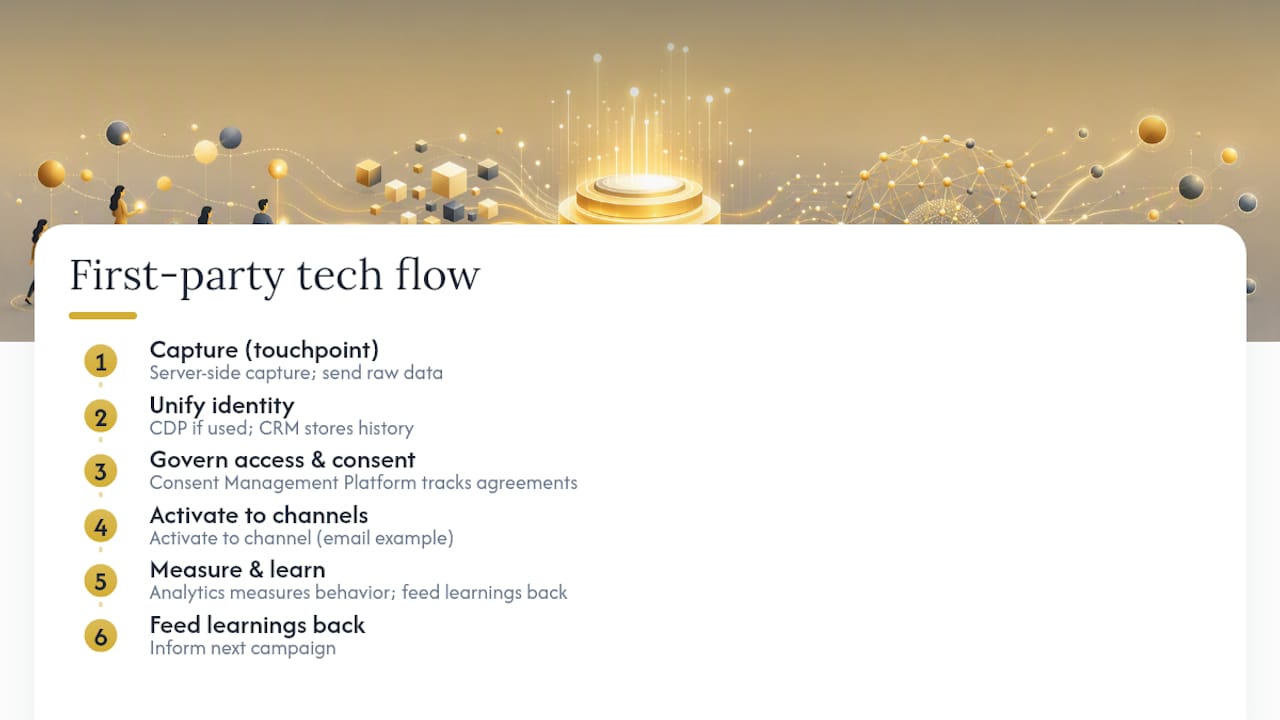
Data should flow in one direction logically: capture at the touchpoint, unify identity across systems, govern access and consent, activate to a channel, measure the result, then feed learnings back into the next campaign.
Smaller teams don't need a full CDP to start. A simple stack of email platform, CRM, and a shared spreadsheet acting as a lightweight master customer record can run a defensible first-party program at low cost. The trade-off is manual maintenance versus a CDP's automated matching, worth it until your customer volume outpaces what a spreadsheet can track cleanly.
One technical decision matters more than people expect: server-side capture (data sent from your server to a platform) tends to survive browser restrictions and ad blockers better than client-side tracking scripts, and it gives you more control over exactly what leaves your systems.
How Do You Handle Privacy and Governance?
Governance is the part most programs skip, and it's the part that determines whether you can scale at all. The operational checklist looks like this: capture consent at the point of collection, maintain a preference center customers can actually find and use, build a process for data subject access requests and erasure, keep an audit trail of who accessed what and why, and enforce purpose limitation (data collected for shipping shouldn't quietly get used for ad targeting).
GDPR and CCPA/CPRA set the legal floor, and the practical implication for marketers is simple: if you can't prove when and how a customer consented, you can't safely use that data, period. This isn't legal advice, consult counsel for your specific obligations, but the operational pattern holds across most US state privacy laws now on the books.
Governance done right speeds things up rather than slowing them down. Treating consent as a live, checkable signal rather than a one-time checkbox lets teams activate data faster with less legal back-and-forth, because everyone downstream can trust the status is current.
| Requirement | What It Covers |
|---|---|
| Consent capture | Records the specific permission given at the moment of collection |
| Preference center | Lets customers update or withdraw consent without a support ticket |
| DSAR/erasure workflow | Handles requests to view or delete personal data within legal timeframes |
| Audit trail | Documents who accessed data, when, and for what purpose |
- Automated discovery tools help classify data sprawled across CRM, email, and warehouse systems.
- When a customer withdraws consent, that change needs to propagate to every downstream system, ad platforms, email tools, AI training sets, not just the system where they clicked "unsubscribe."
How Do You Activate and Measure First-Party Data?
Collecting data is only half the job. Activation is where it turns into revenue, and the use cases stack up fast once the foundation is solid:
- Personalized email sequences triggered by purchase history or service anniversaries
- Onsite product or service recommendations based on browsing behavior
- CRM-driven SMS reminders for maintenance visits or contract renewals
- Lookalike audiences built from your highest-value customer segments and uploaded securely to ad platforms
- Predictive churn scoring that flags at-risk customers before they leave
Uploading a customer segment directly to an ad platform instead of relying on a third-party audience is one of the cleanest ways to reach high-intent buyers without sacrificing where the data came from.
Measure with a checklist, not a single vanity number:
- Track capture rate at each touchpoint monthly
- Monitor match rate to confirm identity resolution is holding up
- Run A/B tests comparing personalized versus generic campaigns
- Watch ROAS and customer lifetime value shifts over a 90-day window
- Design a one-month mini-experiment (one segment, one channel, one clear hypothesis) before rolling anything out company-wide
If you're feeding first-party data into AI models for personalization or lead scoring, keep the guardrails simple: only use data with current, valid consent, and document the purpose it was collected for before it touches a training set.
What Are the Most Common Pitfalls?
Most programs don't fail from lack of data, they fail from how the data gets handled after collection.
- Data silos across CRM, email, and support tools. Fix: unify identity with a shared customer ID before adding more sources.
- Stale consent that never gets rechecked. Fix: set an automatic re-permission cadence, annually at minimum.
- Poor identity resolution linking the wrong records together. Fix: audit match rate monthly, not quarterly.
- Overcollection asking for data you'll never use. Fix: cut any form field that doesn't map to a specific campaign or workflow.
- Measuring database size instead of impact. Fix: report conversion lift and ROAS, not subscriber count.
Fix identity resolution first. Everything else, personalization, measurement, AI readiness, depends on knowing your records actually point to the same person.
What Practitioners Get Right About Activation
The businesses that get real value from first-party data treat every collection point as a two-way trade, not a form to fill out. Ask for a phone number, explain it's for appointment reminders, and actually send useful reminders. Skip that last part and the data you collect next quarter gets worse, not better, because customers stop trusting the ask.
One pattern shows up again and again in home service businesses specifically: a company starts routing inbound leads through basic intent scoring instead of a first-come, first-served queue. Match rate between ad clicks and CRM records climbs because the data feeding the model is cleaner. Within a few months, return on ad spend improves noticeably, not because the ads got better, but because the follow-up got faster and more targeted.
This is where an agency earns its keep, not writing better ad copy, but building the plumbing: CRM automation that turns a form fill into an instant scored lead, on-premise AI dispatch that routes it to the right technician, and activation that closes the loop between what a customer told you and what happens next.

Where Leapify Media Fits Into Your First-Party Data Program
If your business is buried in leads but short on the infrastructure to turn them into booked jobs, Leapify Media is built specifically for that gap. Leapify Media runs CRM automation, on-premise AI lead dispatch, and intent scoring in-house rather than routing your customer data through a third-party AI vendor, which means the first-party data you collect stays inside systems your business controls.
Home service operators, HVAC, plumbing, roofing, restoration, don't need a generic CDP rollout. They need ad management, local SEO, and CRM setup that connect directly to how quickly a lead gets scored, routed, and followed up on. Leapify Media's service offering maps to exactly that: capture, unify, activate, without months of platform evaluation. A discovery call typically starts with a quick audit of your current lead flow and consent capture, followed by a plan for where automation closes the biggest gaps. If you're ready to see where your own touchpoints are leaking value, book a consultation and start there.
Frequently Asked Questions
What is the difference between first-party and zero-party data? First-party data covers everything you collect from customer behavior and interactions, including data they don't directly hand you, like page views. Zero-party data is a subset: information a customer explicitly and voluntarily tells you, like a survey answer about their preferences.
Do I need a CDP to start a first-party data program? No. A small business can run a functional program with an email platform, a CRM, and a shared record system before investing in a dedicated customer data platform. A CDP becomes worth the cost once manual matching can't keep up with your customer volume.
How does first-party data help with AI-driven marketing? AI personalization and lead scoring models perform better with data that has clear provenance and current consent status, because the model isn't learning from guesswork or expired permissions. Poor consent hygiene creates both legal risk and worse model output.
What's a realistic first KPI to track? Capture rate at one high-traffic touchpoint, like your checkout or contact form, is a simple starting metric. Once that's stable, add match rate to confirm your records are linking correctly across systems.
Is first-party data marketing only for large enterprises? No. Pilot programs built around one channel and one clear goal can launch in a few weeks for a small business, well before enterprise-scale identity resolution or governance tooling becomes necessary.
Sources
- What is first-party data? A plain-English guide for marketers | Transcend
- How To Build a First-Party Data Strategy | PayPal US
- Responsible marketing with first-party data (BCG / Think with Google)
- 8 Steps to Create a First-Party Data Strategy | LiveRamp